Notes on:
The Economic Impacts of the US–China Trade War
Annual Review of Economics
2022
trade war · tariff pass-through · survey · welfare
Paper · doi · PDF
Written by Fable 5
Pablo D. Fajgelbaum and Amit K. Khandelwal, published in the Annual Review of Economics 14 (2022), 205–228, doi:10.1146/annurev-economics-051420-110410. A survey, not a new result; no talk video. Written from the published version.
A parameter everybody thought they knew
The optimal-tariff argument is the one piece of protectionist logic that trade economists have always conceded. It goes like this. You are a large country. You buy so much of some good that if you tax it, your foreign suppliers cannot simply sell the units elsewhere, so they cut their price to keep your business. Part of your tariff is therefore paid by them, you collect the revenue, and your terms of trade improve at their expense. This is not a fringe view; it is Johnson (1953), it is the reason Bagwell and Staiger (1999) think trade agreements exist at all, and it is why “large country” is the load-bearing phrase in every undergraduate treatment of tariffs.
The whole argument turns on one number. Call it , the elasticity of the before-tariff price the foreigner receives with respect to the tariff:
(equation 3 in the review), where is the price at the dock before duties, is the ad valorem tariff, is the exporting country, the product and the month. If , foreigners cut prices and you extracted something. If , they didn’t, and you paid the entire tax yourself. Pass-through to the duty-inclusive price is .
The prior was firmly that . The review assembles the evidence into one table, and it is worth looking at, because it is the record of a settled empirical belief.
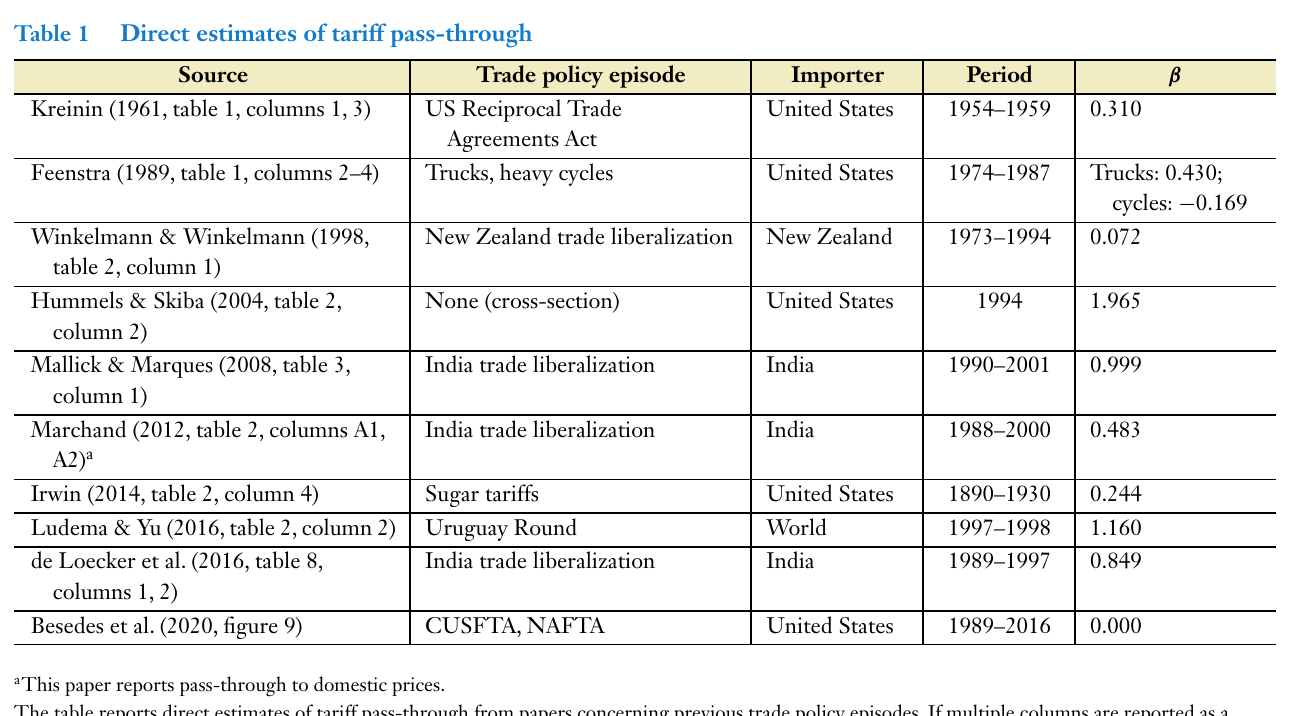
Feenstra (1989) gets 0.43 on Japanese trucks, Irwin (2014) 0.24 on nineteenth-century sugar, Marchand (2012) 0.48 on Indian liberalization, de Loecker and co-authors (2016) 0.85. The elasticity literature agrees: Broda, Limão and Weinstein (2008) imply a median between 0.79 and 0.95, and — this is the part that stings — they find tariffs positively correlated with inverse supply elasticities, i.e. countries appear to already be doing terms-of-trade manipulation. The exchange-rate pass-through literature, which is the same economics wearing different clothes, lands around 0.4.
Anyway
“Against these priors, it is surprising that several papers find pass-through to be virtually complete during this trade war (i.e., β = 0).”
Fajgelbaum, Goldberg, Kennedy and Khandelwal (2020) estimate with a standard error of 0.08. Amiti, Redding and Weinstein (2019), using twelve-month differences, get (se 0.023). Cavallo and co-authors (2021), using the confidential microdata underlying the bls import price indices rather than public customs unit values, get a one-year cumulative (se 0.030). Different teams, different data, different horizons, same zero.
And it is not a story about America being small. Across six-digit products in 2017, China supplied an average 23% of us imports and the United States supplied an average 12% of China’s. Both are exactly the “large country” the textbook has in mind. Chang and co-authors (2024) and Ma and co-authors (2021) then ran the same specifications from China’s side and also found complete pass-through. So the two largest economies on earth fought a tariff war in which neither was able to push any of the cost onto the other. Each paid its own tariffs in full.
The review is careful about what this does and does not establish, and the caveat is the same one that limits the underlying papers. These regressions identify price changes across exporters within a product or across products within a sector. Anything common to all of a country’s exports — a general fall in Chinese wages, say — is absorbed by the country-time fixed effects. So the result is not “the us could not affect Chinese prices at all”; it is “the us did not move Chinese prices relative to other suppliers of the same product.” Cavallo and co-authors make the point concrete: drop the country controls and rises to 0.079 (se 0.026), small but no longer zero.
Why won’t it move?
The review’s most useful section is section 4.2, which is an honest list of candidate explanations, none of which the authors claim to have established. The framework is a demand-and-supply pair: import demand and inverse foreign supply , which combine to give
so that requires either infinitely inelastic demand () or infinitely elastic foreign supply (). Inelastic demand is ruled out directly, because the same paper estimates (se 0.26) — a real, finite elasticity. That leaves elastic supply, and there is supporting evidence: us tariffs cut Chinese exports to America but raised them elsewhere, and one cannot reject that Chinese product-level exports to the world were unchanged. Chinese producers seem to have redirected containers rather than cut prices.
The remaining candidates are laid out and mostly left open. Demand shifters moving with tariffs (stockpiling ahead of expected escalation; quality upgrading on the extensive margin). Supply shifters moving with tariffs — this one is genuinely interesting, since 64% of six-digit codes were taxed by both countries, so American tariffs raised Chinese exporters’ input costs, pushing their prices up just as falling demand pushed them down. Sticky dollar-invoiced contracts, which would reconcile complete tariff pass-through with incomplete exchange-rate pass-through, except that the finding persists two years out and 21% of surveyed Chinese firms citing contract rigidity is not enough to carry it. Foreign market power. And the possibility that is exactly what a standard Armington model predicts when you condition on exporter-time effects, in which case the surprise is an artifact of the specification rather than a fact about the world.
That last one deserves emphasis, because it is the review quietly conceding that the profession’s headline finding may be partly definitional. In Anderson–Van Wincoop (2003), the import price is , so relative prices across origins move only with relative wages — and the regression has thrown relative wages into a fixed effect. Read that way, complete pass-through is not news; it is the model.
Adding it up, and the number that doesn’t fit
Welfare accounting is the Dixit–Norman (1980) decomposition, the same one used in the underlying paper: importer cost, exporter revenue, tariff receipts. With complete pass-through the first term is arithmetic — the import share of gdp (15%) times the fraction of imports targeted (17.6%) times the average tariff increase (22.1%), giving a loss to American buyers of imports of 0.58% of gdp. Add a simulated producer gain of 0.13% and tariff revenue of 0.34%, and the aggregate loss is 0.10% of gdp. China’s corresponding loss is 0.29%. Caliendo and Parro (2022), using a full multi-country Eaton–Kortum setup with worldwide wage adjustment, get −0.01% for the us and −0.09% for China. Different machinery, same order of magnitude: everybody loses, nobody loses much.
Small in the aggregate is not small in distribution, and the review is good on this. Tradeable real wages fall about 1% on average with a standard deviation of 0.5% across counties. Flaaen and Pierce (2019) find that moving an industry from the 25th to the 75th percentile of combined exposure — protection, input costs, retaliation — reduces manufacturing employment by 2.3%, because the input-cost and retaliation channels swamp the protective one. Waugh (2019) finds counties in the top quartile of retaliation exposure had 0.75 percentage points slower employment growth and 3.8 percentage points weaker auto sales. The trade war did not bring manufacturing jobs back; on the available evidence it destroyed some.
Then there is the number that refuses to fit. Amiti, Kong and Weinstein (2021) study eleven tariff announcements and find the stock market fell a cumulative 12.9% over three-day windows around them, attributing most of it to the war. Huang and co-authors (2023) find a 4.3% decline around the March 2018 announcement alone. Set that against the trade models’ 0.01% to 0.1% of gdp and you have two measurement systems, both respectable, disagreeing about the same event by two orders of magnitude.
The review declines to resolve it, which is the right call, and offers the two readings. Either the static models are missing something large — dynamic losses, investment, the uncertainty that Amiti and co-authors estimate more than doubled the vix — or three-day equity windows are not measuring fundamentals at all, because market participants had no experience pricing a policy shock of this kind. Finkelstein and Hendren’s (2020) marginal value of public funds calculation sits somewhere in between, putting the tariffs at −1.2 to −1.5, meaning that as ways of raising a dollar of revenue these were unusually destructive ones.
The honest position
What the trade war actually settled is narrower than the headlines suggested and stranger than the theory expected. It did not show that tariffs are costless — the transfer from American buyers of imports was 0.58% of gdp and precisely measured. It did not show that they are catastrophic — the net static loss rounds to a tenth of a percent. What it showed is that the one respectable argument for tariffs, the one where a big country makes foreigners pay, failed its most favorable test in modern history: two enormous economies, discriminatory tariffs, deep bilateral dependence, and neither could shift a measurable share of the burden onto the other.
Fajgelbaum and Khandelwal put the geopolitics explicitly out of scope in their closing section, noting that questions about soft power and the future of the trading system “often do not lend themselves easily to clean econometric studies.” Which is a fair description of the position economics found itself in: unusually confident about the pass-through coefficient, and unable to say much about the thing the tariffs were actually for.