Notes on:
Exporting Ideology: The Right and Left of Foreign Influence
Quarterly Journal of Political Science 20(1): 33--70
2025
geoeconomics · foreign influence · ideology · capital mobility
Paper · doi · PDF
Made with AI: Opus 5 (reading and writing)
Pol Antràs (Harvard University and nber) and Gerard Padró i Miquel (Yale University and nber), “Exporting Ideology: The Right and Left of Foreign Influence,” Quarterly Journal of Political Science, 2025, vol. 20, no. 1, pp. 33–70, doi 10.1561/100.00023119, accepted 10 April 2024. This is the version of record and it supersedes nber Working Paper 31399 of June 2023, which differs from it substantially. No talk recording exists, so this is a pdf-only digest. The published article contains no figures and no tables — it is a theory paper end to end, and every substantial proof now sits in a separate Online Appendix rather than in the article.
Sixty-five percent
Begin where the paper begins, with a number. Bubeck and Marinov (2019), whose dataset the authors lean on throughout, document that between 1946 and 2012 some form of foreign intervention occurred in 65% of competitive elections. If you assume that is a Cold War artefact, the last decade in their data disagrees: in 2002–2012 the share is still about two-thirds, in line with the whole post-war average. Restrict the count to candidate interventions only — public statements for a particular person, as opposed to “process” interventions like assigning election observers — and you still get 33% of elections across the whole period, which the authors reasonably call a lower bound. Foreign meddling in elections is not an occasional scandal. It is the modal way an election happens.
And it has a direction. Incumbents back their own side. Hugo Chávez intervened for Evo Morales in Bolivia, Rafael Correa in Ecuador and Cristina Fernández de Kirchner in Argentina, and all three went on to win. Between 1999 and 2009 Venezuela sold petroleum at subsidised rates, extended concessionary loans and invested in countries with friendly governments; Romero and Curiel (2009) put the bill at roughly $45 billion. Once elected, those governments did what you would expect: Morales imposed royalties on Bolivian extractive industries, Ollanta Humala introduced new mining levies in Peru and raised the minimum wage, Correa raised Ecuador’s corporate income tax repeatedly and renegotiated the oil contracts. The paper’s driest observation is that this was useful to Chávez himself, who was renegotiating with his own private foreign investors at the time. Not solidarity. Comparables.
So: why would a government spend real money to make a foreign government look like itself? The usual answer is geopolitical blocs, and the paper does not deny it, but it points at the platform data and notes that 39% of the domestic platform disagreements that motivate foreign intervention are economic in nature — investment and trade alone account for 11% — against 25% for spheres of influence and 26% for military issues. The authors’ conclusion is not that economics is a nice complement to grand strategy; it is that “cross-country spillovers caused by economic policies are at least as important as a cause of foreign concern as geopolitical concerns.”
A tax-competition model in which nothing the tax-competition literature worries about happens
The engine is a standard tax competition model — Wilson (1986), Zodrow and Mieszkowski (1986) — with one modification that quietly detonates the genre. There are N large countries. Capital is perfectly mobile across borders, labor is not, and governments can tax both to fund a public good that only workers value. Because labor is supplied inelastically, the labor tax is non-distortionary, so every government of every ideology funds the public good to the efficient level. That is Proposition 2, and it means the race to the bottom does not happen here: nobody underprovides anything. This is a tax-competition model in which the thing the tax-competition literature is about has been switched off, and what remains is a purely political question. Not how much public good, but who pays for it.
Ideology is the answer to that question, and it is one parameter: a government maximises workers’ utility plus times capitalists’ utility, so high is pro-capital and low is pro-labor. A sufficiently pro-capital government sets the capital tax to zero (Proposition 3); a sufficiently pro-labor one sets it strictly positive (Proposition 4), limited by fear of capital flight, and monotonically lower the more pro-capital it is. In the published version these are no longer hand-waves about being “sufficiently” anything: Propositions 3 through 8 all state explicit thresholds .
Now the externality. Proposition 1 says that when any non-negligible country raises its capital tax, it depresses the world return to capital, drives capital out of itself, and raises the capital stock everywhere else. Totally differentiate Foreign’s welfare with respect to Home’s capital tax and you get the equation the entire paper turns on, equation (13) of the published version:
Two terms, and they are sorted by ideology. The first is Foreign’s tax base widening as capital flees Home — non-negative, and exactly zero for a pro-capital Foreign government, because such a government taxes capital at nothing and a wider base of nothing is nothing. The second is the world return falling, which is bad for a capital-heavy Foreign and good for a labor-heavy one. So for a sufficiently pro-capital Foreign the first term vanishes and the second is negative: foreign capital taxes are pure loss. For a sufficiently pro-labor Foreign both terms are positive: high taxes abroad reduce the capital flight its own tax would trigger, which makes domestic redistribution cheaper, and a lower world return tilts income toward its workers.
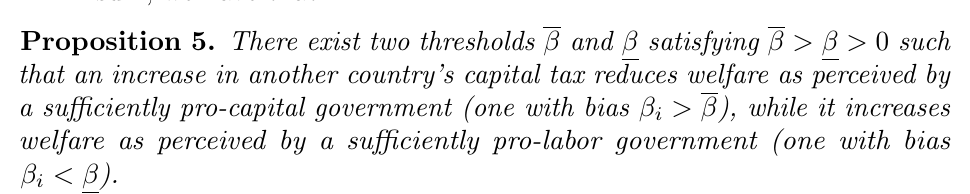
The elegant part is that equation (13) is the domestic first-order condition, equation (11), with the derivative taken with respect to somebody else’s tax. Same expression, foreign subscript. Ideological affinity falls out with no hegemony, no altruism and no belief that one’s own ideology is superior — incumbents in this model care exclusively about their own constituents, and that is precisely why they end up caring who runs Bolivia.
What a foreign incumbent can actually buy
The politics is bolted on in the Alesina (1988) manner: parties cannot commit, voters know each will implement its own ideal policy once in office, so the only credible platform is one’s own ideal policy. Probabilistic voting gives the pro-capital party’s win probability in Lemma 1 as one half plus a policy term plus , where is a non-policy pro-capital bias in the electorate and is how impressionable voters are. Foreign influence is then modelled with brutal directness: the Foreign incumbent simply buys , setting it equal to effort at cost , where is its efficiency at applying international pressure and may be negative. Differentiating gives equation (17):
Everything outside the bracket only scales the spend. The bracket is Foreign’s welfare gap between the two possible Home tax outcomes, and Proposition 5 has already signed it by . Hence the headline result.
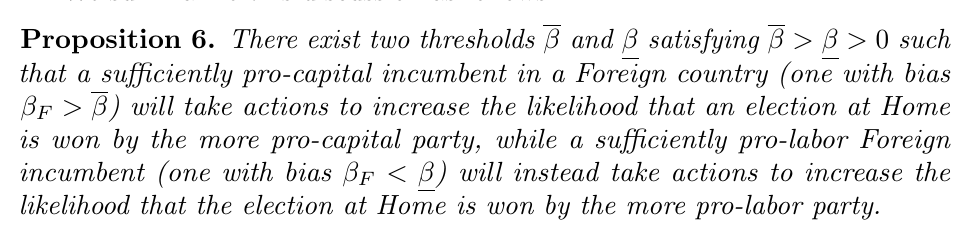
Note what the no-commitment assumption does. Because Home’s parties cannot bind themselves, influence can change who wins but never which policy is set. That is why the thing being exported is a government rather than a treaty — the cheapest way to change a foreign policy is to change the foreign politician. And empirically the money goes where the model says it goes: around 45% of influence operations in the data are public endorsements and photo-ops, 31% involve direct campaign help including financing and propaganda, and 25% publicly tie rewards and punishments to the outcome. China issues statements for the kmt as Taiwanese elections approach; the eu lets accession candidates know an election result will have consequences; the United States funded Italy’s Christian Democrats for decades.
The authors are careful about what is new here relative to their own 2011 model (Antràs and Padró i Miquel 2011), and it is worth repeating because it is the point. In that earlier work ideology played no role, so foreign influence “only worked as a threat and did not actually materialize in the subgame perfect equilibrium of our game.” Adding ideology is what makes the money actually get spent: influence now occurs along the equilibrium path. On welfare, the published paper does no welfare analysis of foreign influence at all; the only welfare claim it makes points the other way, recalling that the 2011 result had influence producing policies that maximise a weighted sum of domestic and foreign welfare and so “may thus increase aggregate world welfare when there are no other means of alleviating the externalities that arise from cross-border effects of policies.” Whether you find that reassuring is your business, not the paper’s.
Any policy that moves the return to capital
The extensions section is where the published version leaves the working paper furthest behind, because its first part does not exist in the working paper at all — the word “expropriation” appears in that draft precisely zero times. Here the authors replace the capital tax with a probability that capital is expropriated, with the proceeds funding the public good, and show that Propositions 2 through 5 all survive intact. Then they replace it with a generic redistributive lever that shifts income from capital to labor and need not be a tax at all — they explicitly read it as unionisation rates or minimum wage legislation — and show that the first-order conditions are identical to equations (11) and (13) with in place of , so Propositions 1 through 5 hold again. Public goods turn out not to be necessary for any of it.
This is a genuine widening rather than a robustness box. The model is no longer about capital taxes; it is about any policy that moves the return to capital. Which means it reaches coups. If Home is reducing capital returns by nationalising things, and if the reduced-form political game applies to any foreign effort to probabilistically replace a government, then pro-capital incumbents abroad should be the ones sponsoring regime change. The authors then walk the Cold War record. Mossadegh nationalised British-owned Anglo-Iranian assets on 1 May 1951; Truman confined itself to brokering; the Eisenhower administration took office in January 1953, MI6–cia coup plans were approved in July, and Mossadegh fell in August, after which American companies received 40% of the new National Iranian Oil consortium. In Guatemala, Árbenz took power in 1951 promising land reform, alarming domestic coffee planters and the American-owned United Fruit Company, which owned 40% of the country’s land; by 1953 announced reforms implied expropriating more than 400,000 acres from United Fruit; Eisenhower approved the overthrow in late 1953 and Castillo Armas was in power by June 1954. In Chile, Allende won in 1970, the legislature approved copper nationalisation in July 1971 against Kennecott and Anaconda, and coup planning and funding had begun by January 1971. All three under Republican administrations — and in Iran the approach changed sharply at the exact moment the party in Washington did. Berger, Easterly, Nunn and Satyanath (2013), along with Dube, Kaplan and Naidu (2011) and with Kinzer (2006), are cited in the running prose for the propositions that capital returns drove these operations and that American capital owners profited from them. In the working paper this material was not there to cite.
The genuinely counter-intuitive line is about Iran, and the authors say it themselves: “While it may seem strange that the United States would intervene on behalf of British capital-owners, it is consistent with our framework: a reduction in capital returns in one country reduces the global rate of return and thus affects all capital owners.” Because the externality runs through the world return, the nationality of the expropriated owner is irrelevant. Any capital-heavy government anywhere has standing to object to any expropriation anywhere. The whole model is in that sentence.
To their credit the authors volunteer their own counter-example — the Bay of Pigs, April 1961, under Kennedy, against a Castro who had expropriated mostly American-owned holdings — and answer it by noting that operations against Castro were first approved by Eisenhower in March 1960, that Kennedy inherited a fully-formed programme that was difficult to stop, and that analysts attribute the failure to his scaling back of air support. A footnote concedes further that later Democratic interventions in Southeast Asia, such as replacing Diệm in South Vietnam, fall outside the model’s scope, since capital returns were not plausibly the driver. This is the correct way to handle a case that does not fit, and it is worth saying that the defence is a partial one.
Waves, platforms, timing
Aggregate the mechanism and you get ideological waves, which the authors read into the pink wave: from Chávez’s accession in 1998, Argentina, Bolivia, Ecuador, Honduras and Nicaragua all elected left-wing presidents within ten years, with the moderate left taking Chile, Brazil, Panamá, Uruguay and Guatemala in the same period; the following decade’s conservative wave under Bolsonaro and Macri is acknowledged as a setback, after which the wave resumed through Mexico, Honduras, the return of the left in Brazil and Argentina, and Petro in Colombia, a country that had never previously elected a left-wing president. The right-wing populist wave in the West from the mid-2010s is the mirror case.
The remaining extensions add several foreign incumbents competing over one election, staggered elections across countries (Proposition 7: first-term incumbents spend disproportionately, because an aligned Home government will help them get re-elected later, so lame ducks influence less), and commitment (Proposition 8: once platforms are credible, influence moves the platforms too, and facing a pro-capital foreign incumbent Home’s pro-labor party announces lower capital taxes than it means to implement, specifically to shrink the intervention that would otherwise be spent against it). The authors read the post-Cold War left’s general abandonment of nationalisation as consistent with this — with a single pro-capital hegemon, proposing to badly curtail capital returns invites intervention, so moderating is simply the electorally rational move. Influence does not fully converge the platforms, so it stays strictly positive on the equilibrium path.
Where it sits
This is the one paper on the list in which geoeconomic influence runs through domestic politics rather than through trade, finance or threats, and it belongs in 2.2 as the counterpart to Kleinman–Liu–Redding (2024) and Liu–Yang’s (2025) alignment results. Those papers find that countries realign toward partners on whom their real income depends; this one supplies a reason a government would spend to make a foreign government resemble itself even with no threat available, namely the externality from foreign redistributive policy. The cms (2026) Targets question — firms or governments? — has an answer here that neither cms nor Liu–Yang consider: sometimes the cheapest way to change a foreign policy is to change the foreign government. It also rationalises at the country level the ideological pattern in Kempf–Luo–Tsoutsoura (2025). And Berger, Easterly, Nunn and Satyanath, on cia interventions raising us exports to the target, is no longer a stray empirical footnote in this paper but part of a three-page argument that the model’s reach extends from capital taxes to coups.