Notes on:
Learning to Harm: The Intergenerational Transmission of Gender-Based Violence
Working paper
28 July 2026
gender · violence · intergenerational transmission · Sweden
Talk · Transcript
Written by Opus 5
Part of NBER Summer Institute 2026 — Gender in the Economy
Bilge Erten, Susan Niknami, Emily E. Nix, Sean Ratcliff and Anna Sandberg — “Learning to Harm: The Intergenerational Transmission of Gender-Based Violence,” presented by Nix at the nber Summer Institute, Gender in the Economy, on 28 July 2026 (Day 1, afternoon). No discussant; questions ran throughout. Source note: written from the recording alone — the paper is listed as work in progress on the authors’ pages with no public draft, so every number below is one the speaker showed on a slide or said out loud. Questioner names are as heard and mangled by the captions.
Nix opened with a story she got from a police officer who runs a large domestic violence unit in Texas, and it is the paper in miniature.
The officer arrives at a house. A man has beaten his wife badly. He is shouting at her to fetch his shoes. The officer is trying to defuse it — no, you don’t have to get his shoes, I’m taking him now — and the couple’s teenage son walks over, slaps his mother, and says: you have to get his shoes.
The officer now has to arrest the boy, because she has witnessed an assault. And what she said to Nix was that she does not think this is a bad kid. She thinks it is a kid who has watched his father do this for twelve years and is copying it.
That is a mechanism claim, and it has a policy implication attached: if violence against women is learned from a specific person in the house, then removing that person might unlearn it. The paper tests both halves.
Part one: how strong is the correlation
Swedish registers, 1972 to 2022 — a long window is unavoidable when the outcome is a crime committed by the next generation. Demographics and household composition linked to the crime suspicions register and the conviction register from 1973. Over three million father–son and father–daughter pairs.
A father is coded as a “vaw father” if he is ever suspected of assault of a woman, murder, unlawful threats, harassment, violation of a restraining order, stalking, sexual violence including rape and molestation, or gross violation of a woman’s integrity. Almost all of them are assault of a woman. A crucial limitation, raised from the floor and conceded immediately: the Swedish data do not identify the victim, so “violence against a woman” is not necessarily violence against the child’s mother. Robustness checks restrict to offences committed while the child is 0–18, and Nix’s fallback argument is a good one — if the behaviour is not being modelled in the home, then removing the father should do nothing, and the second half of the paper is precisely that test.
For sons, the outcome is being suspected of one of the same crimes in adulthood. For daughters, it is cohabiting with a man who is.
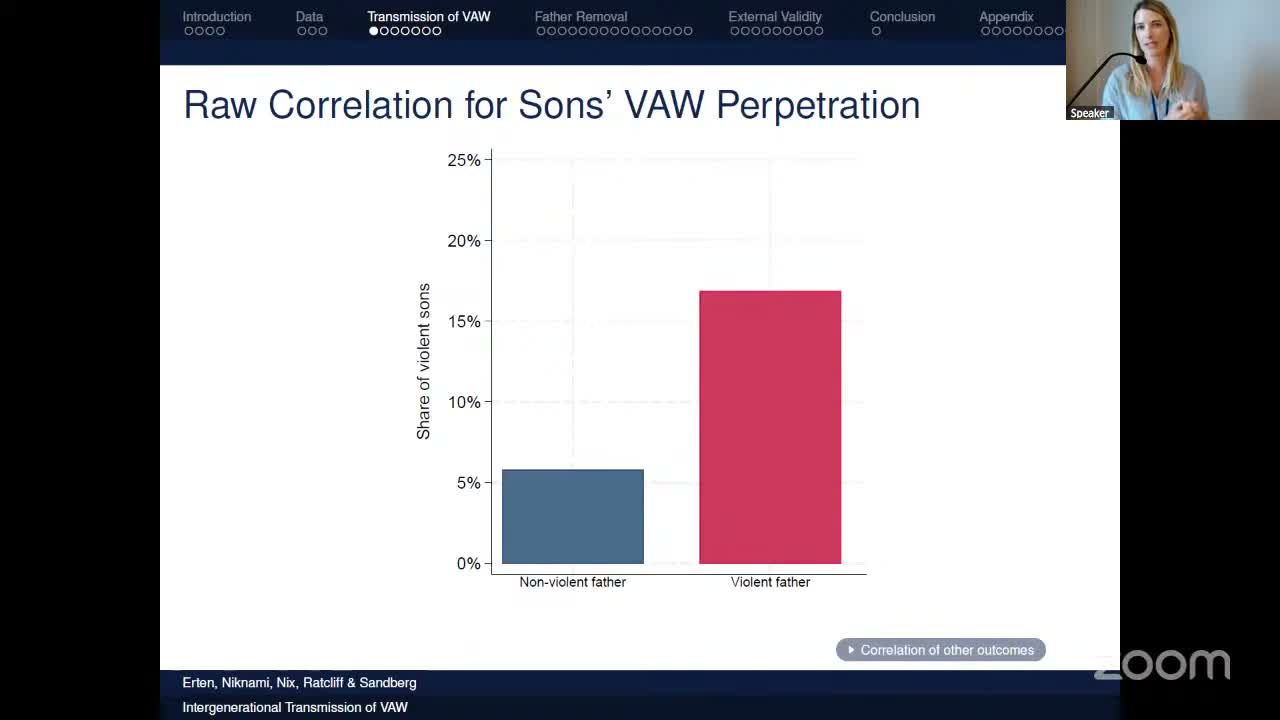
Sons of non-vaw fathers: about 6 percent are themselves later suspected of violence against a woman. Sons of vaw fathers: about three times that. In a linear probability model the raw gap is 11 percentage points, and throwing the entire Swedish register at it — everything the Nordic data can control for — takes it only down to just under 8.
For daughters, 8 percent of those with non-vaw fathers end up cohabiting with a vaw-suspected man, against 16 percent of those with vaw fathers; conditional on partnering at all, 10 versus 21 percent. Controlled, the gap is about 6 points. And because these crimes are badly under-reported, the authors cross-validate against health records: the probability a daughter appears in hospital or primary-care data with an intimate-partner-violence flag is four times higher if she grew up with a vaw-suspected father. That measure only catches assaults severe enough to reach the health system and confident enough to be coded as ipv — so if anything the police data understate it.
There is also assortative matching. Both sons and daughters are significantly more likely to partner with someone whose own father was suspected of violence against women. Whatever is being transmitted, it is being matched on.
That first 6 percent baseline caused the sharpest exchange of the talk. A senior questioner — Nix addressed her as Claudia — pushed back that a lifetime suspicion rate that high among the unexposed seemed implausible, and said so twice. Nix’s answer was that these are suspicions rather than convictions, that suspicion of violence against women is very common in lower-income families, and — the line she chose to end on — “I would say we live in a bubble.” She also said the number was devastating to her when they first computed it. That is a more honest exchange than most seminars produce, and neither party pretended it was resolved.
Part two: remove the father
Correlations are cheap. Women who leave violent partners differ from those who don’t — more social support, less isolation, better outside options — and all of those independently help children. So the paper needs quasi-random removal.
The design is a judge IV. Take vaw-suspected men who appear in court for any crime; some draw a harsher judge and go to prison, some don’t. First stage: a 10-percentage-point increase in judge stringency raises the probability of imprisonment by 5 points. Randomization is conditional on court × year × crime × age strata, because Swedish judges specialize.
Before the second stage, a question that has to be answered first. The median Swedish prison sentence is three months. Is that enough to change a child’s exposure at all?
Yes, remarkably. Five years after trial, the probability that the child lives with the biological vaw father drops by 73 percentage points. And the mother is not simply replacing him: the probability she cohabits with any vaw-suspected man falls by 47 points. Her own ipv healthcare flags fall too (significant only at the 12 percent level — Nix flagged this herself). Three months of breathing room converts into a durable separation, which is a policy fact independent of everything else in the paper.
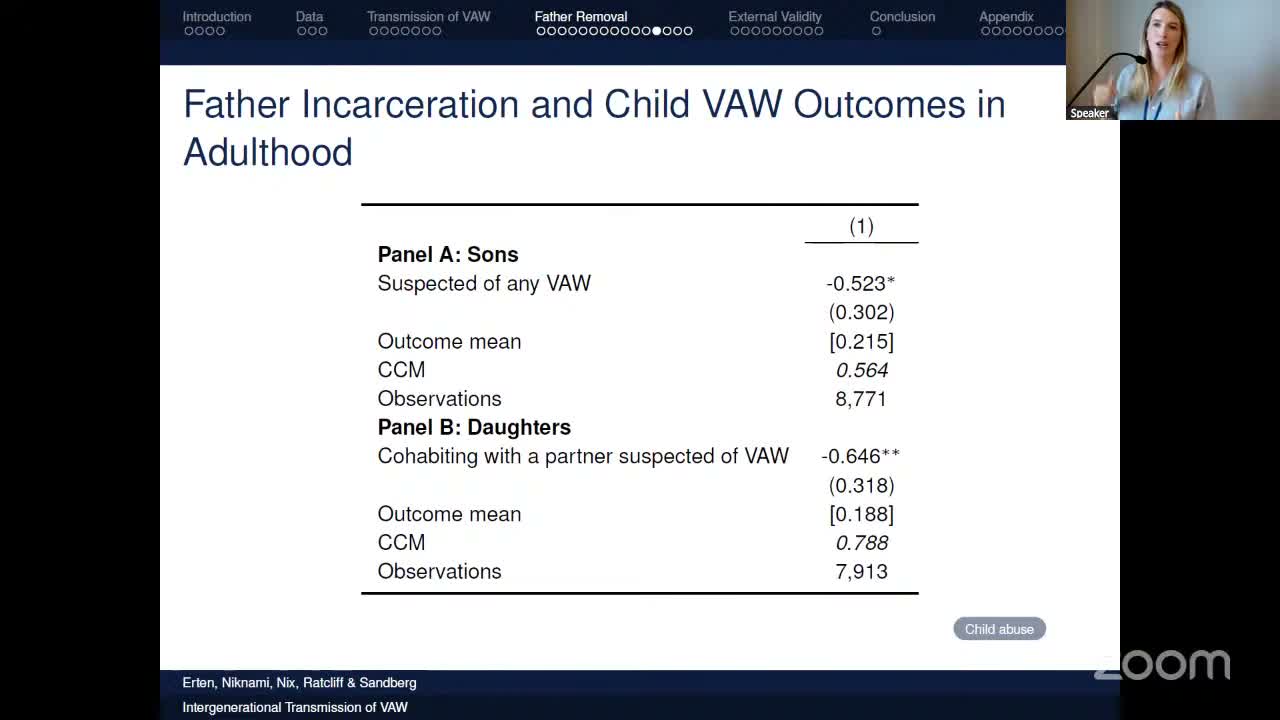
Sons are about 52 percentage points less likely to be suspected of violence against women. Daughters are about 65 points less likely to partner with a violent man — an 82 percent decline against the complier control mean. These effects nearly eliminate the behaviour, and Nix was insistent about the caveat rather than the headline: these are the worst men in the sample, still committing court-worthy crimes while their children are growing up, and the compliers sit in the extreme right tail even among vaw-suspected men. The confidence intervals are wide; the sons’ estimate is significant only at 10 percent.
One mechanism result is genuinely elegant. Removing a father bundles several things together — less modelled misogyny, a mother who recovers (she is less likely to show up for alcohol addiction as well as for ipv), and possibly deterrence. To separate deterrence, drop the cases where the imprisonment was for violence against women. For sons, nothing changes: no deterrent effect. For daughters, the effect disappears. So what a daughter learns from watching the state punish her father for this specific thing is that it is not to be tolerated; what a son learns from his father’s absence has nothing to do with why he left.
Part three: it isn’t the man, it’s which man
The judge-IV sample is severely selected, so the paper triangulates twice more.
First, descriptively. Take the 11-point raw transmission for sons and slice it by exposure. Among sons who never cohabited with their vaw biological father it roughly halves, to 6.3 points. Add a stepfather and it falls to 4.5. Among sons who were adopted by a stepfather it is 2.6 points and no longer significant — the transmission is gone. (For daughters it does not vanish: still 4.2 points and significant even under adoption, which Nix noted.)
Second, and this is the table she chose to dwell on because, as she put it, she often presents this to a room of mostly men who become worried she is telling them to remove fathers from families:
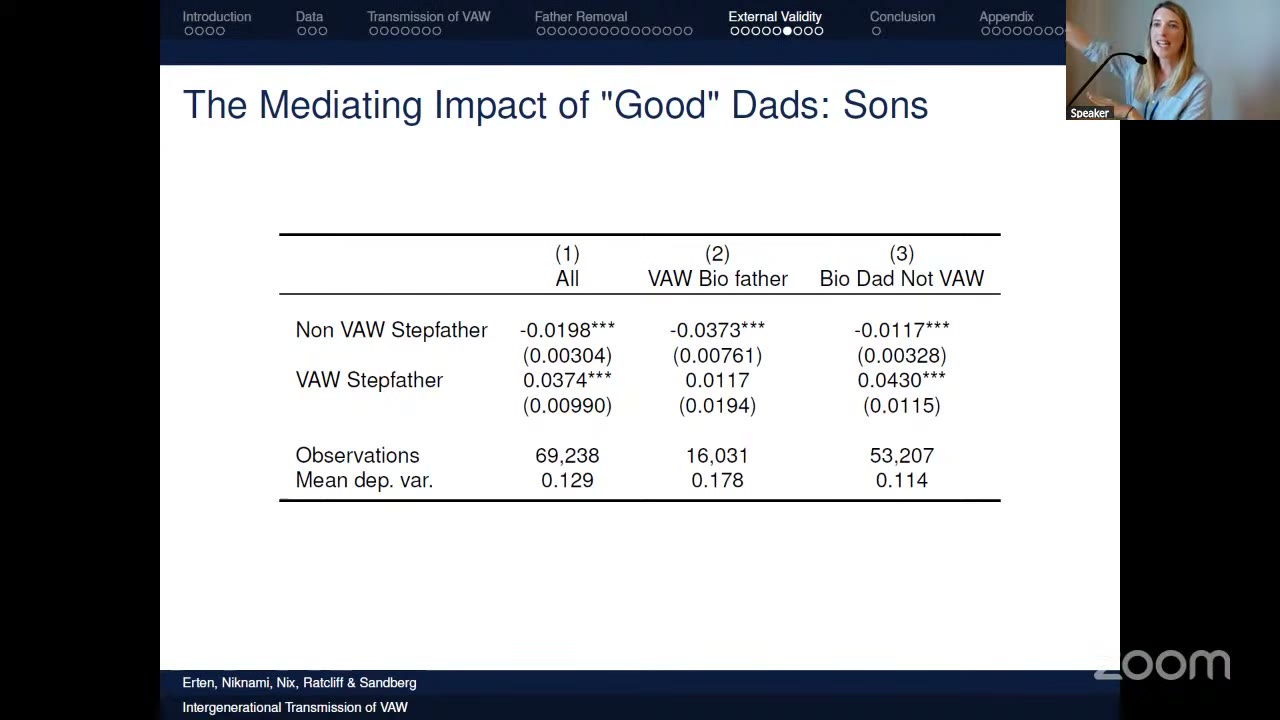
Bringing a non-violent man into the household reduces transmission, and reduces it most where the biological father was violent. Bringing a violent one in raises it, including for sons whose own fathers never were. The result is not about the presence or absence of a father. It is about which man is in the room.
Third, a family fixed-effects design comparing siblings with different lengths of exposure to the same father. Roughly ten more years of exposure raises the son’s probability of perpetration by about 2 points — a fifth of the baseline gap, much smaller than the judge IV, which Nix reads as exactly right: the judge IV removes the very worst men very early, whereas the average vaw father is presumably also doing things for his children that are good. And the placebo runs the right way: in families where the father was never suspected of violence against women, removal shows no transmission benefit and, for daughters, actually raises later partnership risk — consistent with the broader literature finding that removing fathers is bad for children.
Learning, or damage?
The best question came right at the end, and Nix did not have a full answer. The paper’s frame is learning — role models, modelled behaviour, norms. But an alternative frame is trauma: these children are not copying a script, they are damaged, with all that implies about ptsd and preferences rather than imitation. Those are different mechanisms with different policy implications and the data cannot cleanly separate them.
Nix’s response was the family fixed effects. If the harm were indelible, four years of exposure would be as bad as fourteen; the sibling design says duration matters, which means some of it is reversible. She drew the contrast with the foster-care literature, where the rule of thumb is that undoing trauma takes triple the time it took to inflict. Here the coefficients say it can be undone.
That is a real answer but not a complete one, and she said so. The paper’s stated goal was narrower: establish that the correlation exists, and establish that it can be broken.
(The unlovely finding underneath all of this is that a three-month sentence is doing the work. Not rehabilitation, not treatment, not a programme — ninety days of physical separation, which turns out to be enough for a woman to make the separation permanent and for a boy to stop learning. Whether that generalizes to a country where the median sentence is measured in years, and where the punishment is not bundled with Swedish social support, is exactly the question Nix said she could not yet answer, and it is the reason the American version of this paper cannot use a judge IV at all.)