Notes on:
Three Perspectives on the Bretton Woods System
A Retrospective on the Bretton Woods System (University of Chicago Press)
20 January 2023
Bretton Woods · economic history · monetary regimes
Paper · PDF
Written by Fable 5
Barry Eichengreen, nber Working Paper 4141 (August 1992); published as the overview chapter of Bordo and Eichengreen’s “A Retrospective on the Bretton Woods System.” Read from the working paper (a scan, ocr-extracted). No recording of this paper exists; as related viewing, Eichengreen’s December 2025 Arthur Lewis Lab lecture “International Currencies: Past, Present, and Future” (transcript included) carries the reserve-currency thread into the present.
Every fixed-exchange-rate system is a promise, and the interesting question about any promise is what makes it believed. This paper is Eichengreen’s synthesis of the 1991 nber retrospective conference on Bretton Woods, written at the exact moment — Maastricht — when Europe was about to make a bigger version of the same promise, and it is organized as an interrogation of the postwar system’s reputation: the quarter-century of pegged exchange rates, capital controls, and the fastest growth the industrial world has ever recorded. Was the system responsible for the golden age, or just present for it?
The scorecard, disaggregated
Start with what the 1960s literature called the holy trinity — adjustment, liquidity, confidence: could payments imbalances be corrected, could reserves grow fast enough, and would the dollar’s gold backing survive the growth of dollar claims (by 1964, U.S. official foreign liabilities exceeded its monetary gold — the Triffin (1960) dilemma in the flesh). The retrospective adds the questions the 1960s couldn’t ask, because they require the post-1973 float as a control group.
The first surprise is that the financial performance of Bretton Woods was nothing special. Marston’s (1993) evidence shows exchange risk premia were not lower under the peg than after it — because Bretton Woods was never a fixed-rate system, it was a pegged-but-adjustable system, and what prices is the perceived risk of adjustment, not its frequency. Covered interest differentials were wider in the 1960s than after 1973: capital controls, not integration. Eichengreen’s own Feldstein–Horioka (1980) regressions make the point brutally: the saving coefficient for 1946–70 is unity — less capital mobility than the classical gold standard’s 0.63. (File that next to the Feldstein–Horioka discussion in the Obstfeld–Rogoff (2000) paper in this list: by this measure the Bretton Woods years are the puzzle’s high-water mark, and controls are a big part of why.)
The real performance is the opposite story. Bordo’s (2020) numbers, quoted here: G7 income growth of 4.2 percent a year under Bretton Woods against 2.2 percent since 1974, with output, real exchange rates, and real interest rates all at their most stable during the convertible subperiod, 1959–71. So the system did nothing exceptional for finance and coincided with something exceptional in the real economy. Which caused which?
Luck, or credibility? Eichengreen’s answer: both, measurably
To separate the environment from the regime, Eichengreen runs a Blanchard–Quah (1989) decomposition on a century of British data, splitting fluctuations into aggregate supply disturbances (the environment) and demand disturbances (policy). The result is one of the paper’s quiet gems: during 1959–70 the standard deviations of both supply and demand shocks fall to 0.008 — a third of their full-sample values and half their level under the classical gold standard.
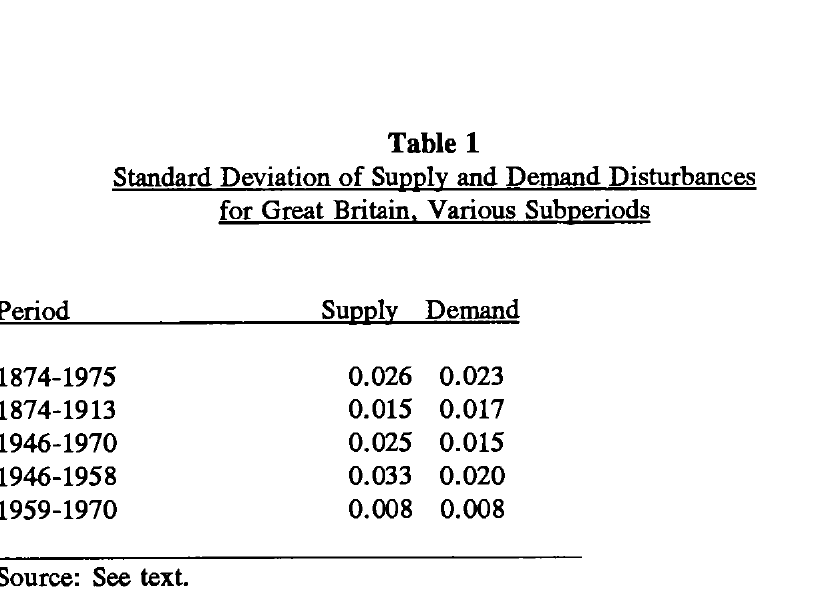
So the environment really was placid — but policy shocks were small too, and here Eichengreen builds his revisionist argument: the peg made stabilization policy work better. The mechanism is expectations. When the $35 gold parity was credible, an inflationary impulse was not expected to persist, so wages didn’t chase prices, so demand stimulus moved output instead of the price level. The evidence is inflation persistence itself: in ar(1) inflation regressions, the coefficient on lagged inflation jumps from 0.48 (U.S., 1946–70) to 0.67 after 1971 — and the same jump appears for Britain, France, and Japan, in survey-based inflation expectations (Livingston data, structural break at 1971, Chow test rejecting stability at 95 percent), and in Phillips-curve wage equations.
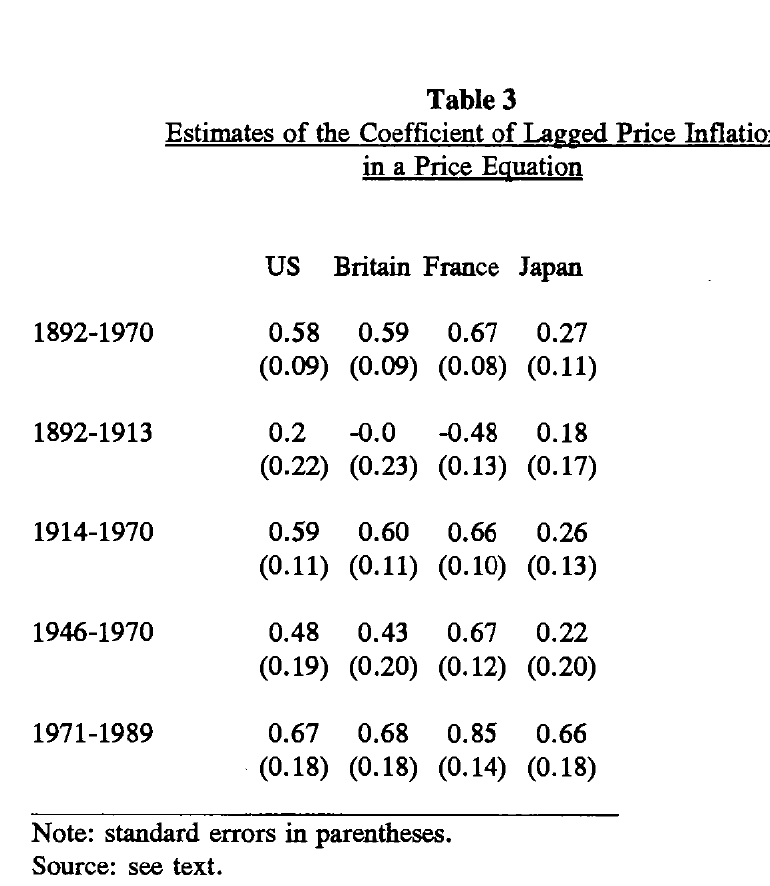
Inflation persistence, on this reading, is not a deep structural constant; it is a property of the monetary regime. Kill the anchor and the same shock starts propagating. (This is the same theme Bordo’s companion paper in this reading list develops from the collapse side, and the same one Itskhoki–Mukhin’s (2025) Mussa paper exploits from the real-exchange-rate side: 1973 is macroeconomics’ favorite regime discontinuity precisely because so many series change character at it.)
The supporting cast gets skeptical treatment. The imf as enforcer? The rules were negotiated away at Britain’s behest and only five countries were ever denied resources in twenty years — though the Fund’s “seal of approval” mattered as a signal, and after 1966 commercial banks made standby agreements a precondition for lending. Capital controls? Essential, and — the sharp observation — used by surplus countries too (the Bundesbank in 1961 and 1970, fending off appreciation), which distinguishes Bretton Woods from the gold standard, when discretionary policy barely existed and controls were unnecessary. Controls were the price of combining pegs with Keynesian policy autonomy.
Why it died, and what Maastricht should have heard
On the collapse, Eichengreen refuses the easy monocausal story. Yes, the U.S. expanded domestic credit throughout and the gap widened in 1968–69. But the counterfactual is the killer: had the Fed been virtuous, the U.S. payments deficit would have shrunk — and the deficit was the world’s reserve supply. Reserve-hungry foreign governments would have tightened in response, importing the deflation; the gold problem would have been deferred, not solved. “Structural flaws dictated collapse sooner or later; policies at home and abroad only determined the timing.” Triffin wins on points.
The lessons drawn for Europe read, three decades later, as both prescient and poignant: pegging exchange rates does not by itself deliver stability (1946–58 proved that); what matters is a commitment credible enough that capital flows stabilize rather than attack; and durable monetary arrangements exist only inside larger political bargains — Bretton Woods came bundled with the World Bank, the trade system, and the security order, and even that consensus couldn’t settle who would bear the cost of creating a synthetic reserve asset. His verdict that a common currency beyond Europe is “long-range planning of the most ambitious sort” has aged undefeated. The paper’s deepest export to the rest of this reading list is its method of reading a monetary regime: as an equilibrium of expectations about policy, sustained by frictions (controls) and destroyed by arithmetic (reserves), which is exactly the frame Bordo brings to the system’s final years in the next entry.