Notes on:
A Theory of Economic Sanctions as Terms-of-Trade Manipulation
Journal of International Economics 150: 103898
2024
geoeconomics · sanctions · optimal tariffs · terms of trade
Paper · doi · PDF
Made with AI: Opus 5 (reading and writing)
John Sturm Becko (mit, now Princeton). “A Theory of Economic Sanctions as Terms-of-Trade Manipulation”, Journal of International Economics 150 (2024), article 103898, 19 pages, doi 10.1016/j.jinteco.2024.103898 — the published version of record, which is what is cited and paginated throughout. No talk recording could be found; pdf-only digest. Figures are cropped from the published pdf.
Daleep Singh’s sentence, as an optimization problem
On the day Russia invaded Ukraine, the White House’s deputy nec director said the sanctions had been “intentionally scoped” to hit the Russian economy hard “while minimizing the cost to the U.S.” That sentence is a constrained optimization, and the paper’s observation is that trade economists already know how to solve it, because it is the optimal-tariff problem with the sign of one parameter flipped. The enormous sanctions literature had never written it down that way: case studies and databases (Hufbauer et al. 1990; the gsdb 2020), targeting of “strategic” goods, and the bargaining games of Eaton–Engers (1992) all sit beside the question of which trade restrictions hurt the target most per unit of harm to the sender.
The result
Two countries, competitive markets, a representative household and firm in each, Foreign trading freely, Home free to tax or subsidize trade in any good by any amount, including quantity-dependent schedules (which the paper shows add nothing: linear taxes implement every allocation that quotas or price caps can). The object is the set of welfare pairs Home can reach, and its frontier — the most damage Home can do to Foreign at each level of its own welfare.
Theorem 1 says that at every point on that frontier except autarky, the trade tax on good is
(eq. 9), where is Foreign’s terms-of-trade elasticity for good — the inverse of the elasticity of Foreign’s net export supply, which is exactly the classic optimal tariff — and is the weight Home places on Foreign welfare along the frontier: one for a global planner (free trade), zero for a purely selfish Home (the Mill (1844)–Bickerdike (1906) tariff), and negative for a sanctioner. The structure of the optimal sanction is therefore identical to the structure of the optimal tariff; only the scale changes. The reason is a fact the tariff literature has always known and never used this way: in a neoclassical setting, Home’s trade taxes affect Foreign welfare only through Foreign’s terms of trade, which are the negative of Home’s. Hurting Foreign and enriching Home are the same vector.
Three lessons
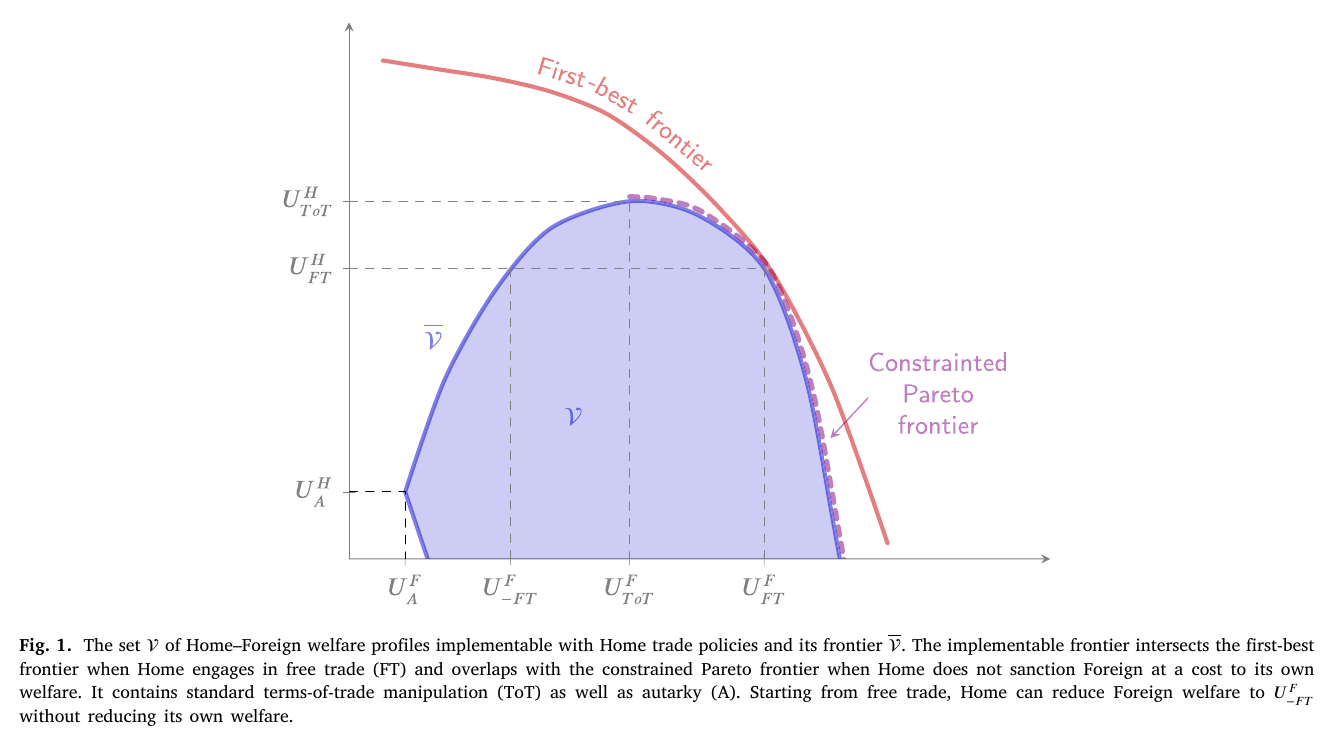
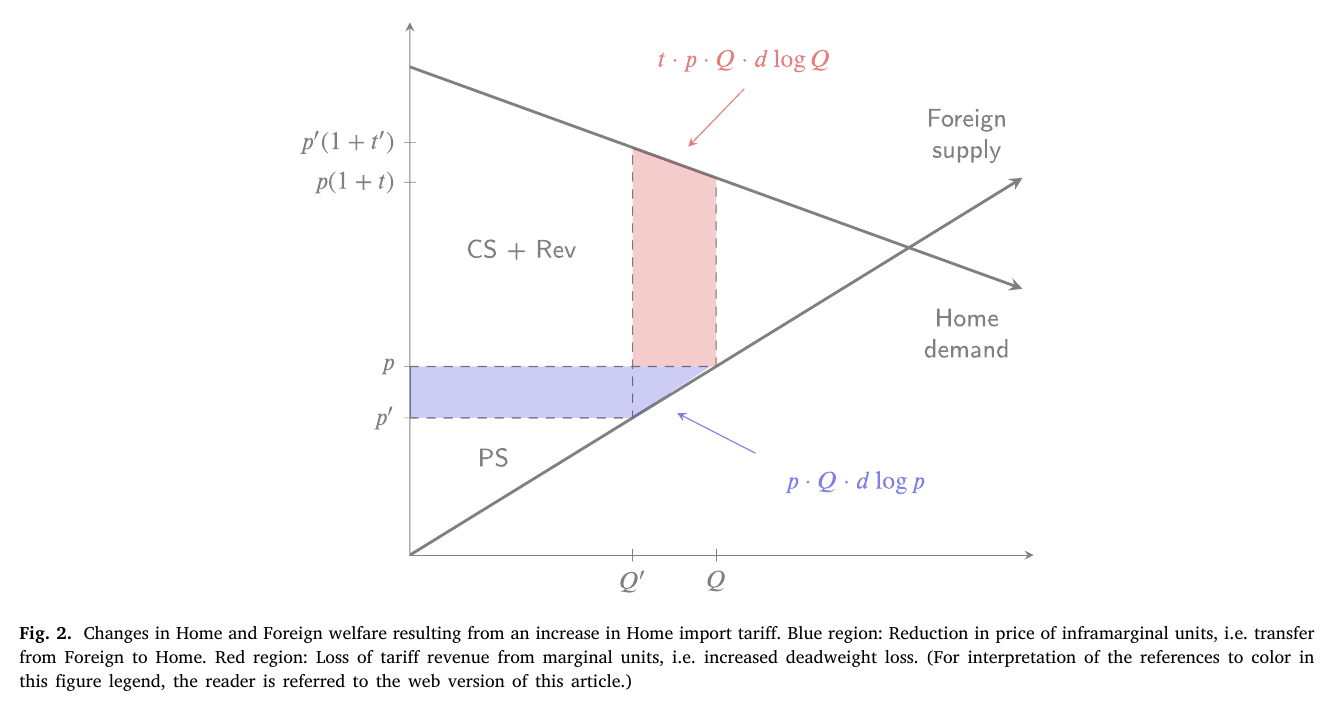
First, starting near free trade, weak sanctions raise the sanctioner’s welfare — they are terms-of-trade manipulation that happens to also hurt the target — and only sanctions beyond the optimal tariff cost Home anything. In Figure 1, Home can move Foreign from to for free. Second, optimal sanctions target the goods optimal tariffs would: those Foreign supplies or demands inelastically, where a given tax moves the world price most. “Bottleneck inputs” are right for the reason the tariff literature gives, not for a strategic one. Third, Home’s own demand and supply elasticities do not enter: with a fixed sanction motive the ratio of taxes across goods is invariant to anything about the Home economy, so the sanctioner should not be scoping its sanctions around which goods it finds easy to replace. The paper’s Figure 2 is a single-market diagram making the last point: as Home raises a tariff the division of the harm between Home and Foreign is governed by Foreign’s supply elasticity alone.
Extensions, including the trade war
Theorem 1′ allows Foreign to have its own trade taxes, which adds a motive — deprive Foreign of tariff revenue — and changes the formula. Holding each country’s ad-valorem taxes fixed and letting both set sanctions optimally gives Corollary 1, a characterization of Nash sanctions: the structure of a trade war in which each side’s taxes are pinned down by both sides’ terms-of-trade elasticities and mutual welfare weights (eq. 15). Further extensions cover many Foreign households (Home sanctions harder the goods whose restriction hurts the households it values least, which is the “target the elites” logic in trade terms), neutral third countries (the design must account for their terms of trade as well), and a coalition of sanctioners, who should trade freely among themselves and impose the same sanctions on Foreign.
Where it sits
The paper is short, closed-form and deliberately neoclassical: no networks, no dynamics, no threats. That is what makes it the right bridge in the list. It tells a trade-literate group that the 2.3 sanctions literature and the 1.2 geopolitical-tariff papers are one machinery — Becko, Grossman and Helpman’s (2025) Optimal Tariffs with Geopolitical Alignment is the same author adding an alignment motive to the same formula — and it supplies the benchmark that De Souza et al. (2023) quantify in a Caliendo–Parro (2015) model (the cost-efficient sanction on Russia is a uniform tariff or an energy embargo, depending on willingness to pay) and that Ghironi–Kim–Ozhan (2025) dynamize. What it leaves out is exactly what block 2 adds: the cms (2024) sanction is a threat that works off the equilibrium path by excluding a firm from a network, and its power is nonlinear in market share, whereas here the sanction is a tax that works on the path through world prices.