Notes on:
The Limits of Government Outsourcing: Property Tax Re-Assessments in India
Working paper
27 July 2026
development · state capacity · taxation
Talk · Paper · Slides · PDF · Transcript
Written by Fable 5
Part of NBER Summer Institute 2026 — Development Economics
Esther Duflo, Rema Hanna, Benjamin Olken and Shreya Tandon, presented as a nine-minute lightning talk at nber Summer Institute Development Economics, July 27, 2026 (the chair’s handoff — “you’re going to be meaner to me probably” — suggests one of the authors presented; captions don’t identify which). Paper: June 2026 draft, and the slides. Timestamps refer to the session video.
The standard theory of outsourcing, the Hart–Shleifer–Vishny (1997) prisons framework, concedes the private sector its efficiency and then worries about everything else: the contractor will cut costs on dimensions you can’t contract on, quality will suffer, use with care. The presumption of private productive efficiency is the part nobody bothers to test. This paper tests it, in about the least favorable setting the presumption could ask for — property tax reassessment in Chennai — and finds the government’s own inspectors beat the contractors on quantity, on revenue, and on accuracy, which is not how the trade-off was supposed to work.
Property tax matters because it’s the workhorse revenue instrument available to developing-country cities, and reassessment is where the money leaks: someone has to visit the property and determine that the “residential single unit” is now a three-story building with a commercial ground floor. It seems like the perfect outsourcing task — measurable output, piece-rate contractible, no obvious multitasking dimension. The Greater Chennai Corporation randomized its 199 wards among government tax assessors, private firms on a fixed per-property fee, and private firms on an incentive contract (a share of the revenue raised) — over 206,000 properties in the experimental sample. Then, in a twist that doubles as a data point, the government halted the whole exercise mid-stream for political reasons: it was raising a lot of revenue, and raising a lot of revenue from urban property owners is a thing elected governments discover they don’t enjoy. The researchers measured everything anyway, through administrative data, their own surveys, and independent third-party assessments they commissioned as an accuracy benchmark.
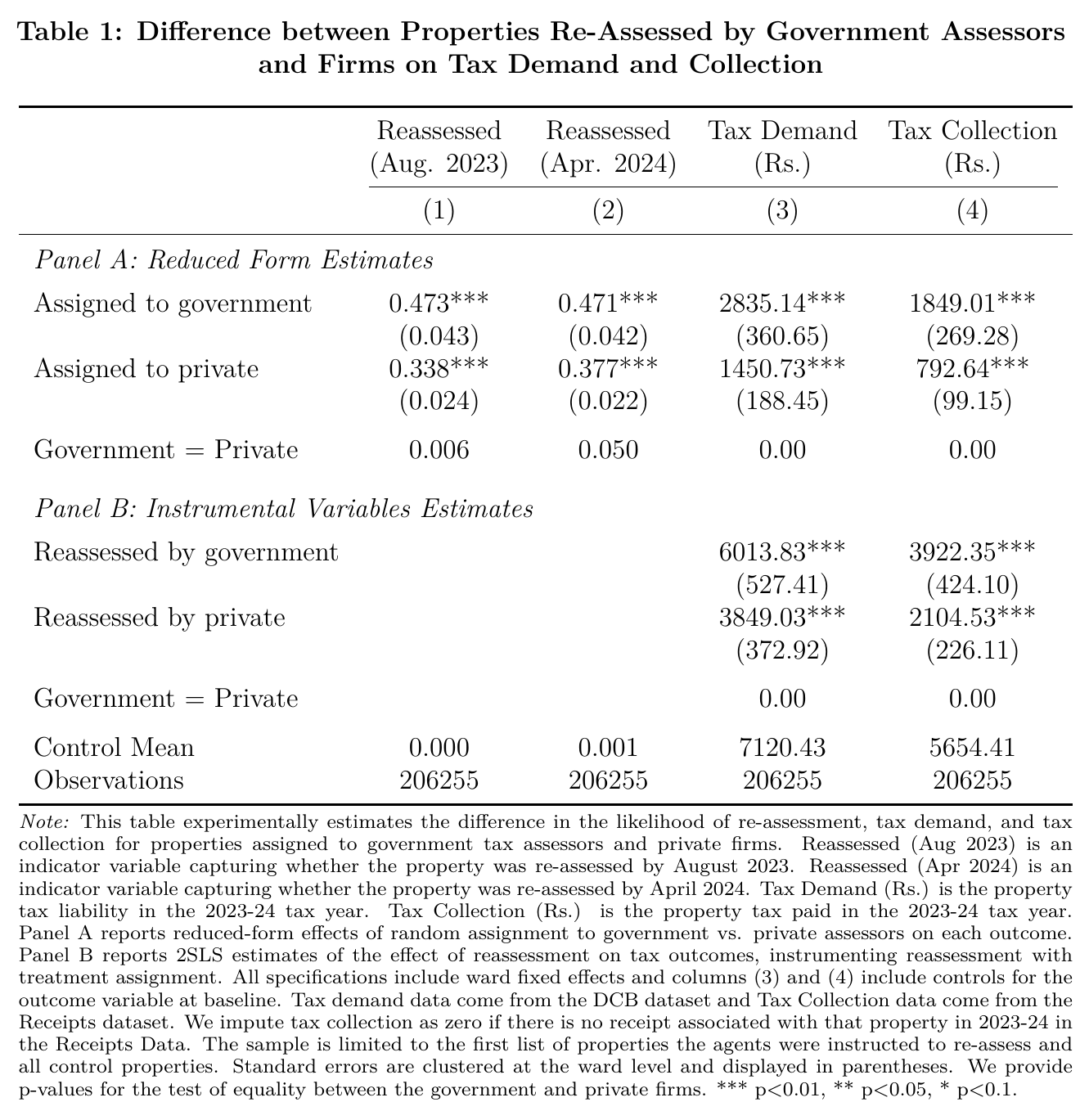
Government assessors got through more properties (47% vs. 34% by August 2023) and extracted more per inspection — the increase in collected revenue per property inspected was 87% higher than the private firms’ — and their assessments tracked the independent third-party benchmark more closely. The two private contract types, fixed fee versus revenue share, performed indistinguishably, which matters theoretically: if the private shortfall were classic incentive-design slippage, the high-powered contract should have closed the gap. It didn’t, so the problem is upstream of incentives.
Upstream, the paper finds two things. First, selection into the procurement itself: 23 firms attended the bidding meeting, five bid, one was disqualified and one priced out, leaving three — and firms reported not bidding because of low prices and the general hassle of past dealings with government. The firms a difficult government client attracts are not the private sector of the textbook; they’re the firms with the least outside option. Their workers were lower-skilled and put in less effort than the government inspectors. Second, and less transferable to any firm however competent: authority. The task means entering people’s homes and telling them their taxes are going up. Private assessors faced more refusals at the door, and when refused had to escalate through a cumbersome managerial procedure; a government inspector carries the state’s implicit authority across the threshold. As the presenter put it, this is a task that is “very adversarial with citizens,” where the person entering your house being an agent of the government is a feature of the production function, not an incidental credential.
The cost-benefit arithmetic favors in-house strongly — the revenue raised dwarfed the exercise’s costs, more so for government assessors — though the presenter floated the honest caveat that government workers have an opportunity cost in other tasks, and noted suggestive complementarity: for small, simple properties the private sector does about as well, so an optimizing city might assign by complexity. The concluding claim is the theoretically pointed one: the limits of outsourcing here have nothing to do with multitasking or quality-shading, the frictions the literature has spent thirty years modeling. The government was simply the more efficient producer — better selected, better motivated, and carrying legal authority that can’t be subcontracted. The political economy coda writes itself: the one actor efficient enough to raise the revenue was the government, and the one actor that could stop it was also the government, and it did.