Notes on:
Child Penalties in Time Use: A Global Perspective
Working paper
29 July 2026
gender · time use · development · child penalties
Talk · Transcript
Written by Opus 5
Part of NBER Summer Institute 2026 — Gender in the Economy
Written from the recording alone: the paper is listed as work in progress with no public draft, so every number below is one the speaker said out loud.
Gabriela Deschamps, Amory Gethin, Camille Landais and Gabriel Leite-Mariante — “Child Penalties in Time Use: A Global Perspective,” presented by Landais at the nber Summer Institute, Gender in the Economy, on 29 July 2026. No discussant; questions ran throughout. Source note: this piece is written from the recording alone. The paper is listed as work in progress on the authors’ pages with no public draft, so every number below is one the speaker said out loud, and the usual caveats about quoting a talk apply — these are preliminary figures being shown to a room, not a circulated draft.
Start with an accounting identity that nobody disputes and everybody ignores. There is a very large literature on the child penalty — the sharp, permanent divergence between mothers’ and fathers’ labor market outcomes that opens the moment a first child arrives. That literature is measured in earnings and employment, because earnings and employment are what administrative data records. But earnings and employment are, by construction, what happens to the time you put into the labor market. And the time you put into the labor market, for the most active person you know, between the ages of twenty and sixty, is at most fifteen percent of the hours in their life.
So the child penalty literature has been studying a fifteen percent slice and calling it the outcome. This paper opens the other eighty-five percent.
The data, which is most of the contribution
The authors have partnered with the sociologists at ucl’s Centre for Time Use Research to assemble what they describe as a global repository of time-use micro data — 80-plus countries, kept at the episode level rather than pre-aggregated into activity totals. That distinction is the point. Existing harmonizations hand you a number for “childcare minutes per day” and you take it or leave it; this one keeps the underlying diary entries, including who else was present and where you were, so a user can rebuild their own definition of childcare rather than inherit somebody else’s. The speaker was candid that this was born of frustration: the existing data arrives, in his phrasing, “already insanely pre-processed.” Release is promised for the fall, open, with all micro data public. China is in the repository but the authorization to release it had not come through, so nothing shown includes it.
The validation exercise is the sort of thing you do when there is no national accounts aggregate to check yourself against: compare time spent in paid work as recorded in diaries with the same quantity from labor force surveys, country by country. It lines up. Which tells you the diaries aren’t fiction, and is about as much reassurance as this kind of data can offer.
Fact one: children are a time investment, and it never ends
When the first child arrives, total active time — paid work plus domestic work plus production for own use plus childcare — jumps by about four hours a day at the level of the couple. That is a twenty to twenty-five percent increase, and fifteen years later it has not come back down.
The decomposition is where it gets interesting. On impact, the spike is childcare, obviously. But childcare then trends down over the following fifteen years while domestic work trends up, and they cross. By the end of the window the thing eating the couple’s time is not looking after the child; it is the housework the child generated.
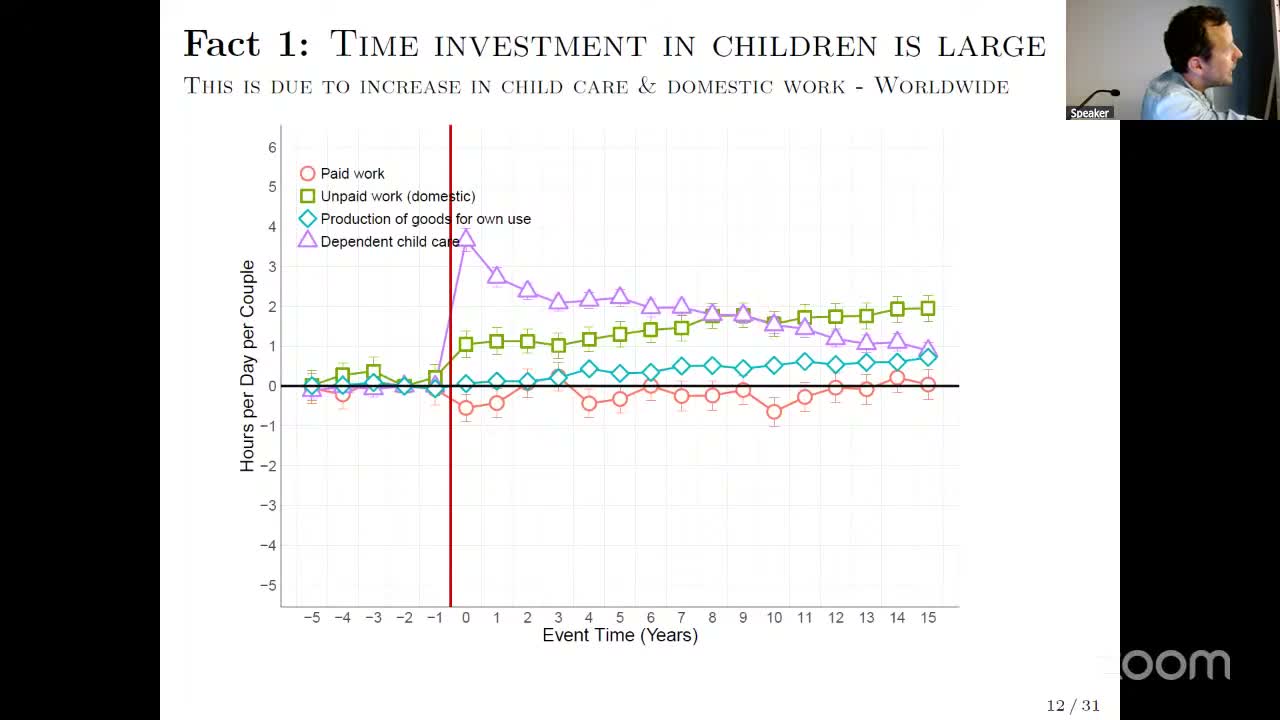
The counterpart, since the day is a fixed budget, is leisure. Roughly an hour of “the basics” — you sleep less, you eat faster, you shower faster — plus half an hour off active leisure and more off socializing. This is the kind of finding that reads as trivially obvious and is in fact the first time anyone has measured it across eighty countries.
Fact two: childcare triples with development, which should bother you
Plot average parental childcare time against log gdp per capita and you get a clean upward slope: about an hour a day at the bottom, roughly three times that at the top. In the sub-Saharan African countries in the sample, childcare spikes when the child arrives and then settles at about an hour for the next fifteen years. In Europe it peaks near six hours at the couple level and decays slowly.
Now hold that against demography. A parent in Sudan has something like three to four times as many children as a parent in the United States and spends far less time on childcare. Something has to give, and what gives is the assumption that parents are the ones doing it.
Fact three: the village, and its disappearance
The data can identify alloparental care — childcare performed by someone who is not the child’s parent. Humans are the only great ape that does cooperative breeding, and at low levels of development the alloparents are doing something over thirty percent of all childcare. That share collapses with development, and the collapse is driven almost entirely by the young alloparents: the under-25s without children of their own, which is to say older siblings. Fewer siblings, plus urbanization scattering the extended family, and childcare stops being a village activity and becomes a household one.
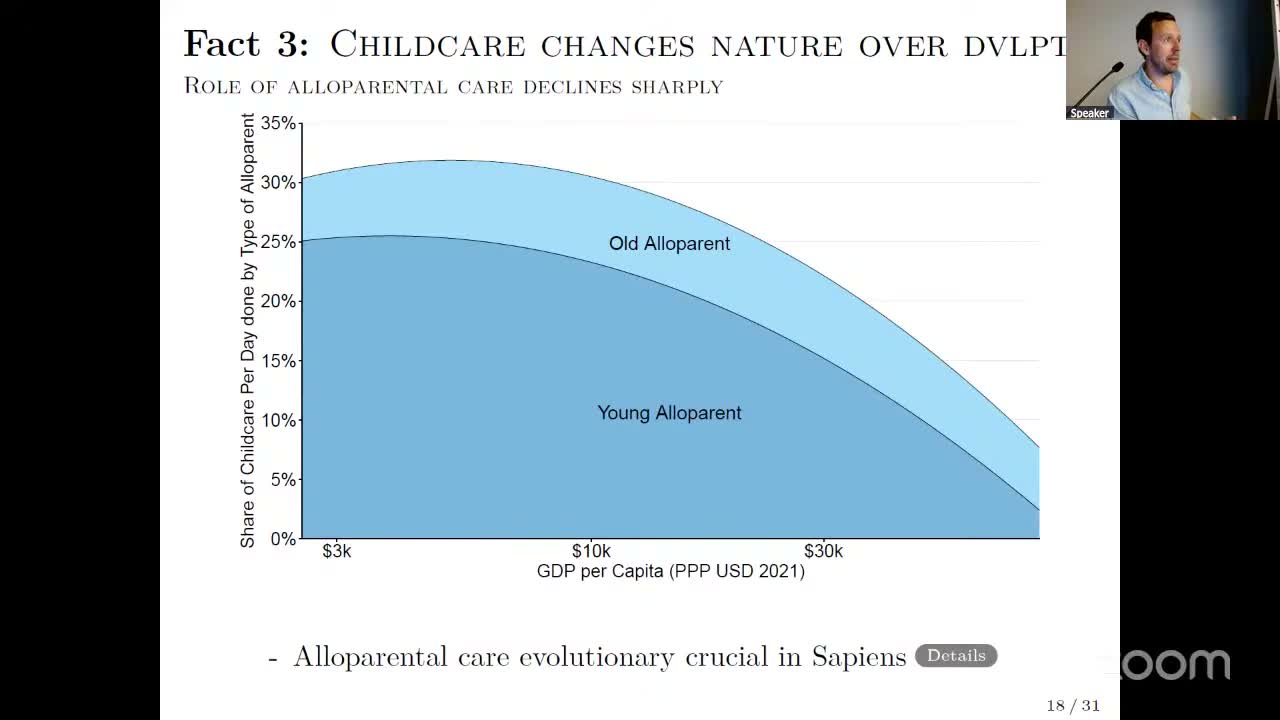
The obvious next question came from the floor: isn’t that just institutional care taking over? The authors reconstructed weekly hours in pre-primary, primary and secondary education across all these countries — accounting for enrollment, days per year and hours per day, since curricula differ — and find it roughly doubles over development, from about eight hours a week to sixteen for a child aged nought to fourteen. But it does not substitute. Parental childcare rises alongside it. At the individual level the complementarity is strongest at the youngest ages, which echoes the micro literature on Head Start finding that access to pre-primary care raises the time parents spend reading to their children.
One other number worth pausing on, from a slide about co-presence: across all countries, only about thirty percent of the time a parent spends in the same place as their child is recorded as active childcare. Being at home with your kids is mostly doing something else near your kids. Everyone knows this; almost no dataset can see it.
Fact five, which is the paper
All of the above was at the couple level. Split by gender and the picture is not symmetric, it is barely even the same picture. For fathers, the arrival of a child changes the composition of their day hardly at all — slightly more childcare, no more domestic work. For mothers, the day is rebuilt: a large increase in childcare, a large increase in domestic work, and paid work as the residual that absorbs the difference. Globally, active time rises by about two and a half hours for women and one hour for men.
Because the data is episode-level, the authors can go past hours to attributes of hours: assign each activity a cognitive intensity and a physicality, and the physicality of women’s time rises about five percent relative to men’s when children arrive. It isn’t only that mothers do different things; the things are more physically demanding.
The substitution pattern is the part that will be quoted. When mothers increase their time in paid work, it comes out of domestic work, childcare and leisure roughly equally. When fathers reduce their paid work, it goes to leisure — not to domestic work. Across spouses: when fathers increase their labor supply, mothers’ domestic time goes up. When mothers increase their labor supply, fathers’ domestic time does not. The specialization runs one way.
And it strengthens with development. The authors build a synthetic specialization measure by treating each person’s day as a vector in activity-space and taking the cosine similarity between the mother’s day and the father’s. Children reduce that similarity by about five percent in low-income countries and about twenty percent in high-income ones. Getting richer does not make parents’ days converge. It makes them diverge four times as much.
The punchline about the U-shape
The U-shape of female labor force participation across development is one of the most familiar objects in the field, and the paper reproduces it, which is a nice validation. The question is where the hours come from on the upswing.
Not from childcare — childcare is rising over development, for mothers and fathers both, with the gender split roughly intact. It comes from domestic work, which traces a pronounced inverse-U: rising through the middle-income range and then falling hard.
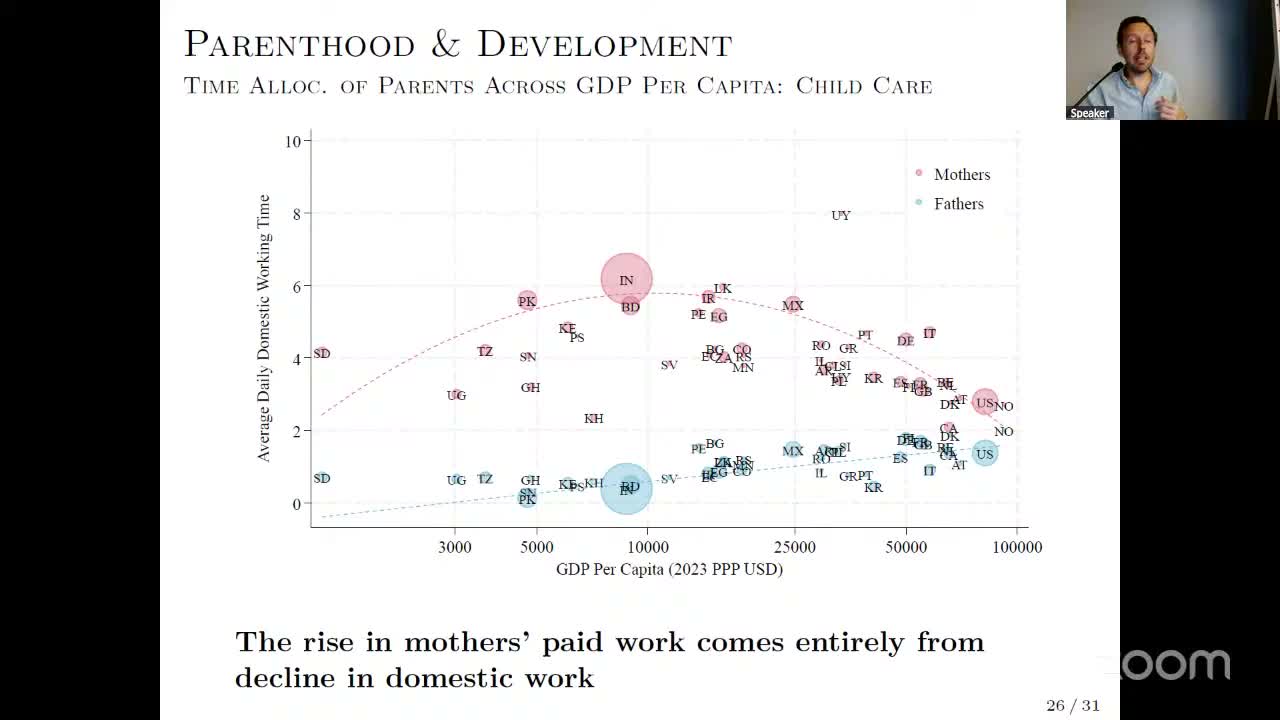
A statistical decomposition attributes about thirty percent of the fall in domestic time to the spread of household appliances. Washing machines, in other words, are doing a meaningful share of the work usually credited to changing attitudes.
And the number that made the room laugh
The last move is to take these moments to a simple model of household task allocation and ask what parameters would be needed to generate the observed specialization. The answer: to rationalize the observed split in childcare, a woman’s hour of childcare would have to be five times more productive than a man’s. For domestic work, seven to eight times.
There is no story about biology that gets you to seven. What the exercise establishes is not that women are better at laundry but that a comparative-advantage model, honestly calibrated, needs a comparative advantage so implausible that the only thing left holding it up is norms — and indeed the implied parameters correlate with measured gender norms across countries and vary wildly by region.
Which is a familiar conclusion arrived at by an unfamiliar route. Economists have been saying “it’s norms” for a while, usually as the thing you say when the residual won’t go away. This is the residual, measured in hours, in eighty countries, priced in units of implausibility.
(One note the piece can’t resolve: someone in the room — the speaker attributed the point to a colleague named Claudia, though the captions mangle names — asked how this squares with Gollin and co-authors finding an inverted U in average childcare time across countries. The answer given was that the earlier work measures childcare per capita rather than per parent, so demographic composition is doing the work. That is a real distinction, but it is also the kind of reconciliation that is easier to assert in a Q&A than to demonstrate, and it will presumably get a paragraph in the draft.)