Notes on:
Understanding the Congestion Child Penalty: Can Remote Work Attenuate It?
Washington Center for Equitable Growth Working Paper
28 July 2026
gender · commuting · remote work · United States
Talk · Paper · PDF · Transcript
Written by Opus 5
Part of NBER Summer Institute 2026 — Gender in the Economy
Ilaria D’Angelis and Keren Horn (UMass Boston) — “Understanding the Congestion Child Penalty: Can Remote Work Attenuate It?,” presented by D’Angelis at the nber Summer Institute, Gender in the Economy, on 28 July 2026 (Day 1, afternoon) — the last paper of the day, a fifteen-minute egg-timer slot with questions held for the evening reception, so there is no Q&A. Written from the February 2026 Equitable Growth working paper.
A commute is a tax on labor, levied in time, and nobody reimburses it. Forty minutes each way is eighty minutes a day you spend on your job and are not paid for, which lowers the value of every hour you are paid for. If your reservation wage is close to your market wage, the tax pushes you out.
Who has a reservation wage close to their market wage? People whose home time is valuable and hard to substitute for. Mothers, in other words. And the tax only bites if you cannot avoid the trip.
That last clause is the paper. Remote work is usually discussed as an amenity — flexibility, work-life balance, a nice thing employers offer. D’Angelis and Horn treat it as something more specific: an exemption from the commuting tax. And exemptions have distributional consequences, which depend entirely on who gets one.
The heterogeneity is the finding
Start with a picture. Women aged 18 to 54 in metro areas, split by whether the msa’s commuting times run above or below average, 2005 to 2019.
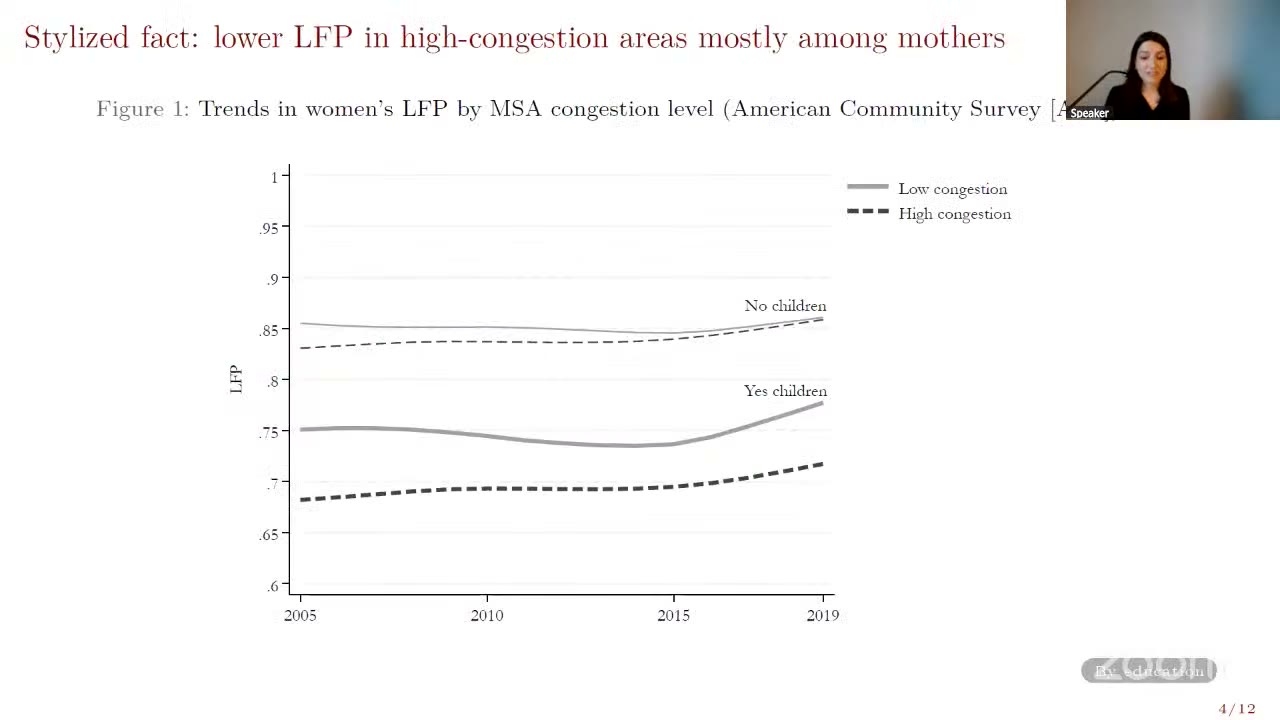
Women without children barely notice congestion — the two lines sit almost on top of each other. For mothers, the gap is large and persistent. Congestion is not a general drag on female labor supply. It is a drag on mothers specifically.
The estimation uses the acs and the American Time Use Survey, 2005–2019, restricted to women 18–54 who are not enrolled and who cohabit with a male partner. The regressor is the log of average commuting time among employed men who drive to work in that woman’s msa and year — a measure of the city’s congestion rather than of her own choices. Controls cover her characteristics, her partner’s, and the metro area’s, plus region and year fixed effects, plus the characteristics of women living in that msa in 1990, to absorb long-run sorting of different kinds of women into different kinds of cities. And to deal with reverse causality and measurement error, commuting time is instrumented with the length of railways as of 1898 and planned highways as of 1947, following Duranton and Turner (2011).
The result splits cleanly on education. For mothers without a college degree, a 10 percent increase in average commuting time — about 2.7 minutes — lowers the probability of being in the labor force by 0.4 to 1.8 percentage points, depending on specification. For mothers with a college degree: nothing. Not at the extensive margin, not at the intensive margin.
That is a striking null, and the obvious alternative explanation is childcare — maybe college mothers can afford to buy their way out. The paper controls for childcare prices, including in the IV specification, and the pattern survives.
Two escape routes, both credentialed
If remote work is the exemption, it should be distributed the way the immunity is. It is, twice over.
First, through partners. Forty-three percent of college-graduate women’s male partners work in occupations with high remote-work incidence, against 22 percent for women without a degree. Thirty percent of those partners had worked remotely for at least half an hour on the previous day, about 21 percent of their working time, with 15 percent fully remote. This matters because — using time use data — men who work remotely do more caregiving and housework, and remote work explains at least a quarter of the gap between college and non-college men in time devoted to care and housework.
So a college-educated mother’s mobility constraint is slackened by somebody else’s flexibility. Consistent with that, when you split non-college mothers by whether their partner has remote access, the congestion penalty concentrates almost entirely on the women whose partners do not. D’Angelis flagged the selection problem herself — people choose their partners — but noted the milder version of the claim survives it: these men at least had occupations available to select into.
The sharper result is that remote-work availability is the only characteristic of a partner’s occupation that generates any heterogeneity in the congestion child penalty. Not income, not hours, not industry. The exemption.
Second, through women’s own jobs. College-graduate women are much likelier to hold remote-capable occupations and to use remote work intensively. But the gap is not uniform across the map — it is widest exactly where commuting is worst.
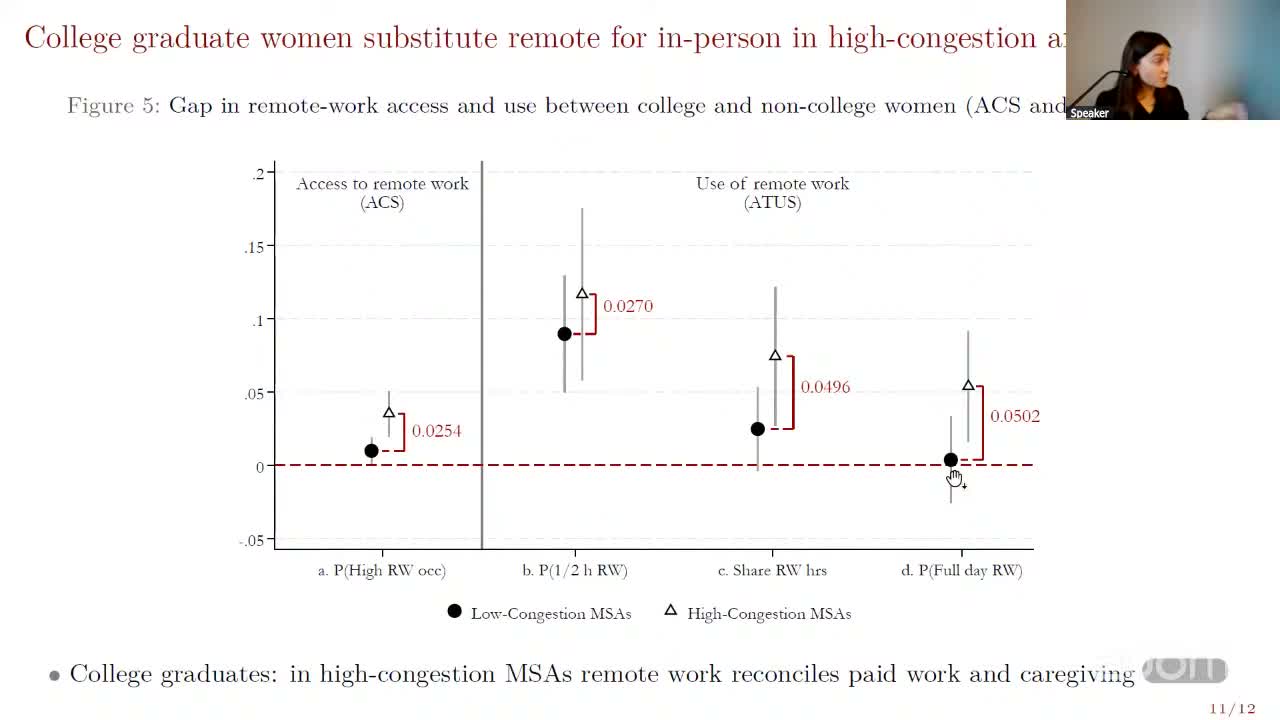
The college/non-college gap in remote-work access is about 2.5 points larger in congested cities; in any remote work, 2.7 points larger; in the share of hours worked remotely and in the probability of a full remote day, about 5 points each. On the last measure, the gap between college and non-college women in low-congestion cities is essentially zero, and about 5 points where commuting is long.
Which is the behavioural result underneath: college-educated women substitute remote work for in-person work precisely when the mobility constraint would otherwise bind, and the time use data show them using that flexibility in congested cities to provide care as a secondary activity while working. They are not escaping the tax by luck. They are escaping it on purpose, using an instrument only they hold.
Why this is uncomfortable
Remote work entered the policy conversation as an equalizer — a way for mothers to stay attached to the labor market. This paper says it is doing that job, and doing it exclusively for women who already had the most options, in the places where the constraint is most binding, thereby widening the gap it was supposed to close.
The transport-policy implication is the one D’Angelis flagged as ongoing work, and it is the right one. For the women who bear the congestion child penalty — in inflexible jobs that require showing up — you cannot fix this with a work-from-home policy, because their jobs do not have one. You fix it by making the trip shorter. Which makes public transit investment, of all things, a maternal labor supply policy.
(There is a version of this finding that is just an old idea in new clothing. Commuting has always been a regressive tax, in the sense that the people with the least valuable time spend the most of it getting to work. What remote work did was hand the top half of the education distribution a coupon, in the cities where the tax is highest. The bottom half is still driving.)