Notes on:
Critical Minerals, Geopolitics, and the Green Transition
Working paper
2026
geoeconomics · critical minerals · market power · green transition
Paper · PDF · Transcript
Made with AI: Fable 5.1 (reading and writing)
Tomás Domínguez-Iino, Jonathan Elliott and Allan Hsiao; discussed by Laura Alfaro. nber Summer Institute, International Economics and Geopolitics session, July 2026 (video posted 16 July; the talk runs 07:03–08:02 of the day’s recording). Paper: the 17 August 2026 draft.
Opec, but the goods are complements
Here is how market power in a commodity is supposed to work. Saudi Arabia cuts oil output, the oil price rises, and American shale drillers — who make a perfect substitute — quietly celebrate. Everyone who produces the thing benefits from anyone who restricts the thing; everyone who consumes it loses; the cartel problem is the classic one of free-riding among substitutes. Now change one fact. Suppose the thing nobody wants is not oil but a battery, and a battery is not one mineral but a recipe — lithium plus nickel plus cobalt in fixed chemical proportions, with several competing recipes. Then the producers of different minerals are not substitutes for each other. They are complements, joined by a chemist. And market power among complements behaves, as Domínguez-Iino put it in the first minutes of the talk, in a fundamentally different way.
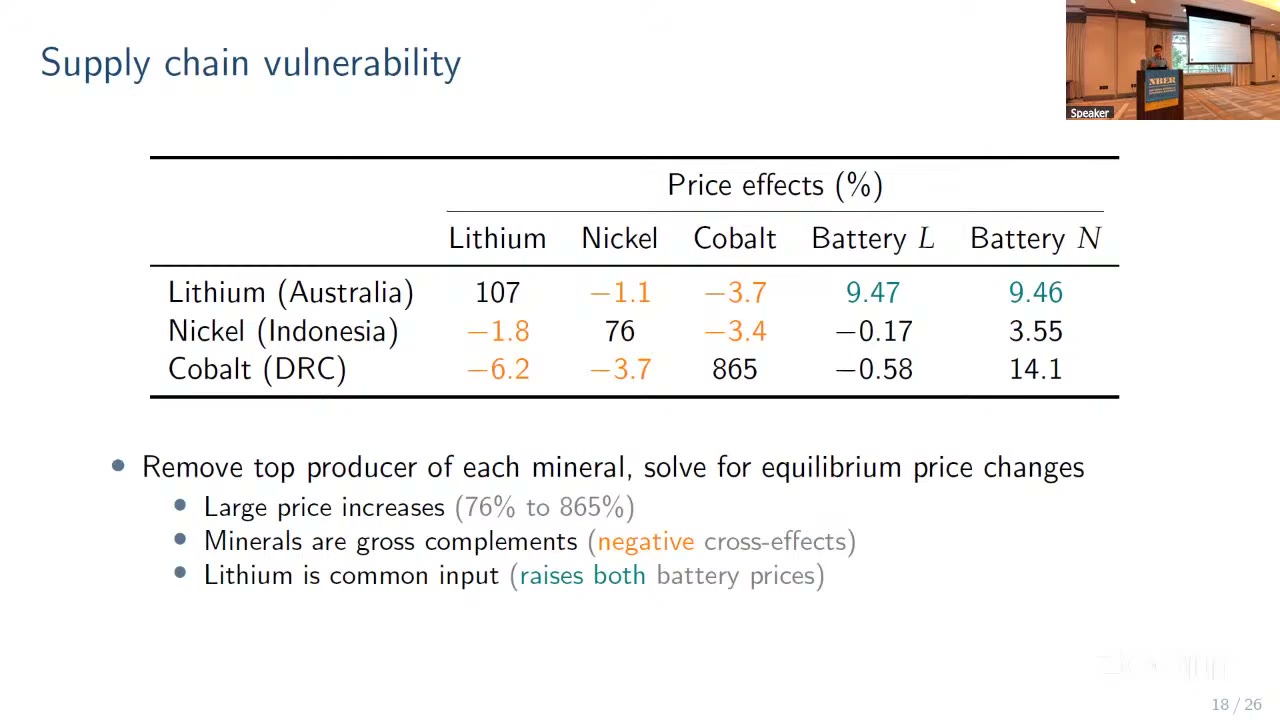
The paper works this out for the three minerals that matter for advanced batteries. The geology is more concentrated than oil or gas is today: the top three producing countries hold 70 to 85 percent of world output, against 40 to 50 percent for fossil fuels, and the top one is a large fraction of that — Australia is half of world lithium, Indonesia half of nickel, the Democratic Republic of Congo three quarters of cobalt. The paper says drily that this is what is “allowing key mining countries to exercise market power through policy intervention”; the talk was blunter, and said all three actively intervene with the explicit goal of raising prices (the paper’s own example, in an appendix, is Indonesia’s 2014 ban on exporting unprocessed nickel ore). The demand side is battery chemistries. The paper names three — lithium iron phosphate, which uses lithium but no nickel or cobalt, and two nickel-based chemistries, nmc and nca, that use all three — but estimates two, because nmc and nca have recipes and prices so alike that they are folded into a single “battery N”, with lfp as “battery L”. The two cover 98 percent of ev battery installations, and every table and figure in the paper has those two columns, not three. So a nickel supply cut by Indonesia sets two forces against each other in the lithium market. Substitution pushes automakers toward lfp, which raises lithium demand. Complementarity shrinks the nickel-based battery, which lowers lithium demand, because that battery used lithium too. The paper writes the two forces down in one line (equation 3):
where is lithium demand, the nickel price, and the cross- and own-price responses of the two batteries, and the terms are the recipes, tonnes of mineral per megawatt-hour of battery. The first term is positive (dearer nickel pushes buyers to battery L, which uses lithium); the second is negative (dearer nickel shrinks battery N, which also uses lithium). “Gross complements” means the second term wins. Which it does is an empirical question, and the paper’s answer is that it does: remove Indonesia’s nickel and nickel prices spike, nickel-battery prices rise, and lithium and cobalt prices fall. In oil, rival producers’ prices move together. Here they move apart. Indonesia’s restriction is, in effect, a tax on nickel batteries and a subsidy to lithium-only batteries, and total green adoption falls less than it otherwise would because buyers can switch recipes.
The machinery
This is an io paper wearing a geopolitics badge; the discussant said it reads as two papers, “a very nice io paper” and a geopolitics paper, and spent her time on the second. On the demand side, an almost-ideal demand system estimated on the universe of ev models worldwide, 2021–2025, by region, gives flexible substitution across the two batteries; engineering data from Argonne give the recipes, which fix how much of each mineral each battery consumes. lfp demand comes out far more elastic than nickel-based demand, which the authors read as lfp serving the cheaper, shorter-range end of the market. On the supply side, a dynamic model of forward-looking mines choosing output under capacity and finite reserves, estimated on a mine-level panel covering about 90 percent of global lithium, nickel and cobalt production, with ore grades, ownership and — the thing that makes the estimation work — detailed cost data. The trick is that observed average cost contains the unobserved cost shock, so the average-cost identity can be inverted and substituted into the Euler equation to remove it. The estimating equation (equation 17) is
with the mine’s ore grade, its observed average cost, its capacity utilization, the convexity of costs by mineral, the terms producer- and owner-country policy wedges absorbed by fixed effects, and an expectational error; the utilization change is instrumented with lagged utilization. The cost shock that would otherwise sit on the right-hand side and bias the convexity downward has been moved to the left and measured. The authors present this as a general method (any separable, invertible cost structure will do), and a paper by Hsiao and co-authors (2025) on aluminum and steel already uses it. Existing policy wedges, the announced pipeline of new mines, and reserve growth are all in. Removing the top producer from each market gives own-price effects of 76 to over 800 percent, which is the vulnerability result, and it is the cross-price effects that are the paper.
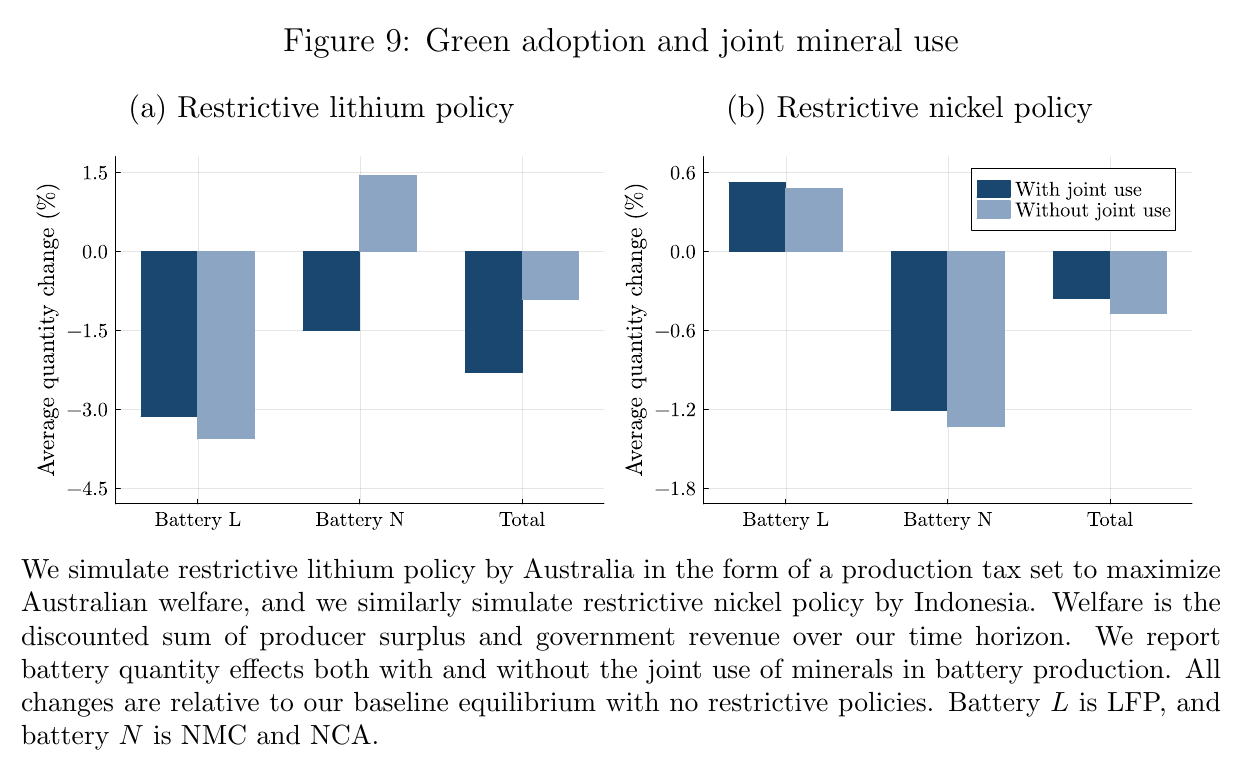
The cleanest picture of the two forces is Figure 9. Let Australia set its welfare-maximizing lithium tax with the recipes as they are and total battery adoption falls 2.3 percent; take lithium out of battery N, so that it is no longer a common input, and the fall is 0.9 percent. Let Indonesia do the same with nickel and the fall is 0.36 percent with joint use against 0.48 without, because the complementarity channel lowers lithium prices and cushions battery L. The paper’s summary: the common-input force is large and hurts adoption, the complementarity force is smaller and helps.
Cartels, and the surprising one
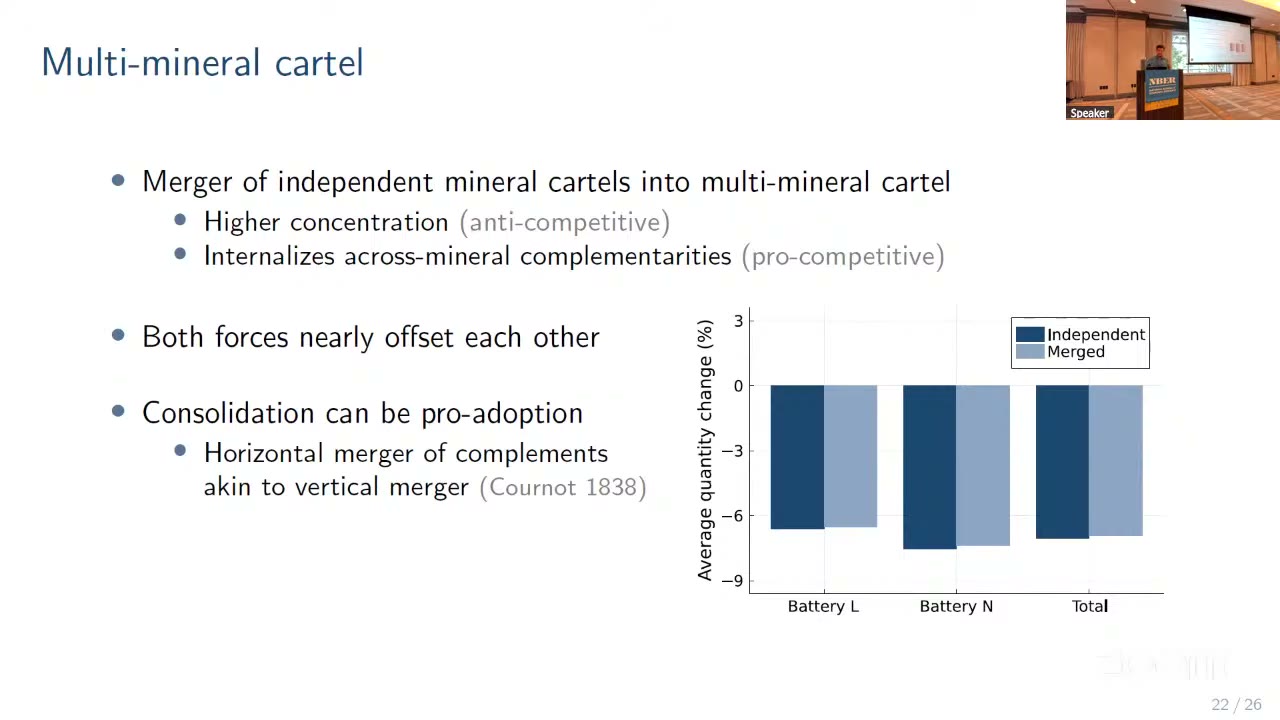
A cartel of substitutes — Australia, then Chile, then Argentina, joining a lithium cartel one at a time — does what cartels do: prices rise progressively, quantities fall, the transition slows. Australia alone raises lithium prices 30 percent and cuts quantity 4 percent; Chile joining more than doubles that; Argentina adds little, and would gain an extra two billion dollars by staying out and free-riding. Consolidation within a mineral is anti-competitive and anti-adoption. Now merge a lithium cartel with a nickel cartel into a single multi-mineral cartel that sets both outputs jointly. Two forces. The merged entity controls more of the battery’s input bill, which pushes prices up. But the separate cartels were each setting prices too high from their joint point of view — the lithium cartel was destroying nickel demand and vice versa, a double marginalization — and the merged entity internalizes that, which pushes prices down. This is Cournot’s (1838) observation about complementary monopolists (the paper cites it), and in the simulation the two forces nearly cancel, with the net effect, if anything, pro-competitive. Consolidation across complements can accelerate the green transition.
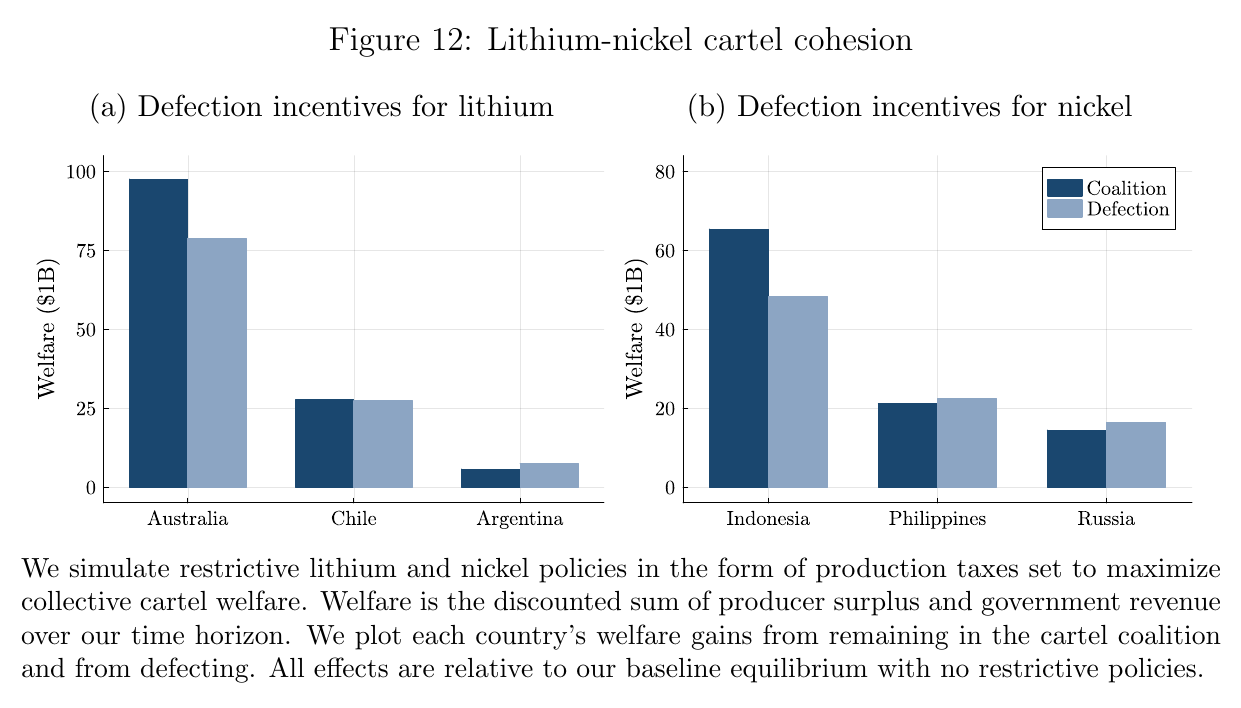
Would such a cartel hold? The paper asks, and the answer is more interesting than the talk’s one-line version of it. The lithium cartel is Australia, Chile and Argentina; the nickel cartel is Indonesia, the Philippines and Russia. Figure 12 computes what each member earns inside the merged cartel and what it would earn by walking out and free-riding on everyone else’s cuts. The two anchors are firmly in: Australia and Indonesia would each lose close to twenty billion dollars of net present value by defecting, because the cartel’s supply cut is mostly their own supply cut and the price rise is mostly theirs to collect. Chile is in but only just, with no transfer needed. Argentina, the Philippines and Russia would each do better outside, by a couple of billion dollars apiece reading the bars — the usual small-member problem. So this is not a cartel that everyone wants to leave. It is a cartel that the two countries that matter want to stay in and the three that matter less want to cheat on, which is, if you think about it, a description of Opec in most decades. (The talk compressed this into “defection incentives for each of the individual members”, which is the version that reached the room.) The authors also said, in the talk, that the merged cartel is better read as a thought experiment about coordination across mineral markets, which brings them to the entity that actually does coordinate across mineral markets.
The one owner who has the whole recipe
There is essentially one owner with mining stakes in all three minerals, and it is China. (The talk placed the mines in the drc and South America; the paper works by owner-country shares instead, and reading Figure 13, Chinese-headquartered firms own about a fifth of world lithium production, an eighth of nickel and two thirds of cobalt.) Horizontal coordination across that portfolio internalizes the complementarity just as a multi-mineral cartel would; vertical coordination with China’s enormous downstream ev industry internalizes the harm that high mineral prices do to Chinese carmakers. Both temper China’s incentive to squeeze upstream. The magnitudes are small — every quantity effect of optimal Chinese policy in Figure 14 is under one percent, and the paper says plainly that modest ownership shares limit the effect and that the direction is the point.
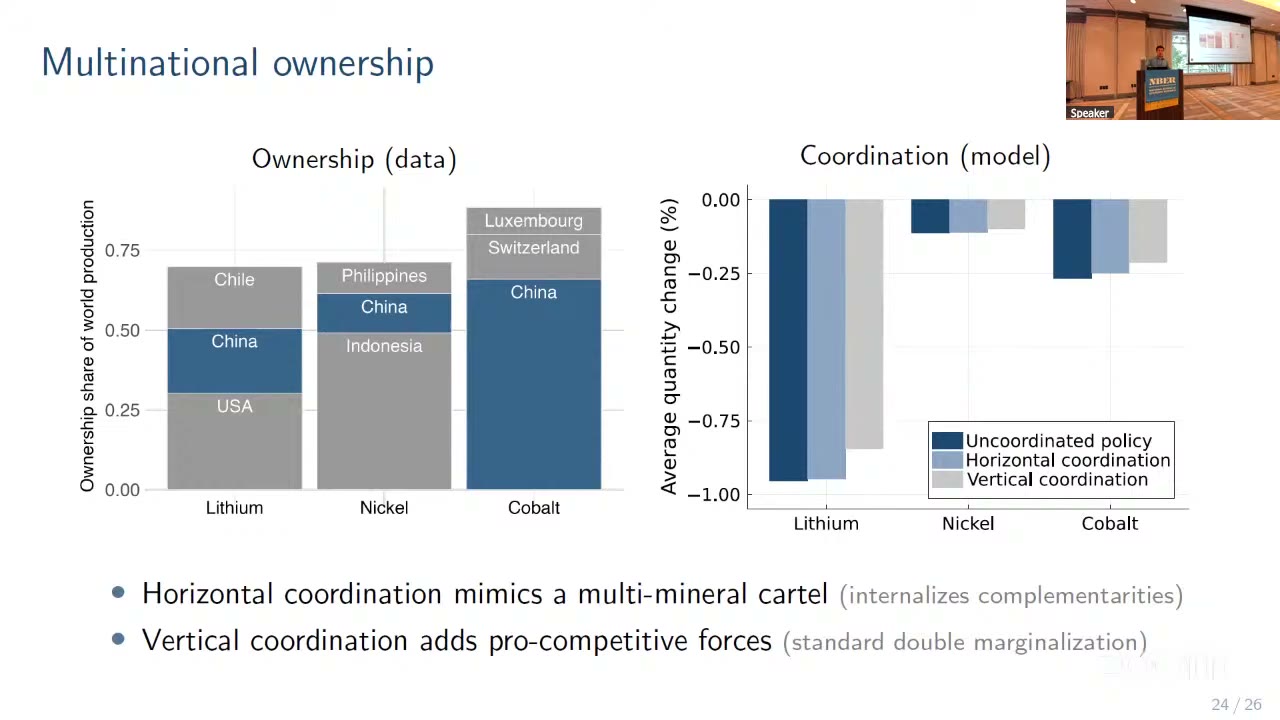
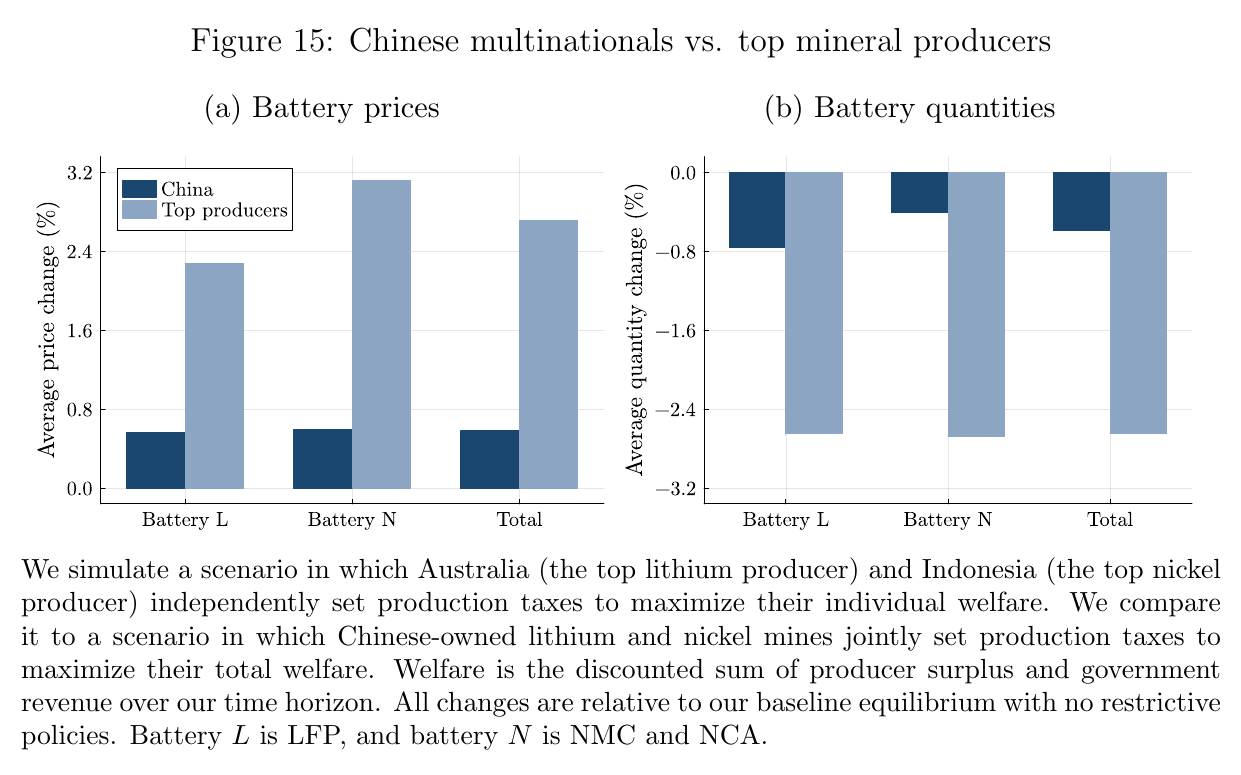
So the paper re-runs the mid-twentieth-century experiment on minerals. The Middle East oil nationalizations transferred control of the fields from Western multinationals to states, and the states formed Opec; the paper’s version transfers control from Chinese multinationals to states — same direction — and asks what happens. The exercise is narrower than the framing. Figure 15 compares a world in which Australia and Indonesia each set their own optimal lithium and nickel taxes with one in which the Chinese-owned lithium and nickel mines set taxes jointly; no drc, no cobalt. Battery prices rise and adoption falls in both. The effects are larger under the sovereigns — roughly 2.7 percent on the total battery price and a 2.6 percent fall in quantity, against about 0.6 percent either way under China, reading off the chart — and the paper gives two reasons, in this order. First, simply, Chinese ownership shares are smaller than Australia’s and Indonesia’s national shares, so there is less to restrict. Second, Chinese policy internalizes complementarity across minerals and the sovereigns do not. Then it hedges: “based on current Chinese ownership shares, resource nationalization may amplify market power.” The talk said “significantly worse”; the paper says “larger” and “may”. The talk’s concluding line was that Chinese multinational presence upstream can be “a positive force for green adoption”. The discussant’s restatement was slightly less diplomatic: the fact that we are all dominated by China is the greatest thing that could happen to us.
What a minerals aficionado says
Laura Alfaro, now at the Inter-American Development Bank and involved in a critical-minerals initiative there (she noted the irony that Costa Rica has tons of insects and no rocks), agreed with the thesis — minerals must be studied as a network of joint use, and this is the right pair of glasses — and then spent most of her time on what the model leaves out of the network, which she thinks biases it toward finding complementarity and toward neutralizing China. Mining is not Snow White with a pickaxe; it is a chemical process with reagents, refining and manufacturing between the ore and the cathode, and in the model the mineral arrives like manna. There is not one lithium: Chilean brine sits in evaporation ponds for two years, is cheap, inelastic in the short run and nearly battery-ready, while Australian hard rock is elastic, expensive, and mostly shipped to China for processing, yet the model clears one global lithium market at one price. There is not one nickel either: Indonesian ore is low-grade and disproportionately goes to stainless steel, not batteries. Lithium is sold mostly on long-term contracts, not a spot market. The midstream — refining, chemicals, cell manufacturing, overwhelmingly Chinese — is a fixed markup that passes mineral shocks straight through to battery prices and cannot exercise market power by assumption. In the paper’s notation (equation 19) a battery’s price is
recipes times mineral prices plus a wedge , recovered from 2024 data and then held fixed through every counterfactual. That is defensible in the data the authors have, she said, but awkward in counterfactuals that rewrite the market structure; the markups may be small because keeping them small is China’s strategic choice, and the question is not whether they are small but whether they can move. The anode is missing: every battery needs graphite, which comes from China, synthetic or not, and chemical substitution does not undo industrial concentration. Recipes change over the sample period and are held fixed. ev demand is exogenous over a 10–15 year horizon, and an assumption that a rise in any input price lowers total battery demand is doing quiet work (the price of Nike goes up, and we all buy fewer shoes). And “restricting supply” means different things in different places — delaying evaporation in Chile, not shipping rock in Australia, not extracting in Indonesia — each with different feasibility, and a country that cuts supply may find China less willing to sell it the reagents it needs. Owning the deposit is not controlling effective supply; a cartel’s problem has never been wanting one but sustaining one, and a footnote that assumes enforcement does not settle that. Her last word, as a macroeconomist: geology is not destiny, and Latin America knows something about resource curses and management.
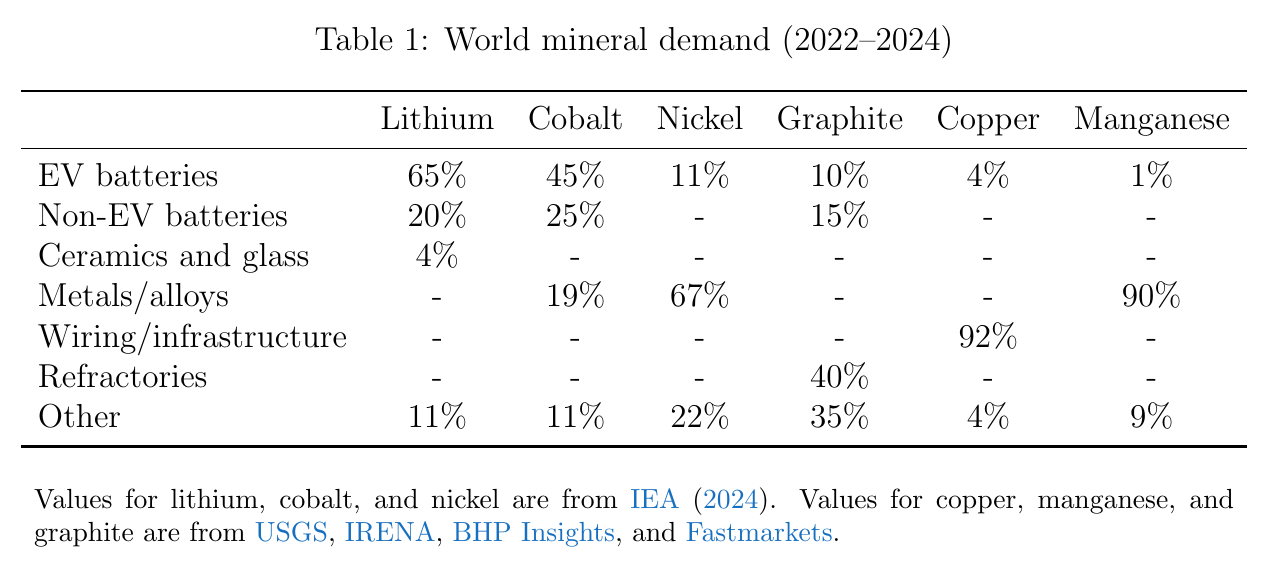
Some of this the paper already answers, mostly in footnotes and appendices, which was itself one of her complaints (the clarifications, she said, were “left as a footnote” rather than internalized). Non-ev demand is in the model, as a linear demand with elasticity −0.1 calibrated to 2024, so the stainless-steel buyers of nickel are there, if inert; and the paper’s Table 1 is candid about the proportions — ev batteries are 65 percent of world lithium demand, 45 percent of cobalt, and only 11 percent of nickel. The fixed midstream wedge is defended by citing Barwick and co-authors’ (2025) estimate of 11 percent average markups in battery manufacturing (142 dollars per kilowatt-hour on costs of 1,286) and by noting that the dominant refiners are vertically integrated into cell-making, which limits refining markups along internal supply chains; this is “the work that has different data than we do” that Elliott mentioned in reply. Graphite gets a footnote: anodes are 13 to 17 percent of cell material cost against 45 to 67 for cathodes, and most graphite is synthetic, so it is treated as a non-mineral input — which does not answer “the synthetic graphite also comes from China”, and is not meant to. Mine lead times are in an appendix, 15 to 25 years in most countries, 29 in the United States, 34 in Zambia, against roughly five for a conventional oil well, which is the paper’s case for treating entry as exogenous. And the enforcement footnote she meant is footnote 19: the cartel exercise checks participation — is each member better off in than out — “taking as given” enforcement within the cartel.
Elliott took the cost-heterogeneity point (the mine-level cost data already allow very different costs by deposit type), agreed the midstream is reduced-form for lack of data, said unpublished counterfactuals in which China responds show “a pretty small effect”, and accepted that “recipe” and Leontief are the same object — a questioner had wondered why the paper cites, in effect, Julia Child rather than Leontief, and Elliott said recipe seemed “a little bit more intuitive” for something that is, after all, a chemical reaction. The chair had called on someone as Steve, and the recording then loses two minutes, so the question survives mainly through the reply: Elliott confirmed he had asked whether the paper could be compared to “a more macro approach, a ces approach”, said the flexible demand system is precisely the point and no such comparison has been done, and, on whether some first-order sufficient statistic could be derived, that “it’s a bit complicated but we will think on that”. The same turn, when the recording resumes, raised supply dynamics — the shale analogy, in which high prices call forth a drilling boom that diversifies geography — and the answer is that mines take “well over a decade” to build; the pipeline of mines under construction is in the model, but as an exogenous object. A questioner called on as John raised demand-side dynamics and stockpiling; stockpiling, Elliott said, is limited by the chemical stability of the minerals, and battery technologies are taken as given, with industry expenditure forecasts disciplining the future. The chair closed by saying the paper’s virtue is taking “the micro bottlenecks a lot more seriously” and getting “pretty different conclusions from what you would just do at a million mile high”, and offered two directions toward the geopolitics the paper is, in the chair’s phrase, “almost there” on: with complements, an exporter might crank export controls on the one input it controls not for the direct effect but for the indirect one elsewhere in the chain, and a would-be hegemon could minimize the cost of acquiring leverage by buying the right few links rather than many — the complementarity being what converts a small stake into a large throttle. Elliott: “you highlight exactly the point that we’re really trying to hone in on.”
So the finding is that the next energy cartel, if there is one, will not behave like the last one, because a battery is a recipe and a cartel of recipe ingredients is partly at war with itself — though the two members who would run it have every reason to stay. And the twist is that the one actor who has already assembled the whole recipe has, partly for that reason and partly because it owns less of each ingredient than the headline suggests, less incentive to spoil it. Whether that is reassuring depends on how long you expect the recipe, the ownership shares, and the incentives to stay fixed.