Notes on:
Liquidity, Debt Denomination, and Currency Dominance
NBER Working Paper 30984; forthcoming, Journal of Finance
1 November 2023
dominant currency · international monetary system · liquidity · debt denomination · search frictions · safe assets
Paper · doi · PDF
Made with AI: Opus 5.5 (reading and writing), GPT 6.1-Sol (reading), Fable 5.2 (adjudication), GPT 6-Astra (verification)
Antonio Coppola, Arvind Krishnamurthy and Chenzi Xu. Version read: the November 2023 draft. The paper also circulates as nber Working Paper 30984 (February 2023, revised March 2024), and the authors list it as forthcoming in the Journal of Finance. No talk video was found, so this digest works from the pdf alone.
Dollar dominance, in Coppola, Krishnamurthy and Xu (2023), is a fact about where you can find something to pay with. It is not a fact about who has the biggest economy, who invoices the most trade, or whose currency is the best hedge. You borrow in dollars because when your bond comes due you will have to hand over dollars, or something that extinguishes a dollar claim, and the dollar money market is the place in the world where that something is easiest to find. Everyone else borrows in dollars for the same reason. That makes the market thicker, and a thicker market is an even better reason to borrow in dollars. The paper’s job is to make that loop precise, to say what starts it and what keeps it going, and to tell four centuries of history (florin, sterling, dollar, and a renminbi that has not arrived) as runs of the same loop.
The settlement problem
The authors open with a farmer who could, in principle, denominate debt in bushels of wheat. A wheat farmer might. A manufacturer would not, because at maturity it would have to go and buy wheat, and if the wheat market is thin that is expensive. Denomination here means what you must deliver to extinguish the debt. It is a settlement concept, not an exposure concept. Most of the international-currency literature (Maggiori 2017; Farhi and Maggiori 2018) works through payoff risk and risk sharing. This paper drops payoff risk entirely: everyone is risk neutral and every bond is safe.
You are a firm in country B with revenue in B’s currency. At you borrow a bond of face value 1, due at , and you pick its currency. Issuing in A’s currency costs you a firm-specific , which stands in for mismatch, hedging and access costs. With probability your project pays early, at , and you would like to park that money in a financial asset that carries it to and retires your debt. So you search for an investor holding a bond in your currency of denomination. If you find one, the two of you split a surplus of (the investor discounts at and will sell for anything above ). If you do not find one, you do not default. You store your profits at zero return and repay anyway. That detail matters later. The baseline gain from liquidity is a trading surplus, not a rescue.
Footnote 7 is where the paper does the most work in the fewest words. A B-firm could issue in B, convert its goods into A at , buy an A bond in the deep A market, and convert back at . The authors assume those two fx legs carry currency-risk costs that make the route never optimal. Everything below depends on settlement having to happen in the market of the debt’s own denomination, and the fx market’s existence is assumed not to undo that.
The thick-market externality
Matching in currency ’s money market, eq. (5), is
where is the number of meetings, the mass of early firms looking for a settlement asset (liquidity demanders), the mass of bondholders (liquidity suppliers), the market’s matching efficiency, and the returns-to-scale parameter.
The condition is the whole paper. Double both sides and matches more than double. That is a thick-market externality in the style of Diamond (1982), which the authors call “at the heart of our theory.” With there is also congestion: add mass to one side alone and that side’s own matching probability falls.
Issuing in currency then pays off twice, eq. (11):
where is firm ’s gain from issuing in before the cost , is the investor’s discount factor, the probability of early profits, and the firm’s share of the trading surplus (set to 1/2 from then on).
The first bracketed term is a convenience yield. Your bond sells above its illiquid price because someone else can use it to settle, and that term grows with the demanders . The second term is the settlement benefit: if you turn out early, you can find a bond. That one grows with the suppliers . A B-firm that switches to A shows up on both sides of A’s market. It is an early firm with probability , and its bond is a settlement asset for others. In the illustrations that unambiguously raises the payoff to everyone else issuing in A and lowers it in B. For general the supplier channel always helps, but the demander channel helps only under an extra condition, so a very large government float with can make more entry congest rather than help. The complementarity, in other words, is a result with a caveat attached in general.
Many equilibria, and what picks one
Complementarity plus heterogeneous costs gives multiplicity. B-firms below a cost threshold issue in A, and if any B-firms go to A, no A-firm goes to B.
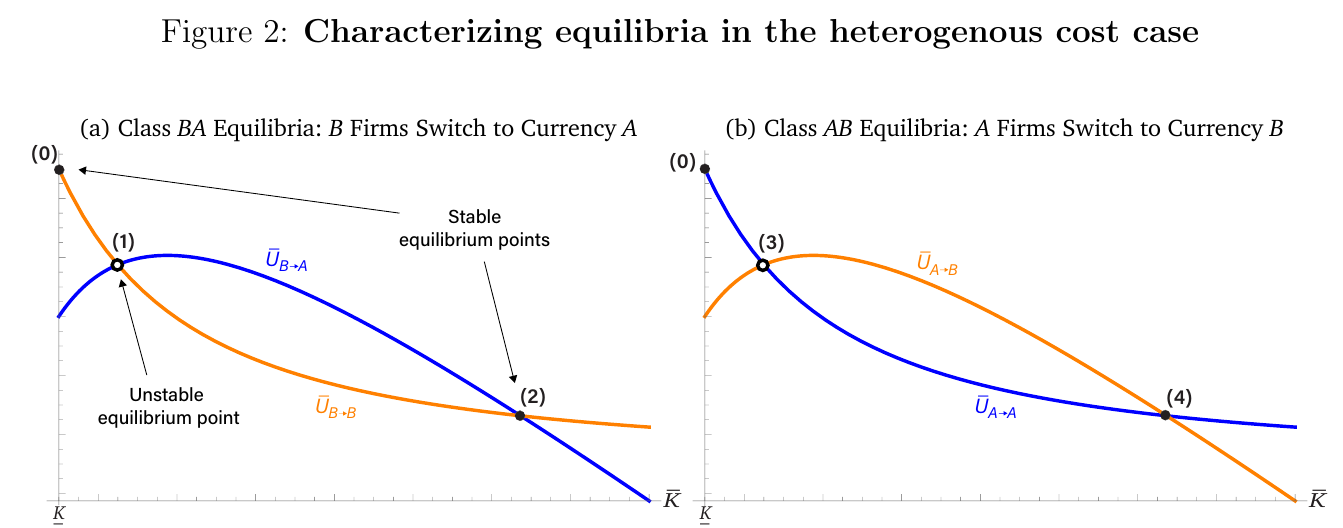
With symmetric fundamentals the picture has five equilibria. Point 0 (nobody switches) is stable, the two low-entry points are unstable, and the two high-entry points, one dominant in each direction, are stable. Because costs are heterogeneous, even the dominant equilibria are interior: high-cost firms stay home, and several currencies coexist with one clearly on top. That is a nicer fit to Eichengreen, Mehl, and Chitu (2017) than a winner-takes-all corner. “Stable” here means stable under a posited adjustment process inside . It is not a dynamic model, and it does not tell you which equilibrium you are in.
Asymmetric fundamentals do the selecting. In an interior equilibrium dominated by A, the entry threshold rises with A’s government bond supply and with A’s matching efficiency for any in the allowed range. A large enough rise in wipes out every equilibrium in which B dominates, and also the no-entry and low-entry ones, so that only high-entry A dominance is left. A’s own private sector also raises entry into A, but the paper states that result under a further parameter restriction, offered as sufficient. B’s private size has an ambiguous effect that turns positive once entry is already high.
The one surprising thing: size can work for the incumbent
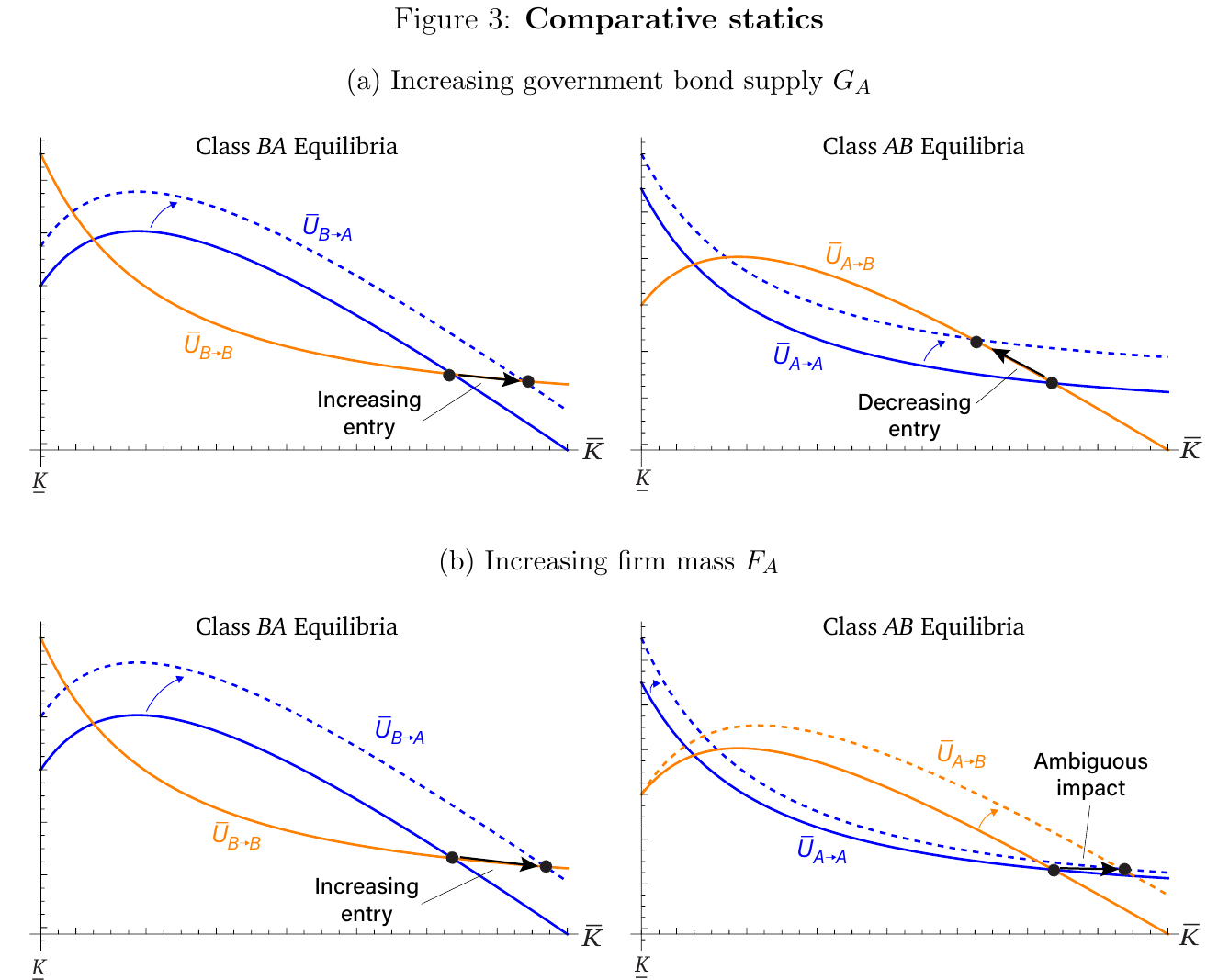
Look at the bottom-right panel. B is the dominant currency and A is the challenger, and A’s private sector grows. You might expect that to pull issuance toward A. In the case drawn, it pushes more A-firms into B, because part of the new A mass issues in the incumbent’s currency and thickens the incumbent’s market. The figure is honest enough to label the effect “Ambiguous impact,” and the sign does depend on how high entry already is. The top row has no such ambiguity: more raises entry into A when A leads and lowers entry into B when B leads. The authors conclude that growing the private sector “is not guaranteed to facilitate the internationalization of its currency, and in fact can be counterproductive,” while safe government debt is “a more reliable instrument” (Coppola, Krishnamurthy, and Xu 2023, 26).
Note what is and is not being claimed. Size is not irrelevant. In the ba panel more does help, and the history section says size alone was “not sufficient,” not that it was useless. What is claimed is that private economic mass is a two-edged input, and the reliable seed of dominance is : “the supply of money market instruments that depends on the government’s commitment to maintain their value.” That definition is broad on purpose. For Amsterdam, is the specie-backed bank florin together with the City’s promise not to seize the specie. For Britain after the Napoleonic Wars it is a debt stock the paper puts near 200 percent of gdp, made safe by tax capacity. Spain had plenty of nominal debt and, given its default record, very little .
The history is told to fit. Spain was the largest economy of the seventeenth century, the real de ocho the most common coin in the world, and Spanish trade, the authors say, a factor of two to six times Dutch trade. The unit everyone chose was nonetheless the florin, which existed only on the Bank of Amsterdam’s ledgers (founded 1609) and settled by free account transfer. Large bills had to settle at the Bank, which seeded the network by mandate. The agio of bank florin over current guilders sat “steadily around 4.5 to 5%” for most of two centuries (Van Dillen 1934), which the paper reads as partly a liquidity premium. When a 1683 repo-style receipt facility widened what could be turned into florin, balances roughly doubled from about eight to sixteen million (Quinn and Roberds 2014), though the window quoted runs from the mid-seventeenth century, so this is suggestive rather than a clean estimate. The end came through : secret loans to the near-failed voc, the French invasion of 1795, and an agio that fell to minus 14 percent, even though the paper notes the ultimate default rate on the florin was low. The us overtook the British Empire in gdp in 1901 and American firms kept borrowing in sterling in London until after 1913, when the Fed pooled regional markets. China today is large , small .
Who crowds whom
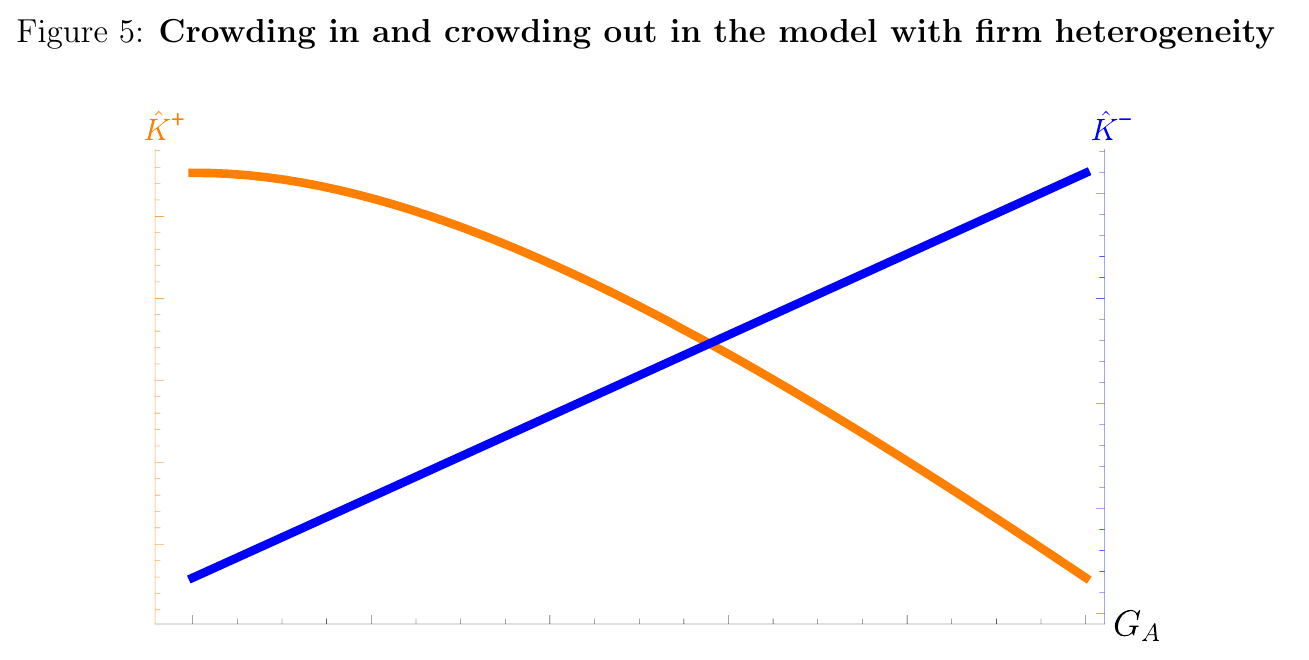
Split B’s firms into pure suppliers, safe issuers like KfW that never need to settle and want only the convenience yield, and pure demanders, whose bonds cannot be resold in the money market and who want only settlement. (“Risky” here means non-resaleable. There is no default process.) Their entry decisions are complements. In the Figure 5 example, more government debt in A crowds out the safe private issuers, who now compete with Treasuries for the convenience yield, and crowds in the risky ones, who get a thicker market to settle in. In convenience-yield-only models such as Krishnamurthy and Vissing-Jorgensen (2015) or Gopinath and Stein (2021), government debt only crowds out. This is one parameterisation with , and the crowding-out half needs . It is still a nice testable prediction. A related point: can lower A’s convenience yield, as in Krishnamurthy and Vissing-Jorgensen (2012), while raising entry into A. So the dominant currency can carry the lower convenience yield and still dominate through the settlement channel. That squares the theory with Diamond and Van Tassel (2021).
Entrenchment, welfare, and swap lines
Once a currency dominates, its sovereign has a stronger marginal incentive to add than the challenger has (Proposition 6). Marginal seigniorage is higher in the leader. The challenger’s extra liquidity also does nothing for its own firms that have already left. The conditions are worth reading. The result needs an interior stable equilibrium, a higher convenience yield in A as a premise, inframarginal seigniorage held fixed, and entry above a threshold, and the proof is a limit argument. It compares incentives in a one-shot model. The chain from military to fiscal capacity to more is narrative around the proposition, not inside it.
The welfare results are all at . The global planner wants more entry into the dominant currency than any stable equilibrium delivers, so A behaves like a natural monopolist whose market is too small. Under condition (43), roughly when B’s private borrowing is large relative to B’s own , the planner values extra more than A’s own sovereign does. That gives the paper its Bretton Woods reading: concentrate the commitment device in the United States, financed by the rest of the world. The paper’s answer to Triffin (1978) is “more liquidity coordination in the form of transfers of commitment (i.e., gold) to the United States.” It supports this with the claim, which it attributes to Monnet and Puy (2020), that the us held more than 90 percent of the world’s gold reserves throughout the period. With aggregate risk, what matters is the covariance of A’s liquidity supply with liquidity demand. Swap lines and discount windows, which expand supply exactly when demand spikes, make A more attractive. A sovereign whose debt gets risky in bad states makes it less so.
Finance, not trade
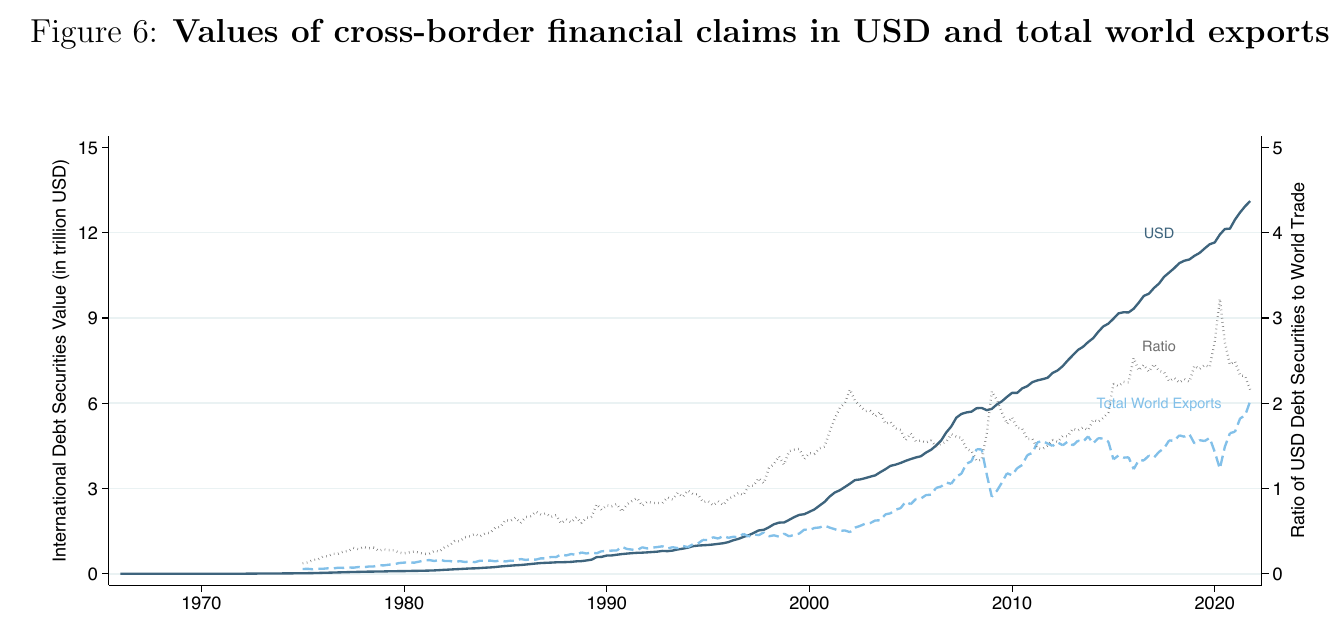
Trade enters as a complement, not the seed. Foreign-currency invoicing lowers , and endogenous invoicing “steps outside our formal analysis.” Figure 6 is the paper’s only modern data exhibit. The usd line climbs to roughly 13 trillion by 2022, and the text puts the ratio to exports at two on average over twenty years, or five-fold after adjusting for the roughly 40 percent of trade invoiced in dollars. Three caveats travel with it. The ratio divides a debt stock by quarterly exports, so it is not a comparison of annual flows. The axis and notes say “debt securities” while the body text calls the series “cross-border bank liabilities.” And no source is given. The sterling-era version of the point is cleaner as narrative: the paper dates sterling dominance to the 1820s sovereign-debt boom, before the mid-century trade surge, and cites Xu (2022) for sterling liquidity underwriting 90 percent of world trade when Britain was 50 percent of it.
Reader’s objections
No discussant text is available, so these are a reader’s. The first is footnote 7. The fx market is the deepest market in the world, and a B-firm issuing in A already bears mismatch through . Why is “convert, settle in A, convert back” strictly worse? The channel stands on that assumption. Second, the modelled gain is a trading surplus for a firm that would have repaid anyway. Rollover risk is described in words but not solved, and it is unclear how much real dollar borrowing reflects the surplus rather than funding stress or dealer intermediation. Third, across a currency’s whole money market is assumed, not measured. The otc evidence the paper cites supports search frictions, not increasing returns across currency pools. Fourth, is elastic. It covers ledger money, legal-tender notes, fiscal capacity and gold concentration, and with no cross-currency measure of at any date, every transition can be read as a shock after the fact. Relatedly, safe float, settlement mandates, empire, trade and credibility move together in every episode, so the narratives fit the mechanism without separating it from alternatives. Fifth, equilibrium selection under near-symmetry is not determined, and the numerical comparative statics pick the highest-entry branch. Sixth, the welfare criterion leaves out the costly spillovers from global dollar mismatch that the conclusion itself acknowledges, which is a lot to omit from a recommendation to subsidise entry into the dominant currency. And the crowding prediction (does Treasury supply raise risky issuers’ dollar issuance?) is the obvious test, and it is not run.
Still, the paper’s sharpest line is the one it does not quite write. If you want your currency to rule the world, a larger export sector may help or may hand business to the incumbent. A deep, credible pile of Treasury bills helps in every equilibrium the paper draws.