Notes on:
Startups in Africa
NBER Working Paper 35261
28 July 2026
development · entrepreneurship · finance
Talk · Paper · PDF · Transcript
Written by Fable 5
Part of NBER Summer Institute 2026 — Development Economics
Emanuele Colonnelli (Chicago Booth), Marcio Cruz and Mariana Pereira-López (World Bank), Tommaso Porzio (Columbia) and Chun Zhao (Stanford), presented by Colonnelli as a nine-minute lightning talk at nber Summer Institute Development Economics, July 28, 2026. Paper: bfi Working Paper 2026-77 / nber wp 35261. Timestamps refer to the session video.
Development economics has spent decades studying microenterprises — the street vendor, the two-person workshop — while an entire policy apparatus (governments, development banks, donor funds) has been pouring enthusiasm and money into something the field knows almost nothing about: high-growth startups, the companies that are supposed to become the future employers of a continent whose workforce is about to double. This paper is a first systematic attempt to establish the facts, and the facts turn out to be pointed.
The data assembly is the heavy lifting. On the “early-stage” side: a continent-wide survey-cum-experiment run in two rounds (2023 and 2025) with young companies aiming to grow — at least two full-time employees, a stated growth ambition — recruited with what Colonnelli describes as an unusually strong response rate for this population. On the “established” side: venture capital deal records combining the standard global databases with counterpart data, plus hand-collected founder and employee histories scraped from LinkedIn and company websites. Geographically the sector is extremely concentrated: four cities — Cairo, Lagos, Nairobi, Cape Town — account for a disproportionate share of everything.
Fact one is about what startups want, and the method is the fun part. Rather than ask founders what financing they’d like (cheap talk), the team ran an incentive-compatible resume-audit-style experiment — “without deception” — in partnership with the ifc, the most recognized investor brand on the continent: entrepreneurs rated 10–15 randomized investor/investment-opportunity profiles (debt vs. equity, $100k vs. more, Italian vs. Nigerian investor, mentorship attached or not) under the credible promise that ratings would feed real matching. The result is a massive revealed preference for equity. Founders care about deal terms; they are indifferent to the investor’s nationality (“entrepreneurs could not care less” about foreign versus local, despite that distinction dominating the policy debate); they assign no value to bundled mentorship. What equity proxies for, the authors argue, is flexible capital from someone with skin in the game.
Fact two is about what the market supplies, which is nearly the opposite.
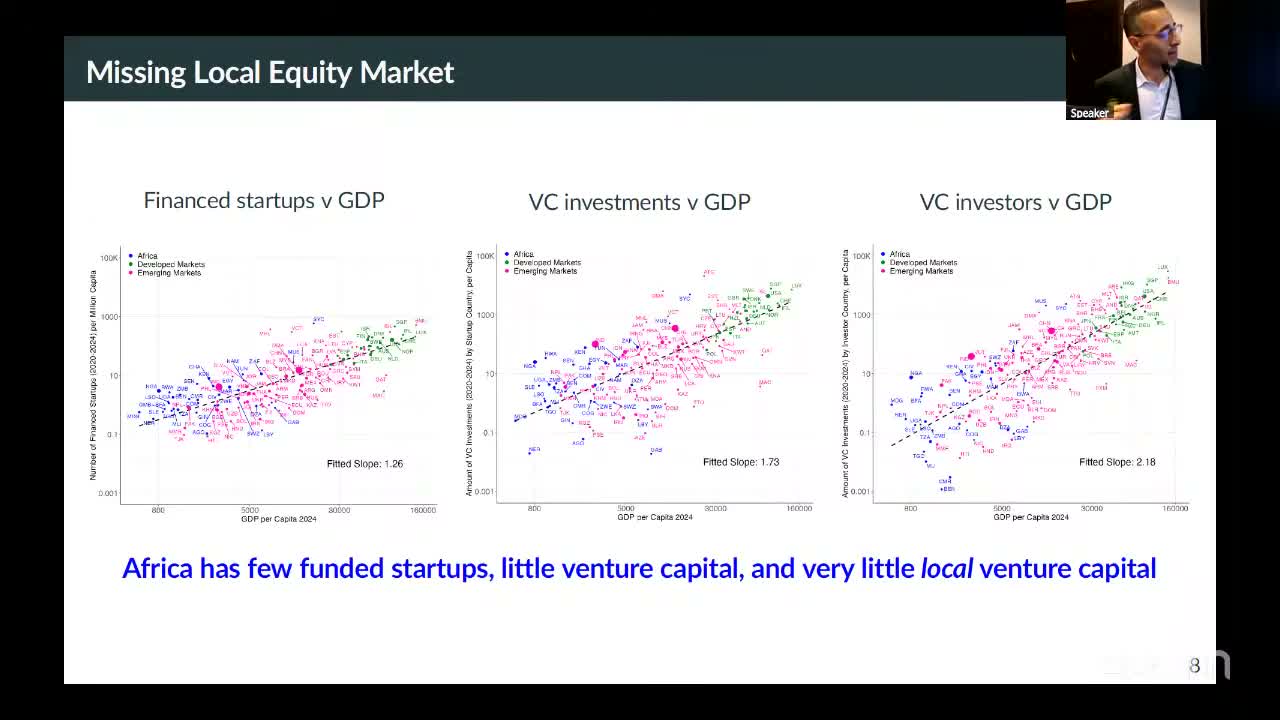
Africa has few funded startups relative to gdp, little venture capital, and almost no local venture capital — most funding comes from outside the continent, far more than in comparable emerging markets. And the foreign capital goes to foreign-looking founders: about two-thirds of vc-funded entrepreneurs studied or worked abroad, and — from the team’s painstaking classification of LinkedIn photos, since nationality is unobservable — roughly half the capital goes to white entrepreneurs, a share exceeding other emerging and developed markets. The comparison with India is the sharpest: India has plenty of foreign-educated founders but overwhelmingly local employees; African startups are foreign at the founder layer and the employee layer. It is, in the paper’s phrase, a very foreign ecosystem.
The last section asks why, with a simple matching model of entrepreneurs and investors — preferences, differential returns, connections, entry and capital wedges. The experiment itself disciplines the model by ruling out the preference channel (founders demonstrably don’t prefer foreign money). What carries the weight is connections: capital from a given region flows disproportionately to entrepreneurs who studied or worked in that region. Recovering the wedges allows counterfactuals of the form “give African-educated founders the us-investor connections of a us-educated founder,” which the authors frame modestly as telling policymakers where to look — the binding constraint appears to be network access to capital, not the founders’ willingness to take it, and it distorts both the composition of who gets funded and the aggregate size of the sector.
The concluding irony is one the paper is too disciplined to state directly, so the reader may have it here: an ecosystem financed by development-minded foreign investors, in the name of building African entrepreneurship, currently allocates half its capital to white founders and most of it to people whose qualifying credential is having left. The founders themselves, when asked incentive-compatibly, don’t care where the money comes from. The money, it turns out, cares a great deal where the founders have been.