Notes on:
The Consequences of Faculty Sexual Misconduct
NBER Working Paper 34456
28 July 2026
gender · education · higher education · United States
Talk · Paper · PDF · Transcript
Written by Opus 5
Part of NBER Summer Institute 2026 — Gender in the Economy
Sarah R. Cohodes and Katherine B. Leu (University of Michigan) — “The Consequences of Faculty Sexual Misconduct,” presented by Cohodes at the nber Summer Institute, Gender in the Economy, on 28 July 2026 (Day 1, afternoon). No discussant; questions throughout. Written from nber Working Paper 34456, November 2025, revised July 2026.
Cohodes opened by noting that people in the room had likely experienced faculty sexual misconduct, and that she would not be describing specifics of any incident. The same applies here.
The paper opens with a quotation from Jennifer Weiner (2019), and it is the whole argument compressed:
When a man gets #MeToo’d… a predictable cry emerges from the predictable corners of the internet: What about his art? What about the jokes he’ll never tell; what about the books he won’t write?… These fans don’t ask about the women who’ve been sidelined or silenced or who have abandoned their chosen fields.
There is by now a small literature on what happens to a perpetrator — he is less likely to be employed (Jogani and Ruiz Sanchez 2023; Shin and Park 2026), his work is cited less (Widmann et al. 2025) — and a literature on what happens to an institution, which finds a dip in applications that recovers, and no change in enrollment (Rooney and Smith 2019). One paper on Title IX cases finds applications actually rise, on an any-press-is-good-press interpretation (Lindo et al. 2019).
Cohodes’s point is that measuring at the institution level misses the margin students actually have. A student who learns that the professor in her field did this does not have to leave the university. She can leave the field. And that response is invisible to any design that counts applications.
The data problem, and an unusual solution
The outcome side is easy: ipeds gives degree completions by institution, field and gender from the 1980s to the present, linkable to the College Scorecard for major-specific expected earnings. (Cohodes noted in passing that ipeds “has been produced for many, many years and hopefully will be continued to be produced, but you never know,” which got the laugh it deserved.)
The treatment side is the Academic Sexual Misconduct Database (Libarkin 2025), begun by Julie Libarkin at Michigan State. It started as a catalogue of anecdotes during #MeToo and became — probably for liability reasons — a systematic search protocol over publicly available sources. Inclusion requires a person in a supervisory role, a qualifying category of conduct, and qualifying evidence: a finding of responsibility, departure from the job following a report, substantiating electronic communications, a court finding or settlement, or the perpetrator’s death.
The authors then re-searched every case, because the asmd records the resolution year and what they needed was the year the case first became publicly known. They also coded the incident date where discernible, the gender of perpetrator and victim, whether the victim was a student, and how much news coverage followed.
The resulting descriptives are worth stating plainly. Over 96 percent of perpetrators are men; 89 percent of victims are women, with 6.6 percent male victims. Fifty-seven percent of cases have multiple reported victims — and the 43 percent with one identified victim are, as Cohodes put it, very likely to have others. About 17 percent involve clustered incidents within a single department. The most common outcome for a perpetrator is that he is no longer employed, which in practice frequently means a departure and a non-disclosure agreement.
Which majors? Two things predict incidents: being a large major (biology, English, psychology — many humans, many interactions) and involving sustained one-on-one work outside a classroom (theatre, music, anthropology — the practice room, the field site). Economics has 11 incidents, which Cohodes placed, drily, “in the middle of the field.”
The estimand is deliberately narrow and the paper is careful about it: this is the effect of a public report, not of misconduct. Students can only respond to what they know. Comparison departments therefore contain both departments with no misconduct and departments with misconduct nobody has reported, which biases toward zero.
Students leave the field
The design is a stacked event study — one dataset per report, each with its own field and timing, pooled, with institution×dataset and year×dataset fixed effects, weighted by each stack’s share of treated observations, errors clustered at institution×field. That machinery exists to dodge the staggered-adoption problems everyone has spent five years learning about.
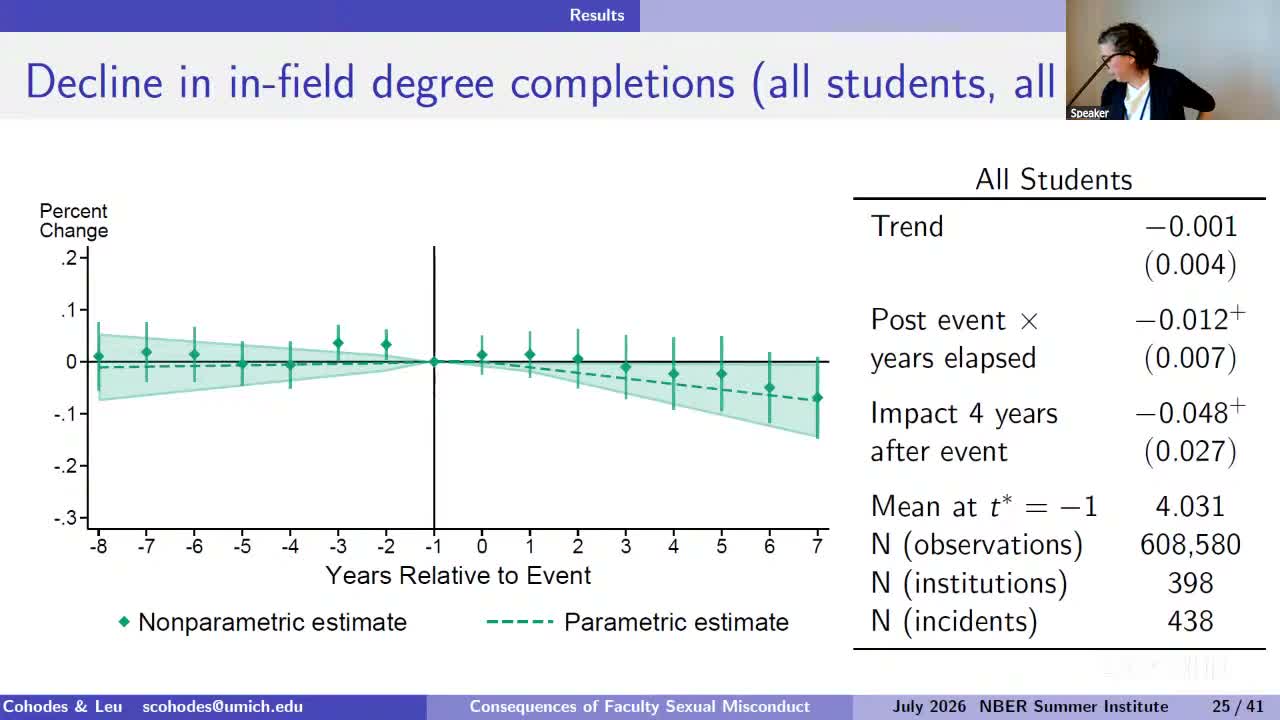
A public report cuts in-field degree completion by 4.8 percent four years on, with a downward drift of about 1.2 percent per year. Split by period, though, the whole effect is recent. Reports from 1983 to 2014 produce nothing — flat coefficients, no cumulative impact. Reports from 2015 onward produce a 9.2 percent decline: 9.0 percent for women, 8.6 percent for men, all significant at 5 percent.
That men respond nearly as much as women is the first genuinely surprising thing here. This is not only women avoiding a field where they might be targeted. It is students of both sexes leaving a department that has been publicly revealed as a place where this happens.
Why only after 2015? The paper cannot say definitively, and says so. Two candidates are tested: whether recent incidents carry more serious consequences for perpetrators (barely — 70 percent versus 66 percent classed as serious) and whether they get more coverage (yes — 56 percent of recent reports have high news coverage against 27 percent of early ones).
The whisper-network test, which cuts the other way
The obvious objection is anticipation: if rumours circulate before a story breaks, students respond early and the event study is misdated. The authors can test this, because they can date the underlying incident for about 87 percent of cases. Eight percent occurred in the same year as the public report, 21 percent one year prior, 26 percent two or three years prior.
Re-run the event study using the incident year rather than the report year and there is nothing.
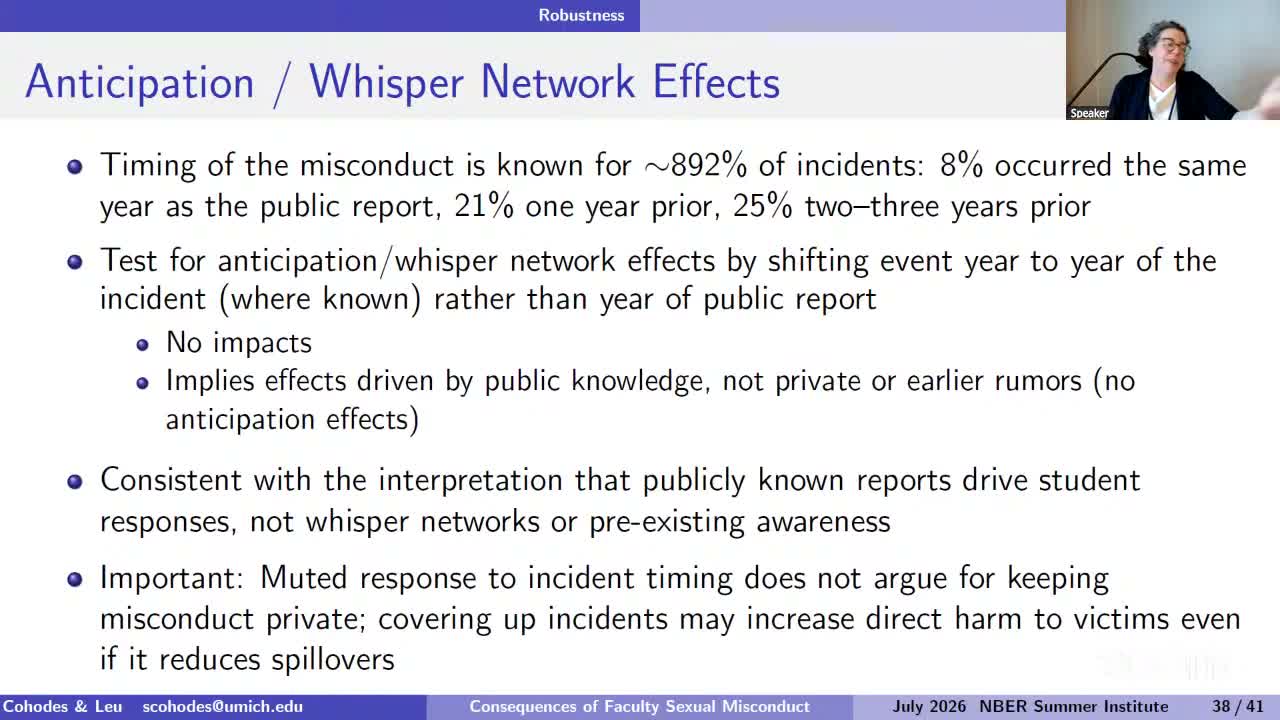
So the response is driven by public knowledge, not by private rumour. And Cohodes drew the inference before anyone could draw the wrong one: this is emphatically not an argument for keeping misconduct quiet. Covering up an incident may increase the direct harm to victims even as it suppresses the spillover onto enrollment. The paper’s own logic makes the point sharper — the estimate is the cost of the report, so a reader tempted to read it as the cost of transparency has to weigh it against a harm this design never measures.
Where the students go, and why it doesn’t pay
Students exit majors dominated by men and move toward majors dominated by women.
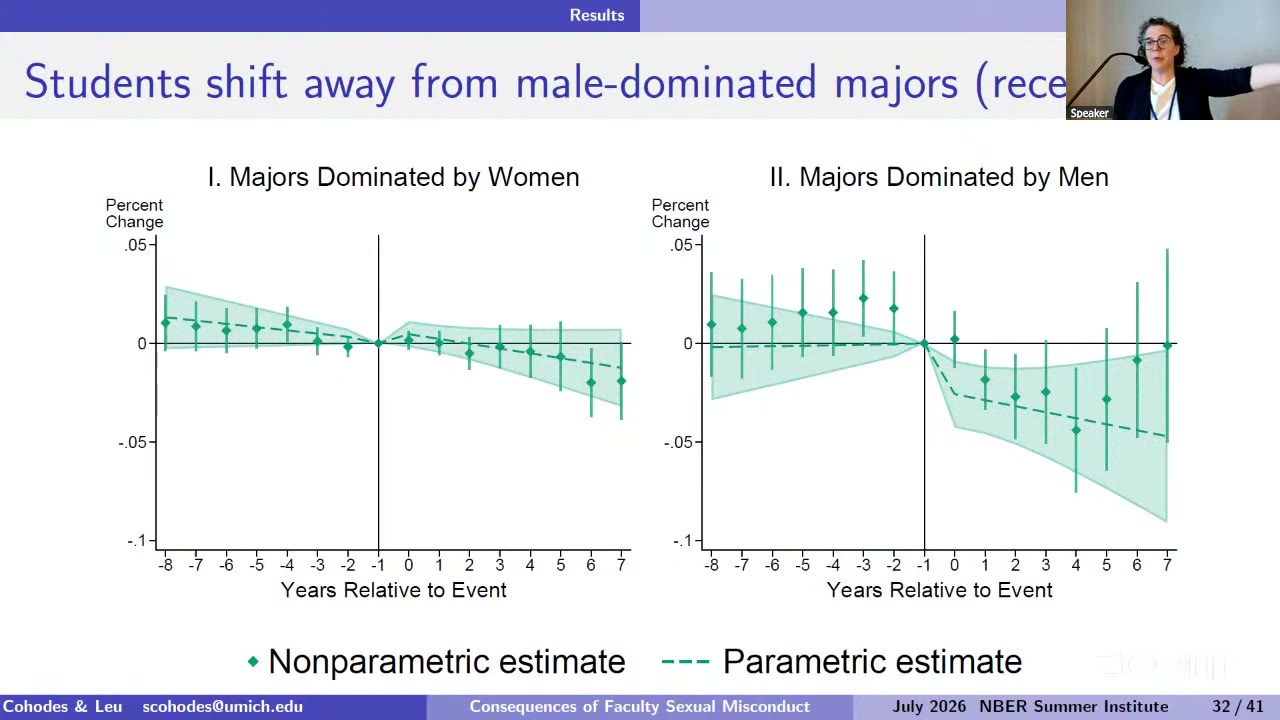
Which sounds like it should be expensive, since male-dominated majors are the high-earning ones. It isn’t, much: predicted earnings barely move, because the shift runs away from high-earning and low-earning majors at once. The male-dominated set contains computer science and engineering, but the female-dominated set contains nursing, and the departures are not sorted by pay.
That is a genuinely awkward result for the paper’s own framing. If you were hoping to price the loss in dollars, you can’t — the students who leave are not, on average, giving up income. The loss is compositional: fewer people in the field, and a field that gets more segregated by gender. What Weiner’s quotation is about is the documentaries we’ll never see, and this paper can tell you the pipeline shrank by 9 percent without telling you what it was worth.
The objections
Two from the floor stuck. Anna (per the chair) asked whether reporting internalizes departmental culture — in a department where you expect not to be believed, you don’t report — which could flip the whole thing, since the departments that appear clean might be the worst. Cohodes conceded the selection and pointed to matching on institution type and to within-major identification, but the point stands as a limit on interpretation, not a solved problem.
The second was procedural and sharper: after a certain period these are Title IX cases, adjudicated by the university rather than the department, so the department is not the natural unit. Cohodes’s answer — that they are not all Title IX cases, but many are — is true and doesn’t fully dispose of it. The paper’s defence is that the student’s response is organised around the field, whoever adjudicates. Coaches and administrators are excluded from the sample for exactly this reason: they cannot be assigned to an academic field. Cohodes noted, twice, that her own institution has not distinguished itself in that category.
(A footnote that is really the paper’s subject. The most common resolution is a quiet departure with a non-disclosure agreement — an arrangement designed to make sure no report ever becomes public. This paper measures what happens when one does, and finds a 9 percent hole in a department’s graduating class four years later. It cannot measure what the ndas cost, and that is not a gap in the data so much as the point of the ndas.)