Notes on:
Putting Economics Back Into Geoeconomics
NBER Macroeconomics Annual
2026
geoeconomics · power · measurement · survey
doi · PDF · Transcript
Made with AI: Fable 5 (reading), Opus 5 (writing)
Christopher Clayton (Yale som), Matteo Maggiori (Stanford gsb), Jesse Schreger (Columbia). Published as “Putting Economics Back into Geoeconomics,” nber Macroeconomics Annual 40 (2026), pp. 23–87; read here in the April 2025 nber working paper, which still carries the note that it is in preparation for the volume. Talk: Maggiori’s PhD lecture at Stanford Graduate School of Business, posted 18 August 2026 — two hours twenty, no discussant, students interrupting throughout. The first hour and forty minutes of the lecture cover this paper together with the two underlying theory papers it builds on, cms(a) “A Framework for Geoeconomics” and cms(b) “A Theory of Economic Coercion and Fragmentation”; slide images are frames from the lecture, and equations are transcribed from the working paper.
A dependency is a number
Everyone in policy has spent three years saying “strategic sector,” “chokepoint,” “economic security,” “weaponized interdependence,” and “de-risking,” and almost nobody has said what any of them mean. This is not an accident of vocabulary. It is very convenient for a widget manufacturer that “strategic” has no definition, because in the absence of one, every widget is strategic and every widget deserves a subsidy.
So start somewhere small. You buy inputs. You buy some of them from a country that would like you to do something you would rather not do — vote a certain way at the un, stop selling lithography machines to Shenzhen, stop financing Iranian trade. That country threatens to stop selling to you. How much does that threat hurt?
The answer turns out to be one line, and it is a line every trade economist already knows in a different costume. Write for the share of country n’s expenditure that falls on good i, and for the total share that falls on the goods the hegemon is threatening to cut off. Let be the elasticity of substitution across inputs and the returns to scale. Then the loss the threat can inflict, if carried out, is exactly (eq. 5 in the paper):
That is it. Two things determine how much a great power can hurt you: how much of your spending goes through it, and how easily you can buy the same thing somewhere else. The functional form is the standard cost-of-autarky calculation from Arkolakis, Costinot and Rodríguez-Clare, pointed at a subset of goods rather than at all trade. “Chokepoint” means near one and near one. “Strategic sector” means a sector where a threat moves that expression a lot. Those are now sentences with truth values.
The index that forgot what it was for
The pleasing part is that this is a restoration, not an invention. Albert Hirschman wrote National Power and the Structure of Foreign Trade (1945) in 1941–42 and published it in 1945 at Berkeley, where he had arrived on a fellowship after escaping occupied Europe, about how Nazi Germany used trade with its neighbouring countries to buy political compliance. In it he proposed measuring a country’s exposure by summing the squared shares of its trading partners. That statistic escaped, went to work in industrial organization, and is now taught to every first-year student as the Herfindahl–Hirschman index, a measure of market concentration among firms. Maggiori’s complaint, which is also the paper’s opening, is that economics reduced power to markup power and lost the rest.
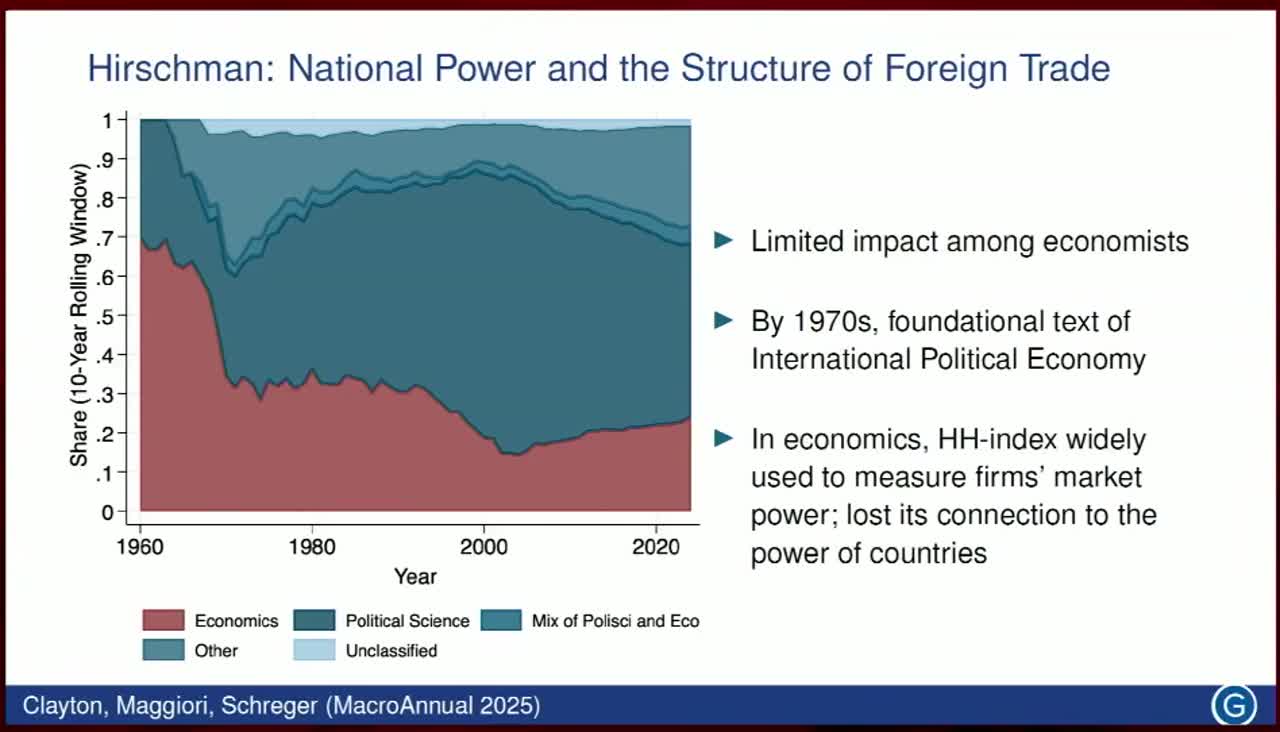
The paper’s version of the hhi is the expression above, and Maggiori is explicit that Hirschman had the right instinct with the wrong exponent: concentration matters, but it matters raised to an elasticity, because what you actually need to know is how hard it is to rearrange your production function when the supply stops.
Power is a gap, and the hegemon is optimizing the gap
Now the part that makes this a theory of behavior rather than a statistic. The hegemon cannot legislate abroad. It has no authority over a Dutch firm. What it has is a threat, and what limits the threat is a participation constraint: the target’s value from complying, net of whatever it hands over, must beat its value after being cut off. The optimal contract makes that constraint bind. Which means the hegemon’s power is the gap between the target’s inside option and its outside option — nothing more and nothing less.
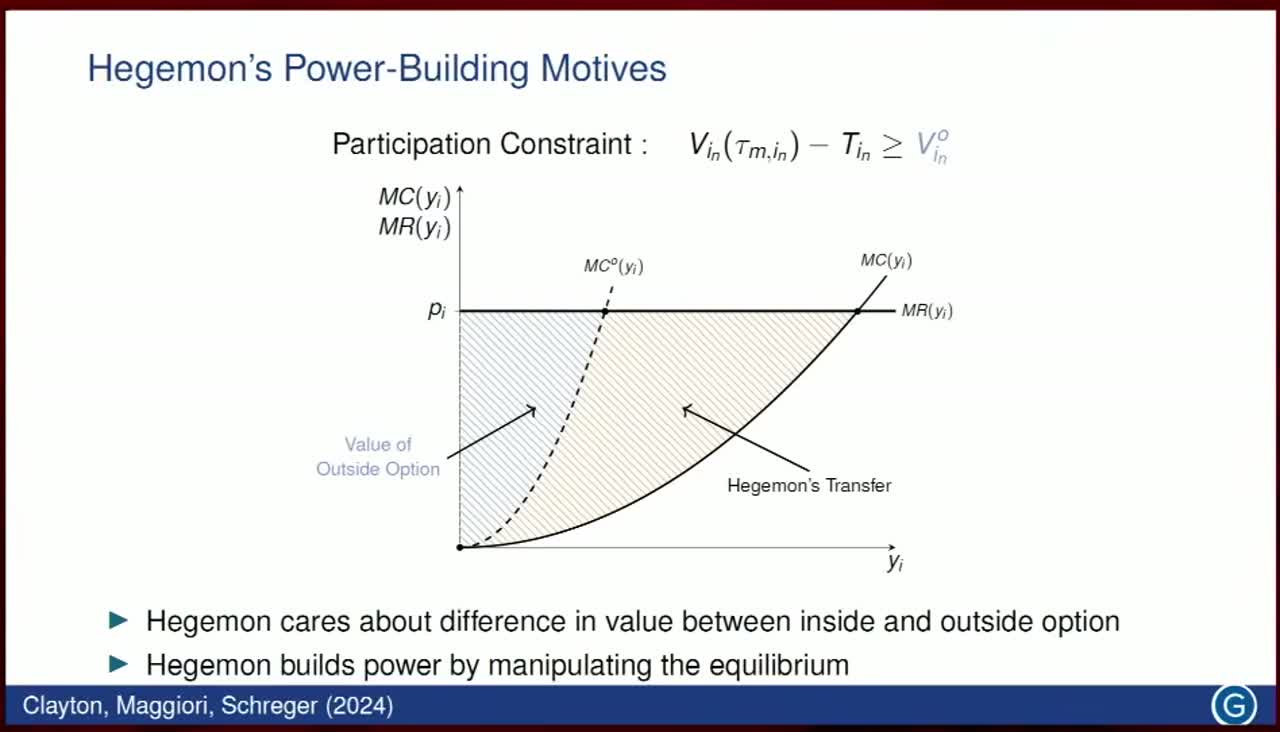
Stated that way the strategy space writes itself, and it is nastier than it first looks. There are two ways to widen a gap. You can lift the inside option, which is the benign, Kindleberger-ish thing: coordinate the global externality, make your payment system efficient and cheap, get everyone onto it. Everyone is better off on path and you extract the surplus. Or you can push the outside option down, which means making sure the alternatives never get built. Maggiori’s name for the second one in the lecture is the drug dealer model, and the uncomfortable implication is that the hegemon may rationally destroy value on the equilibrium path — run a less efficient world — if the outside option falls faster than the inside one. Being indispensable and being generous are the same policy right up until they aren’t.
What everyone else does about it, and why that also goes wrong
Step back one stage and let the targets move first. Each country, anticipating being squeezed, subsidizes its domestic alternative and taxes its use of the hegemon’s system, purely to hold its own outside option up. This is anti-coercion policy, and in the lecture’s rigged closed-form example it goes all the way: full fragmentation, everyone bans the hegemon’s technology, and the hegemon ends up with no relationships and therefore no power at all. That is a knife-edge result and Maggiori says so. What survives generally is worse than the knife edge, because the anti-coercion choices are made in a Nash game. As one country pulls out of the shared system, the system gets less attractive for everyone else, so they pull out further, which makes the first country pull out further still. A fragmentation doom loop, in which everybody buys more security than they wanted and gives up more trade than they meant to.
And the deep point, the one worth carrying around: the trade-off between the gains from trade and economic security is not a coincidence of two forces pointing in opposite directions. It is one force seen twice. Specialization is what generates the gains from trade and what leaves you with a terrible outside option in the thing you stopped making. Krugman’s external economies of scale, read again with a hold-up problem attached.
So how much power is out there, actually
The measurement is the same formula with more layers of nesting — expenditure shares by broad sector, then sub-sector, then foreign versus domestic, then which foreigner — fed with oecd input-output tables, baci and BaTIS, and elasticities borrowed from the trade literature (about six for most sectors, around 1.8 for finance, Cobb–Douglas at the outer nest on the grounds that an economy with no payments cannot operate).
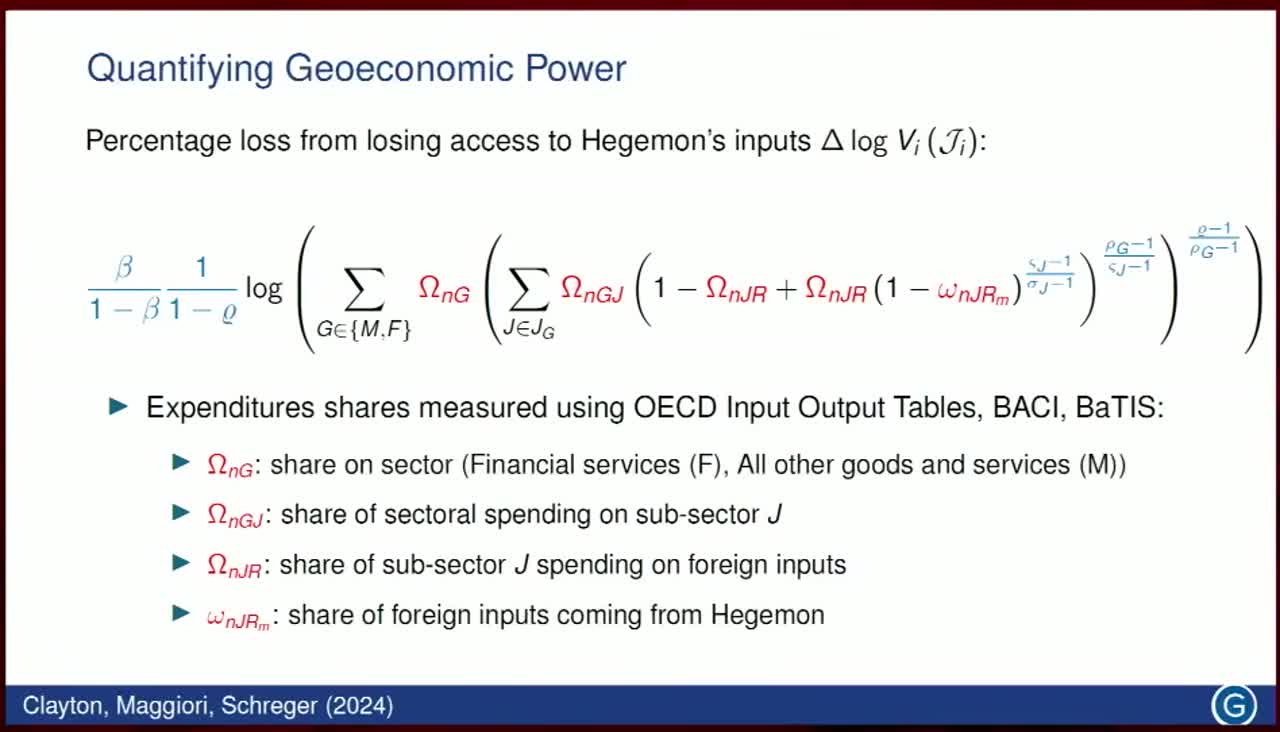
Two results are worth the trip. First, the nonlinearity is brutal. The loss blows up only as the hegemon’s share of a basket approaches one; move a little off the corner and power dissipates almost entirely. This is genuinely good news dressed as a technicality — it means you do not have to reach parity to be safe, only to stop being cornered — and it also means most sectors generate no dependency whatsoever, which is precisely what the industries lobbying for strategic status do not want you to compute.
Second, the two coalitions have differently shaped power. Goods and services do most of the arithmetic on both sides — that is true of the American coalition as well, and it is worth saying because the opposite is usually asserted. What finance is, for the United States, is the distinctive component rather than the dominant one: a sector that is a small share of spending, that everything else needs, whose foreign basket the us and its allies control almost entirely, and which the Chinese coalition has essentially nothing of. It reaches something like forty-five percent of the measured loss for the most exposed targets and much less for the rest, which is not a majority but is a lever the other side cannot answer in kind. Chinese power is almost all manufacturing, which is much larger and, with exceptions such as rare earths, much more substitutable.
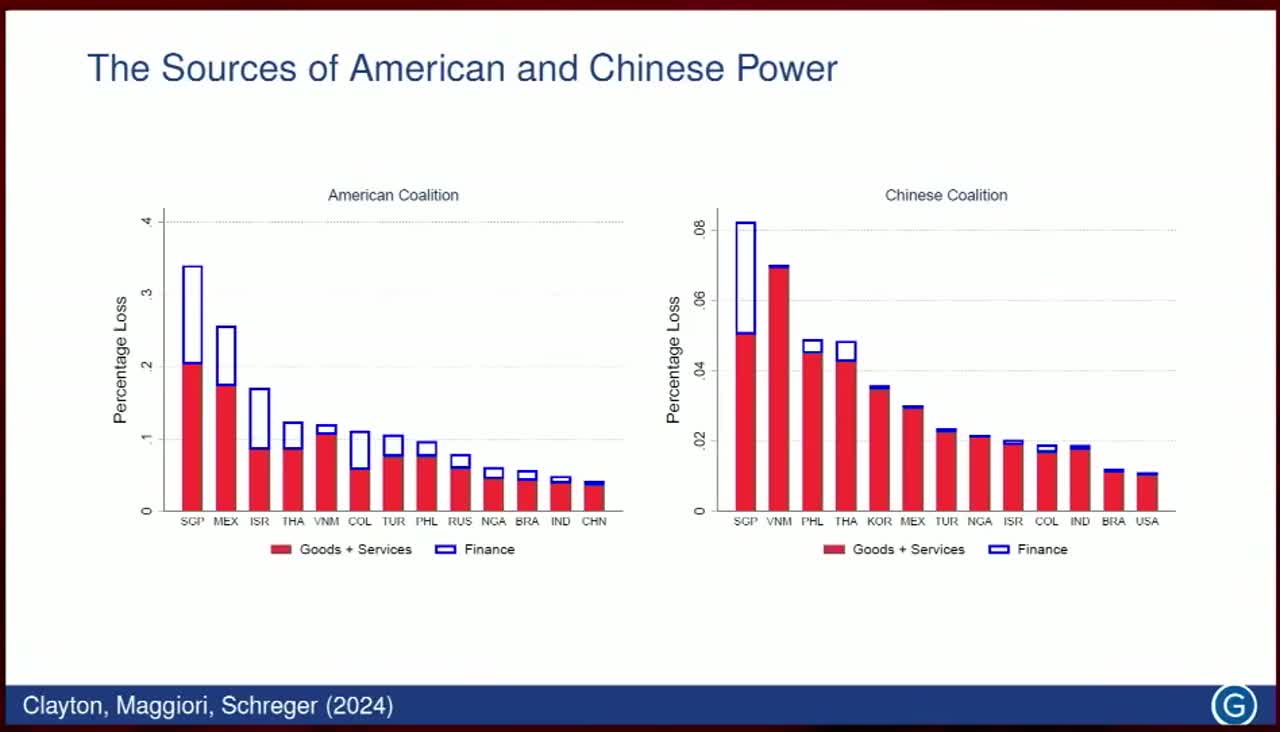
A corollary Maggiori draws out that I had not seen stated before: because power is nonlinear, it is not additive. Ask what Singapore is worth. To the United States it is worth a great deal, because the us already controls nearly all cross-border financial services and Singapore is the piece that pushes those shares to one. To China it is worth much less as an acquisition and much more as a denial — taking Singapore away from the us destroys American power without creating a comparable amount of Chinese power. Power lost by one side does not accrue to the other. Which is a slightly alarming thing to learn about a competition, since it means both sides can burn the thing they are fighting over and neither ends up holding it.
The honest caveats, which the authors do not hide
Most of these come from the companion paper and from the lecture rather than from this one, which is worth flagging since a reader of the Macro Annual essay alone would not meet all of them. These are medium-run numbers, the horizon the companion paper explicitly claims for itself. The target gets to fully reoptimize where it sources from, so they understate a genuine short-run cut-off, where your orders are already placed and the alternative supplier only has a small line running. They also understate nothing at all about the long run, because prices, wages and exchange rates are held fixed, the companion paper’s stated abstraction from general-equilibrium effects — fine for cutting off a small entity, indefensible for cutting off all of China, where everything would move. The elasticities are the weak joint, as Maggiori concedes at length in the lecture, and disaggregating makes it worse in both directions at once: the data quality collapses, especially for domestic production shares, which almost no country measures well, and the elasticities themselves rise, because at fine enough resolution every good has one supplier and none of them matter.
That last asymmetry deserves emphasis, since it is where policy actually goes wrong. Customs offices have been recording cross-border manufacturing flows for two hundred years, so the share-of-imports-from-China number is excellent and gets quoted constantly. The domestic share — the thing that determines whether a 90% import dependence is a crisis or a rounding error — is measured badly or not at all. Services, where the actual us–China contest over information technology and ai is being fought, are barely measured at all — the one caveat this paper does raise in its own voice, calling their measurement an ongoing challenge — because nobody ever built a customs office for them.
So the state of play is that we now have a definition of a dependency that two people arguing can both hold, a clean prediction that most claimed dependencies are fake, and data good enough to establish the fake ones only where the goods physically cross a border and get counted. The economists have finally shown up with the tape measure, some seventy years after Hirschman put it down, and discovered that the interesting part of the room is the part nobody has ever measured.