Notes on:
Sowing Seeds of Mobility: The Gendered Impact of Land Reform
IMF Working Paper 2026/028
29 July 2026
gender · structural transformation · land reform · China
Talk · Paper · PDF · Transcript
Written by Opus 5
Part of NBER Summer Institute 2026 — Gender in the Economy
Ting Chen, Jiajia Gu, L. Rachel Ngai and Jin Wang — presented by Gu (imf, speaking in a personal capacity) at the nber Summer Institute, Gender in the Economy, on 29 July 2026. The talk was billed as “Sowing Seeds of Mobility: The Gendered Impact of Land Reform”; the circulating draft is subtitled “The Uneven Impact of Land Reform,” and that is the version used here (the 2025 steg working paper; there is also an imf working paper, 2026/028). No discussant; questions throughout, and one of them turned into a genuine argument.
Here is a rule. You may farm this land. You may not sell it — the village owns it. Your right to farm it lasts as long as you keep farming it. Stop, and it may be reallocated to someone who will.
Nothing in that rule mentions women. It is written about land, applies to households, and would look identical if you translated it into a world with no gender at all. It is, in the technical sense, gender-neutral.
Now think about how a household complies with it. A factory job has opened in Guangdong. You would like to take it. But if the family leaves, the plot goes. So somebody stays behind — not to farm productively, particularly, but to be seen farming, which is a job the literature calls guard labor (Jayadev and Bowles 2006).
Who stays? The person for whom staying is cheapest, and in rural China that is systematically the wife. Partly because early-stage manufacturing work is male-coded and stigmatised for women. Partly because farm work is the original work-from-home: production and household are in the same place, so the person doing the home production can guard the field at low marginal cost. And partly — a questioner raised this and Gu confirmed it — because under the hukou system a child can only attend school in the place of registration, so somebody has to be there anyway.
So the household’s optimal response to a gender-neutral constraint is to allocate the constraint’s entire burden to one gender. The statute is neutral; the incidence is not. And once you see it that way, the whole paper is an exercise in measuring the incidence of a tax that nobody wrote as a tax.
Why China
The insecurity is common across the developing world — use-it-or-lose-it communal tenure is close to standard in much of Africa. What makes China usable is that the arrangement is embedded in the hukou system, which makes an implicit barrier explicit and measurable; that two national reforms rolled it back on a staggered schedule; and that there is a long panel following the same rural individuals (the Rural Fixed Point Survey, 2003–2017).
The two reforms: the land contracting reform (2003–2014) established the legal framework protecting farmers’ right to rent land out — not to sell it, which remains prohibited — and rolled out province first, then prefecture and county. The land titling reform went further, issuing each household a certificate with its plot’s area and location and building a national registry, county by county, about two years per county.
Measuring who got what, when, is the sort of problem that used to make this project impossible. The authors take over three million policy documents from pkulaw.com, filter by land-reform keywords down to about 4,500, and then use a Chinese llm (Doubao) to distinguish documents that actually implement the reform from documents that mention it in passing — leaving about 4,400, from which they extract administrative level, location and completion year. The result is an index from 0 to 3: 1 for provincial contracting reform, 2 for contracting at prefecture or county level, 3 for completed titling.
The motivating picture is a stacked bar of what rural married couples do.
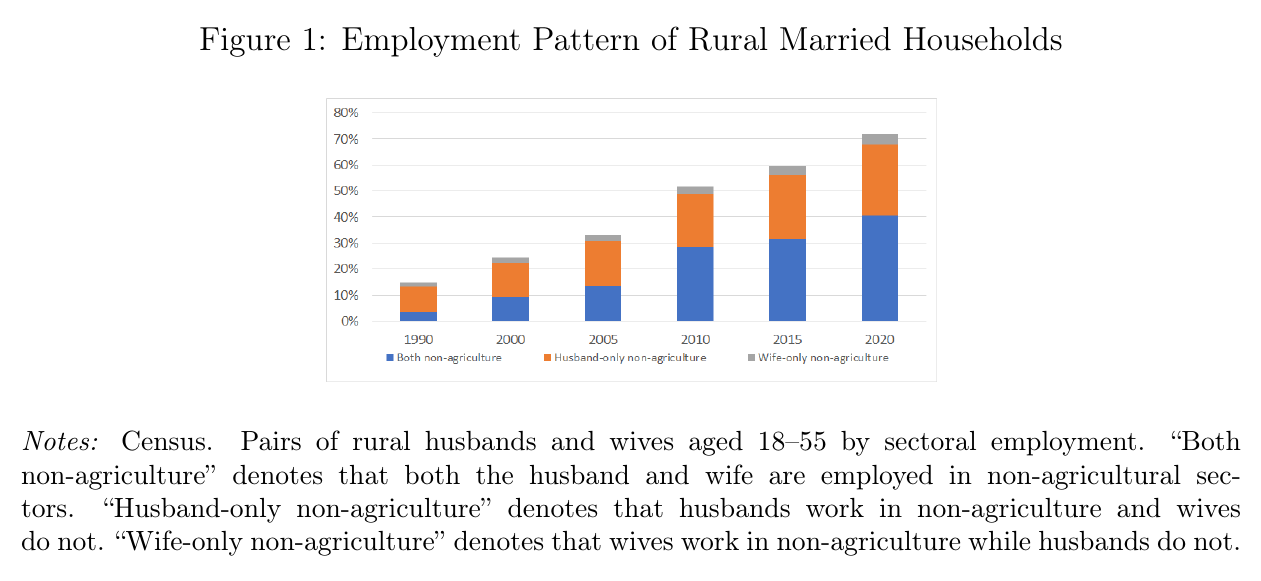
The wife-only category, in grey, remains vanishingly small throughout — which is itself the fact the paper is about.
The estimate
The identifying variation is the timing of local implementation, which is not random: counties with more urban real-estate investment and more land disputes reformed earlier. Both are controlled for, along with a shift-share measure of employment growth in the urban destinations each origin county actually sends migrants to, and the event studies show no pre-trends.
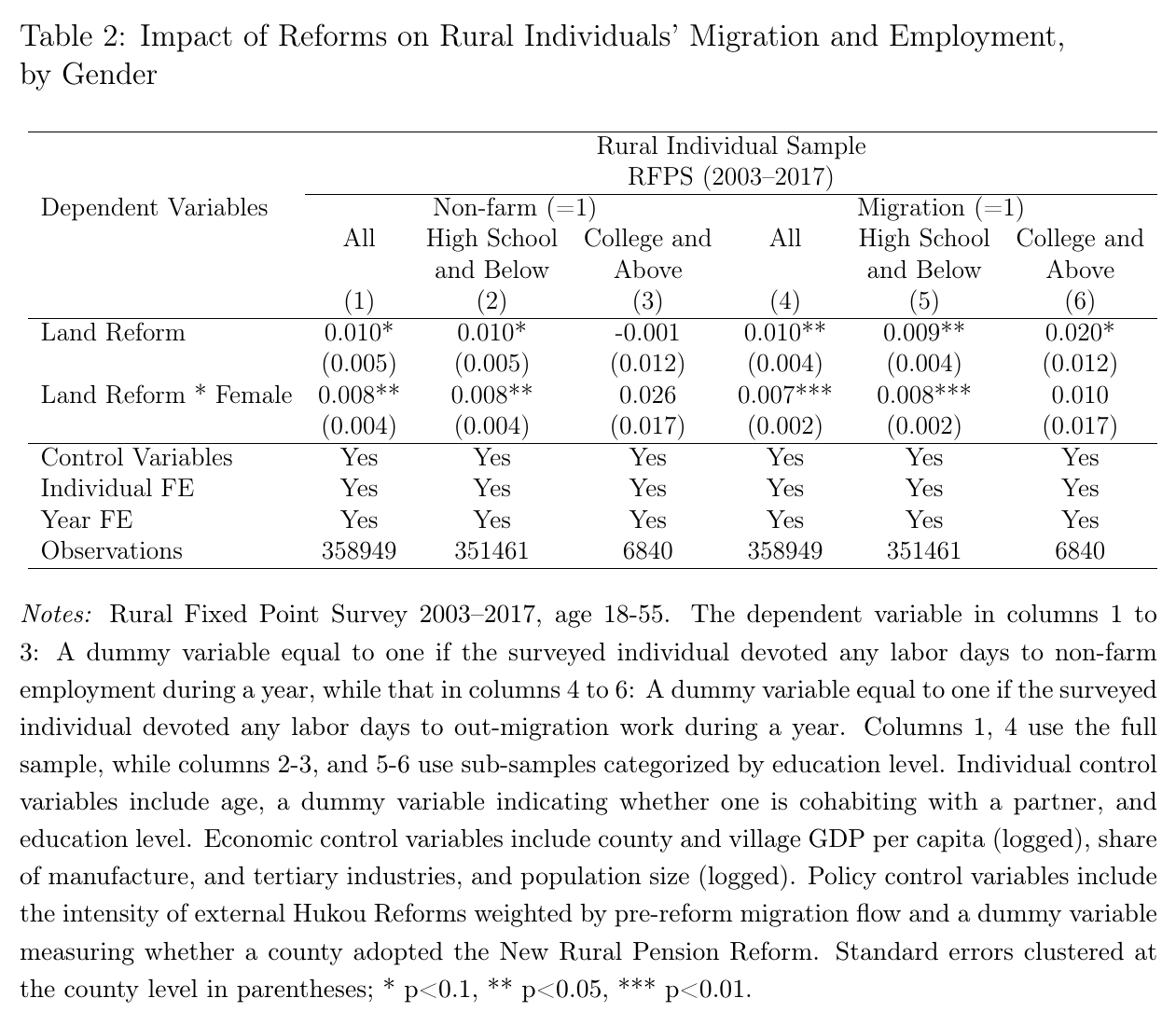
Land reform raises non-farm employment for everybody — 1.0 percentage point per index point — and raises it additionally for women by 0.8 points. Migration behaves the same way. Over the full range of the index, from 0 to 3, that is a differential of about 2.4 percentage points; Gu’s aggregated figures, using the specification that separates the three reform margins rather than lumping them, were roughly 8 points for women against 5 for men.
Two heterogeneity results tighten the story considerably. The effect is driven by married women — split the sample into married women, unmarried women and unmarried men against married men as the reference, and the extra female response sits almost entirely with the married. And on the couple level, the reform raises the share of households where both partners work outside agriculture, both relative to husband-only and relative to neither. The barrier was not “women can’t work.” It was “one of you has to stay.”
The counterfactual that makes the case
The empirics are cross-region comparisons, so they cannot tell you what the reform did in aggregate. For that there is a model: one urban region hosting non-agriculture, a continuum of rural regions of which a share have reformed, and households of one man and one woman choosing, in two Fréchet-distributed stages, whether anyone migrates and then who.
The land policy enters as a parameter on land income by household type . In a reformed region regardless — your rental rights survive whether or not you farm. In an unreformed region, if both members leave, ; if one stays, the household keeps its land income. That is the guard-labor mechanism, written as one parameter.
Then the exercise that earns the paper its claim. Hold everything fixed and set for the stay-behind cases — meaning the person who stays secures her own share of the land but not her migrating partner’s, so there is no longer any extra return to leaving someone behind. The gendered effect vanishes: reform now raises non-agricultural employment by about 7.5 points for both men and women, symmetrically.
Note carefully what survives and what doesn’t. In both worlds women still specialize into agriculture, because agriculture remains female-intensive and because home production suffers when a woman leaves it. What disappears is the asymmetry in the reform’s effect. The guard-labor channel is not why women farm; it is why the reform releases women more than men.
In the baseline model the reformed region’s female non-agricultural employment share runs 8.4 points above the unreformed region’s. Against the data, the model’s headline differential is +3.1 percentage points where the regressions give +2.4 — close, and slightly overstated, which the paper says.
The decomposition, and the one number to take away
Over 2000–2020, rural women’s non-agricultural employment rose about 34 percentage points and men’s about 45. A Shapley decomposition splits this across four sets of time-varying parameters: reform coverage; productivity growth and urbanization; gender-neutral terms including the migration wedge and the disutility of a couple living apart; and women’s roles in market and home production.
Productivity growth and urbanization dominate in magnitude, as they should — but their effect is essentially gender-neutral. The parameters explicitly about women’s market and home roles turn out to matter little quantitatively. And the reform share explains about 11 of women’s 34 points — roughly a third of their entire structural transformation — against about 10 percent of men’s.
Which makes land reform, on this decomposition, the only force that explains more of women’s structural transformation than men’s. A land-tenure statute nobody wrote with gender in mind turns out to be the single most gendered thing in the model.
The pushback
Two objections landed and neither was fully answered.
The first was technical and correct. The main specification treats the 0–3 index as cardinal, so completed titling is assumed to be exactly three times a provincial contracting decree — and, as the questioner pressed, “the relative value of each of those reforms is quite different for women compared to men,” which makes the parameterization restrictive. Gu’s answer was that the paper also runs the three margins separately, that local reform matters much more than provincial, and that titling still matters conditional on contracting. That is reassuring about the ordering, less so about the ratios.
The second was more fundamental and came from a senior questioner who was, visibly, not interested in the model. Their point: what actually happened in China in the 2000s was not only that people moved off the land but that land moved — mayors found ways to bring plots inside city boundaries so that modernization could proceed. A model with a representative agricultural production function has more efficient use of people and less efficient use of land, since fewer farmers now work larger plots, and it says nothing about the state’s objective in any of this. Gu’s reply was that this heterogeneity is real, that others handle it by modelling farmer ability so that the less efficient leave, and that they deliberately stripped it out to isolate the gender margin. When the questioner said, flatly, “I don’t care about the model, I care about the real world,” there was no good answer, and to Gu’s credit she did not manufacture one.
A third, subtler objection was raised about the static model: guard labor is presumably about the option value of future agricultural income, not just this period’s share, and a static calibration has to load that distortion somewhere — probably onto , the migration wedge. Gu conceded the model can’t speak to the uncertainty directly and fell back on the fact that and are calibrated to reproduce the empirical migration coefficients, so the model is not overstating the reform relative to the reduced form. That is a real defence, and it is also an admission that the structural exercise inherits its magnitude from the regressions rather than validating them.
(The policy reading is uncomfortable in a productive way. If you want rural women to move into non-agricultural work, one of the more effective things you can do has nothing to do with women: write down who owns which field. The barrier was never a rule about women. It was a rule about land that a household, optimizing sensibly, converted into a rule about women.)