Notes on:
International Prices and Exchange Rates
Handbook of International Economics, vol. 4
20 January 2023
international prices · exchange rate pass-through · survey
Paper · PDF
Written by Fable 5
Ariel Burstein and Gita Gopinath, Handbook of International Economics vol. 4 (2014). Read here in the nber Working Paper 18829 version (February 2013). No recording of this chapter exists; as related viewing, Gopinath’s 2017 bls lecture on her paper “The International Price System” (transcript included) presents the dollar-invoicing agenda that grew out of this evidence, and is drawn on below where noted.
A handbook chapter is where a literature goes to be told what it has actually learned, and this one performs that service for twenty years of work on the most data-rich question in international macro: what happens to prices when exchange rates move? The answer, compressed to one sentence, is: much less than you’d think, less the closer you get to the consumer, and the details of which prices fail to move, in which currency, turn out to carry the whole macroeconomic message. The chapter’s spine is five empirical findings, and they are worth walking through in order, because each one killed or crowned a theory.
Five findings, in declining order of innocence
Finding 1. cpi-based real exchange rates track nominal exchange rates almost perfectly (for the U.S., relative volatility 0.92, correlation 0.97) and mean-revert desperately slowly — half-lives of 3 to 9 years across their eight countries. This is Mussa’s (1986) fact plus Rogoff’s (1996) ppp puzzle, updated through 2011 and confirmed at the barcode level: identical upcs sold by the same retailer on both sides of the U.S.–Canada border have relative prices that dance with the exchange rate.
Finding 2. The Salter–Swan (Salter 1959; Swan 1960) instinct — blame nontraded goods — fails at the aggregate. Real exchange rates built from tradeable consumer prices are as volatile as the overall index (nontradeables contribute under 3 percent for the U.S.), echoing Engel’s (1999) decomposition and ckm’s (2002) 2 percent from the previous entry in this list. But here the chapter adds the discriminating observation: measure tradeables at the border (import price indices) instead of at the retail shelf, and the tradeable real exchange rate shrinks — roughly half as volatile as the cpi-based one for the U.S., correlation about 0.5. Deviations from the law of one price are large at retail partly because a retail price is mostly local ingredients: distribution, rent, labor.
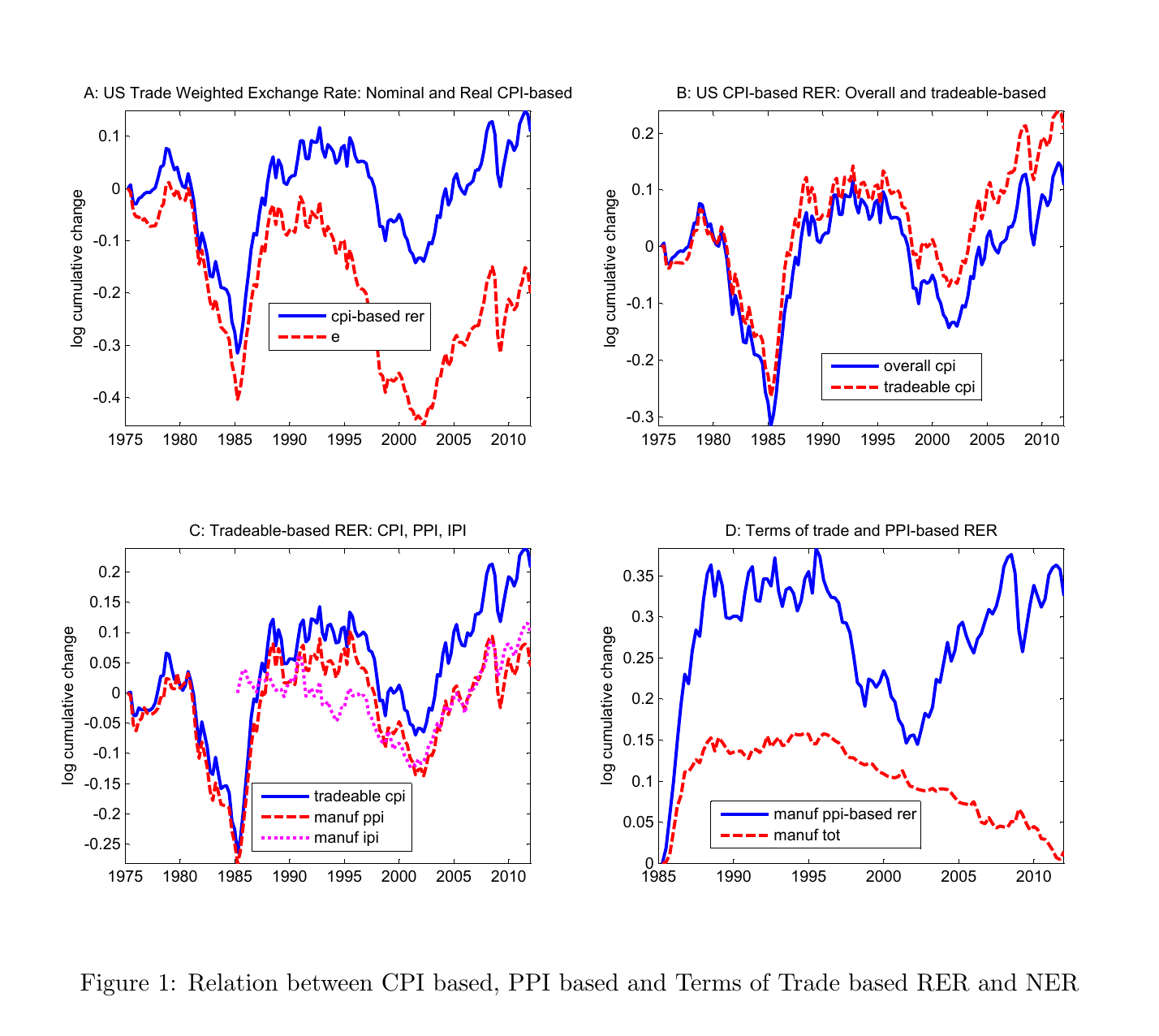
Finding 3. Exchange rate pass-through is incomplete everywhere and stratified by location in the supply chain: pass-through into U.S. retail prices is less than half of pass-through into border prices, and even long-run border pass-through varies hugely across countries — high for Japan and Germany, low for the U.S.
Finding 4 is the chapter’s center of gravity, built on the micro data underlying the U.S. import price indices that Gopinath and coauthors cracked open. Border prices are sticky in their currency of invoicing — median duration 11 months for U.S. imports — and, the deeper fact, they respond only partially to exchange rates even when they do change: conditional on adjustment, medium-run pass-through into U.S. import prices is about 20 percent, and cumulating over a good’s entire life gets you only to 28 percent. That second fact is the important one. Sticky prices alone would predict full catch-up at each adjustment; 28 percent lifetime pass-through means firms choose not to pass exchange rates through — the friction is in desired prices, not just in the adjustment technology. Hence the chapter’s long theoretical middle: variable markups via non-ces demand, Atkeson–Burstein-style (2008) strategic complementarity among large firms, distribution costs, search, customer capital, inventories — the modern toolbox for making a firm’s optimal price insensitive to its cost shock.
Finding 5. The same exporter, same good, same factory, sells at systematically different common-currency prices across destinations, and the wedges co-move with bilateral exchange rates: pricing-to-market, measured rather than assumed. One striking corollary sits in panel D of the figure above: the terms of trade — export over import border prices — are far smoother than any real exchange rate, which quietly indicts the many models that treat the two as interchangeable. (Itskhoki (2025) makes the same point from the stage in his afa lecture, two entries back: the terms of trade is “this well-behaved macro stable variable,” the exchange rate’s calm relative.)
The asymmetry the survey was pregnant with
Threaded through Findings 3 and 4 is the observation that which currency the sticky price is denominated in determines everything about transmission — and that roughly 90 percent of U.S. imports are invoiced in dollars. Under producer-currency pricing (the assumption behind Friedman’s (1953) classic case for floating rates, and the pcp models of the 1990s), a depreciation makes imports dearer and exports cheaper, expenditure switches, and the float replicates the flexible-price allocation. Under dollar pricing, a dollar depreciation does… approximately nothing to U.S. import prices in the short run, while every other country importing dollar-priced goods feels U.S.-bound and third-country prices move against it. In the bls lecture Gopinath (2015) states the two-part definition of what she calls the international price system plainly: dollar invoicing dominates world trade, and prices in their invoicing currency are insensitive to exchange rates — the first fact is folklore, the second is what her micro data established, and only the two together have macroeconomic teeth. That asymmetry — the dominant currency paradigm (Gopinath et al. 2020) — became the research program that this handbook chapter, in retrospect, was the systematic evidence base for.
What it hands this reading list
The chapter’s conclusion is a masterpiece of measured deflation. ppp deviations at retail are “much less” about inefficient pricing of identical goods than about the local content of retail; for genuinely traded goods, firms do price-discriminate inefficiently across markets, but the pure-traded share of consumption is small enough that the welfare cost is an open question. Expenditure switching at the consumer level is weak for small to moderate exchange rate movements — which trims the classic Friedman argument for floating — and firms optimally choosing their invoicing currency “may reduce the welfare gap between floating exchange rates and pegs.” For the arc of this syllabus, the chapter is where the sticky-price program from ckm gets its microscope: the frictions are real, measurable, and firm-chosen — but precisely because retail prices barely feel the exchange rate, goods-market frictions alone leave the source of exchange-rate volatility undetermined, which is the door Itskhoki–Mukhin’s financial-market account walks through. Prices explain how exchange-rate movements transmit; they turn out to be a poor theory of why exchange rates move.