Notes on:
Liquidity Constraints and Capital Allocation in Agriculture: Theory and Evidence from Uganda
Working paper
28 July 2026
development · agriculture · credit
Talk · Paper · Slides · PDF · Transcript
Written by Fable 5
Part of NBER Summer Institute 2026 — Development Economics
Konrad Burchardi (Stockholm/iies), Jonathan de Quidt (Queen Mary), Benedetta Lerva (World Bank) and Stefano Tripodi, presented by Burchardi at nber Summer Institute Development Economics, July 28, 2026. Paper: December 2025 draft, titled “Credit Constraints and Capital Allocation in Agriculture”, and the slides. Timestamps refer to the session video.
Africa never had its green revolution. Yields have stagnated while the rest of the developing world multiplied theirs, fertilizer adoption remains stubbornly rare, and an entire subfield exists to catalogue the suspects: credit constraints, insurance constraints, information, behavioral frictions. Governments, meanwhile, have not waited for the verdict — many run enormous fertilizer subsidy schemes, and economists have mostly clucked at them, on the sound first-best principle that if the problem is a missing credit market you should fix the credit market, not distort the price of fertilizer. This paper’s contribution is to take the government’s side of the argument seriously, on explicitly Lipsey–Lancaster (1956) second-best grounds, and then to measure everything needed to settle it.
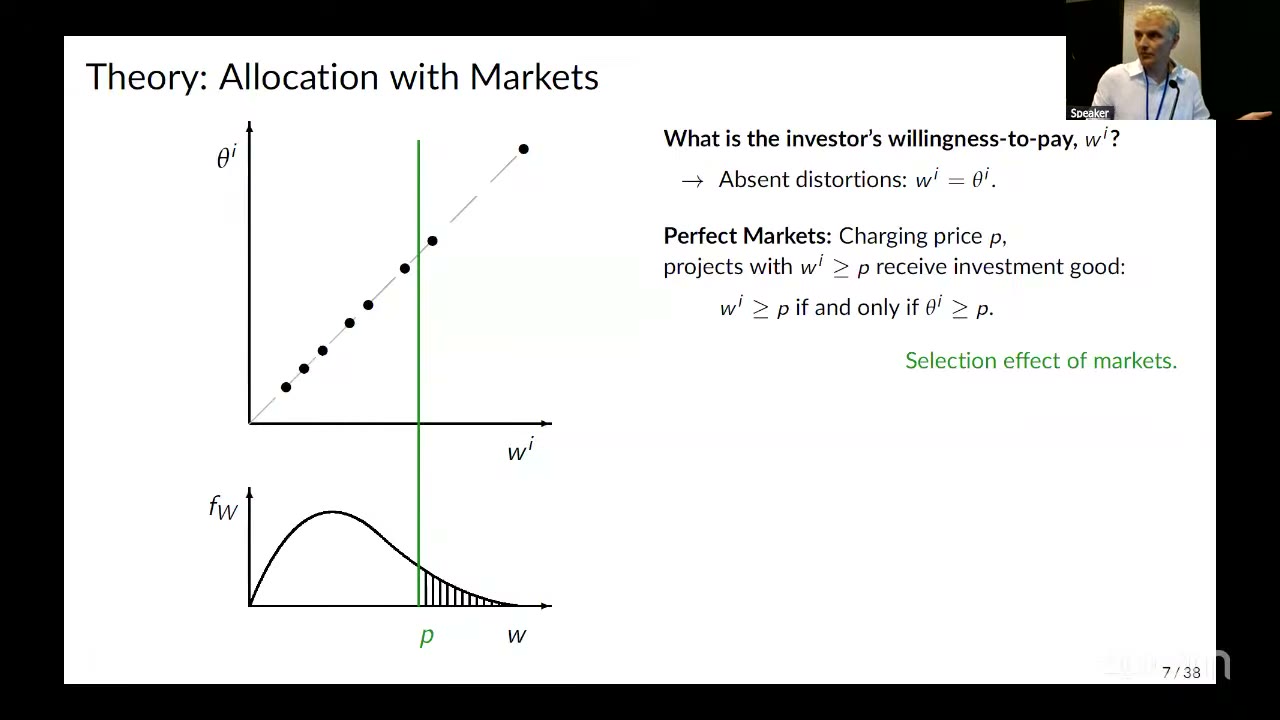
Start with the theory, which Burchardi describes, accurately, as very simple (“you can think of ways of making it more complex; it’s a little harder to think of ways of making it more simple”). Fertilizer has heterogeneous returns across farmers, and each farmer has a willingness to pay . In an undistorted world, : everyone sits on the 45-degree line, and the market price — which equals the social cost of fertilizer — selects exactly the high-return farmers. The market screens horizontally (on willingness to pay), the planner cares vertically (about returns), and without distortions these are the same thing. Every distortion on the list — liquidity, insurance, information — works by shoving the dots off the line, mostly horizontally: a farmer with a high return but no cash has a depressed willingness to pay. Now the market’s screen is broken. Some of the people just below the price are exactly the people you want using fertilizer, and a subsidy that dips below the market price scoops up a mixture of high-return and low-return farmers. Whether that’s worth doing depends on two measurable objects: the average return conditional on willingness to pay, and the distribution of willingness to pay.
Measuring those objects is what the experimental design is for, and it’s a beauty — a “selective trial” in the Chassang–Padró i Miquel–Snowberg (2012) sense. Roughly 1,200 maize farmers in three districts of eastern Uganda (near Tororo, just across the border from the Duflo–Kremer–Robinson (2011) fertilizer studies in Kenya; 408 farmers in the 2017 season, 816 in 2018) went through an incentive-compatible bdm elicitation, implemented as a multiple price list with a scratch card so the price was visibly predetermined: state, for every price, whether you’d buy a one-acre bundle of planting and top-dressing fertilizer whose market price is 200,000 Ugandan shillings. Then the scratch card assigns your price — drawn from a deliberately bimodal distribution (41% of participants at zero, 41% at the full 200,000) so that at every willingness-to-pay level roughly half of farmers get fertilizer and half don’t. That’s the trick: it delivers experimental estimates of the return to fertilizer conditional on each willingness-to-pay level, which is precisely the object the theory says the optimal subsidy depends on. And to create the counterfactual undistorted world, the whole procedure is preceded by a cash lottery — 37.5% of participants win 200,000 shillings, exactly the fertilizer’s market price, unrestricted cash — which relaxes liquidity constraints for a random subset. (Why cash rather than credit? “We were worried that we are not very good at running a bank.” The distinction matters for interpretation and Burchardi flags it: the treatment relaxes liquidity, whatever bundle of credit-and-cash constraints that stands in for.)
The facts, then. Baseline willingness to pay averages 56,000 shillings — barely a quarter of the market price — and only 4.2% of farmers value the bundle at full price, a figure that matches actual baseline adoption (4.2% had used dap the previous season) closely enough to trust the elicitation. Fertilizer works: revenues rise by about 140,000 shillings. But farmers work too — hired and household labor costs rise about 75,000 — so profits rise only 65,000, comfortably below the 200,000 price. (Note the pleasing coherence: average willingness to pay of 56,000 against average profit impact of 65,000 — these farmers know roughly what fertilizer is worth to them.) So handing fertilizer out free would be a clear loser on average. The case for a subsidy lives entirely in the conditional returns: farmers with willingness to pay of 140–180,000 — just under the price — have very high returns. The surplus-maximizing subsidy is about 30%, lifting adoption from 4.2% to 11.1%.
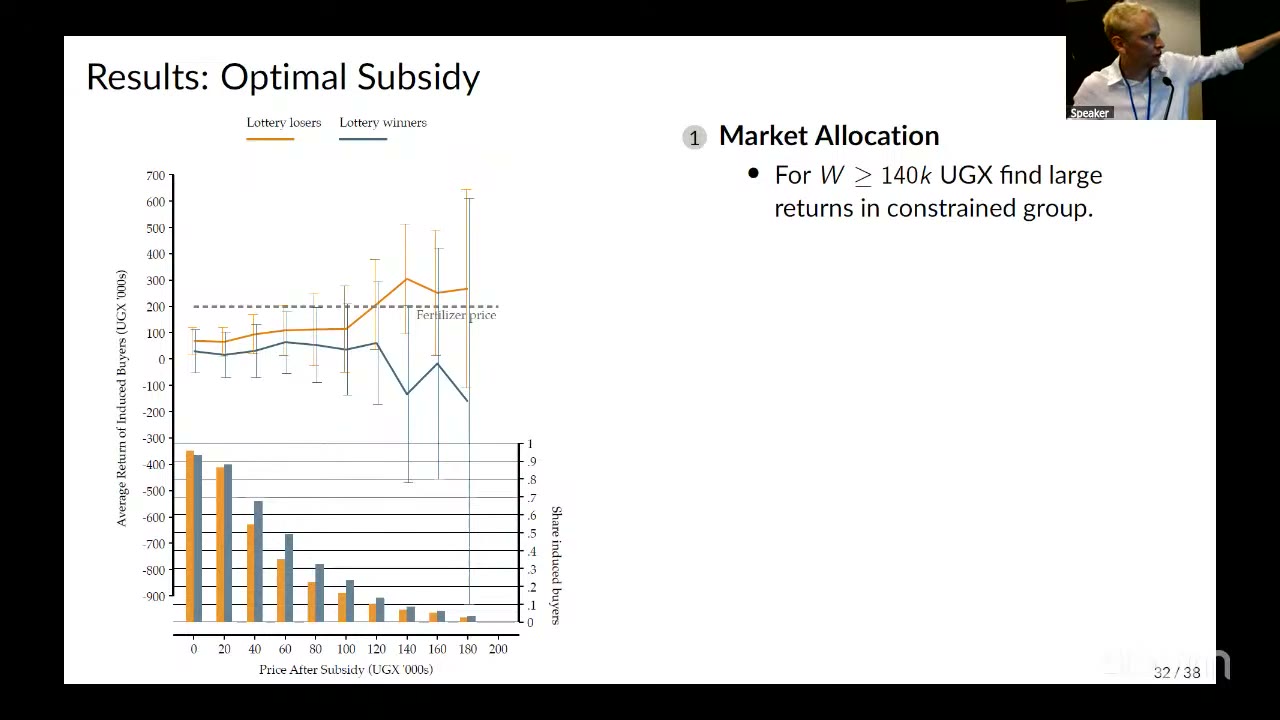
Then the punchline. In the lottery world, the willingness-to-pay distribution shifts right (mean 72,000; the share at full price rises to 6%), the cash itself raises farm profits by about 50,000 shillings — and the optimal subsidy drops to zero. No price below market generates positive surplus once farmers have cash in hand. This is the Lipsey–Lancaster logic executed as an rct: the subsidy is corrective only in the distorted world, and removing the distortion at the source removes the case for the subsidy entirely.
So should governments hand out cash instead? Here the paper turns unfashionably sympathetic to the subsidy schemes economists love to hate. Compare the policies by surplus per government dollar: a small 10% subsidy returns $2.18 per dollar spent; the full 30% subsidy, $2.01; universal cash transfers, only about $1.25 — and the cash program is vastly larger in budget terms. So a government’s choice should hinge on its opportunity cost of funds: at high cost of funds, do nothing; as it falls, run a small subsidy, then a bigger one; only below roughly 1.2 does cash-for-everyone dominate — at which point you drop the subsidy. “This might be one explanation,” Burchardi offers, “for why a lot of governments in developing countries adopt these subsidy schemes.” The scheme the literature scolds as populist turns out to be what a constrained-optimal planner with expensive funds would choose.
The Q&A pushed hardest on agnosticism — Doug Gollin (per the chair; caption attributions are approximate) objected that the paper ties its hands to two policy levers while staying deliberately silent on which market failure is operating, when knowing the failure might unlock better instruments. Burchardi agreed cheerfully and completely, with the caveat that fixing distortions at the source is itself costly, which is the whole trade-off. The team’s next act is characteristically direct about the deepest limitation — that nobody, including the farmers, observes individual returns: they are now teaching Ugandan farmers to run experiments on their own farms, to estimate their own . The market screens on willingness to pay; science, eventually, on returns.