Notes on:
What Drives Child Penalties? Evidence from a Global Organization
Working paper
28 July 2026
gender · child penalties · organizations · promotions
Talk · Slides · Transcript
Written by Opus 5
Part of NBER Summer Institute 2026 — Gender in the Economy
Jessica Bracco, Yves Froude, Maria F. Pinto, Bob Rijkers and Michele Valsecchi — “What Drives Child Penalties? Evidence from a Global Organization,” presented by Rijkers at the nber Summer Institute, Gender in the Economy, on 28 July 2026 (Day 1, afternoon) as a fifteen-minute egg-timer talk; questions were held for the evening reception, so there is no Q&A. Source note: written from the recording and the nber conference slide deck — no public draft, so every number below is one the speaker showed or said. Co-author names are as heard and the captions mangle them.
Almost everything we know about child penalties is measured across employers. Mothers reduce labor supply, or move to a different firm, and earnings fall. Fine. But that framing quietly assumes the interesting margin is entry and exit, and it cannot see what happens to a woman who does none of those things — who stays full time, at the same employer, and still ends up further behind six years later.
To see inside, you need an employer with standardized grades, a common promotion system, essentially no part-time work, no overtime pay, and thirty-six years of personnel records. Rijkers works at one, and got permission to open it.
The World Bank Group is an unusually clean laboratory precisely because it is so bureaucratic. Earnings rise through exactly two channels: an annual performance rating from one to five that converts into a permanent salary increase, and occasional promotion to a higher grade. No part-time and no overtime compensation means any earnings change you observe is not hours. And the institution is explicitly committed to gender equity — the paper shows little evidence that managers evaluate men and women differently conditional on observable performance, which takes straightforward employer discrimination off the table as the main story.
What makes it more than a personnel study is the outcome linkage. The records connect to what people actually did: which development projects they managed, whether those projects succeeded, whether they ran late, how many working papers they wrote, how often those were downloaded, how much they travelled and where, and — for the last decade — whether they worked from home.
The design is a standard event study around the first birth, estimated separately for mothers and fathers, with future parents as the control group, so identification comes only from the timing of the first child. Attrition looks similar for parents and non-parents on observables.
A small penalty, made entirely of promotions
There is a child penalty for mothers and none for fathers. It is 3.1 percent of earnings averaged over the six years after the first birth — small by the standards of this literature, which is what you would expect somewhere with no part-time margin and a rigid pay scale.
The interesting part is which of the two channels it comes through. Not performance ratings: those dip for mothers and fathers, and mothers’ recover after about four years while fathers’ don’t, and Rijkers flagged a clear pre-trend and told the room not to lean on it. It is promotions. Mothers’ year-by-year probability of promotion falls by more than 50 percent, and after six years they are roughly a quarter of a grade behind comparable women who have not yet had a child. Men’s grade progression is untouched.
What changes is the job, not the work
After the first birth, mothers stop doing the visible things. Initiating a development project at the World Bank is a large undertaking — negotiating with client governments, selling it to internal management, satisfying safeguards — and it is time-intensive, stressful, and highly valued for promotion. Mothers do much less of it. For fathers, if anything, the rate goes up.
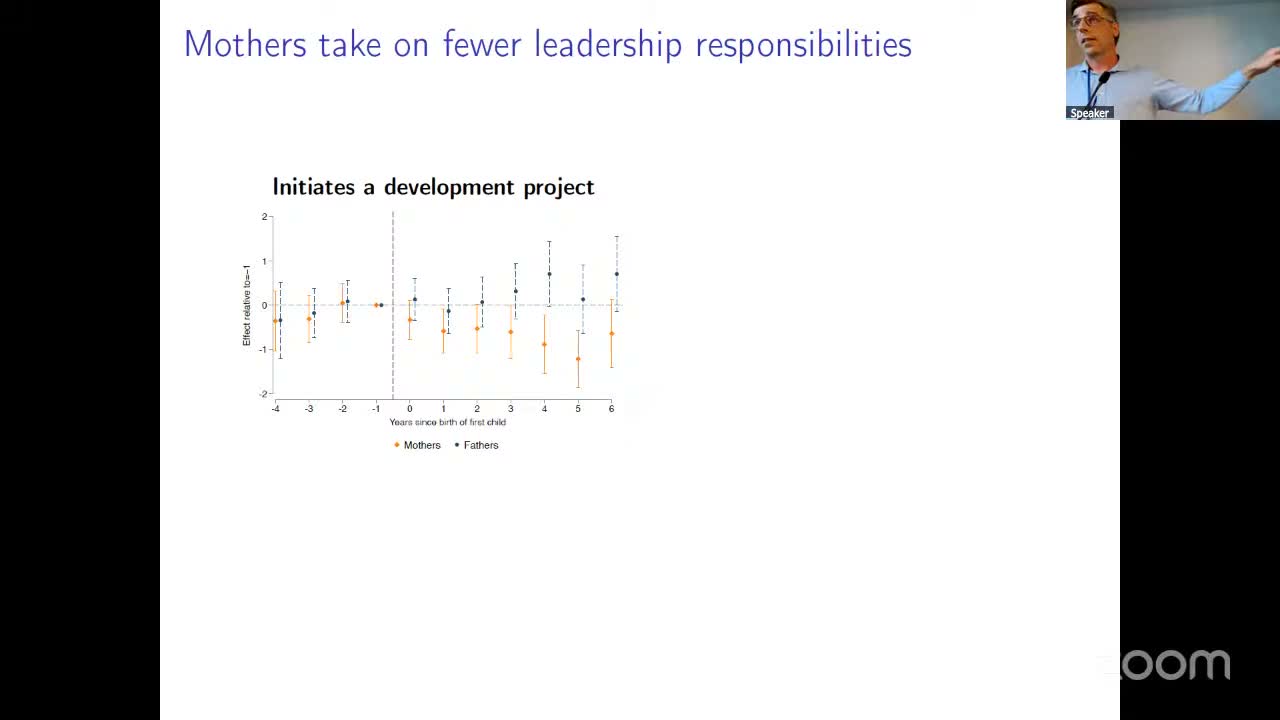
Same for supervising external consultants. And travel — World Bank jobs are extraordinarily travel-intensive, with the average staff member away more than a month a year — falls for both parents, but mothers cut roughly two weeks against fathers’ one. Home-based work rises, though not significantly.
Then the test that gives the paper its spine. Does any of this show up in the quality of what they produce? Project outcome ratings: no significant decline. Project delays: nothing. New working papers: nothing. Downloads of those papers: nothing.
So the tasks shift and the output doesn’t. Which means the promotion penalty is not being generated by mothers becoming worse at their jobs. It is being generated by mothers doing a different set of jobs — specifically, the set that the promotion system does not reward.
The trade the organization is offering
The third finding closes the loop. Both parents sort out of high-promotion-potential jobs, and mothers do so more sharply. Where do they go? Toward jobs amenable to home-based work and away from travel-intensive ones — which happen to be the jobs with the smallest child penalties.
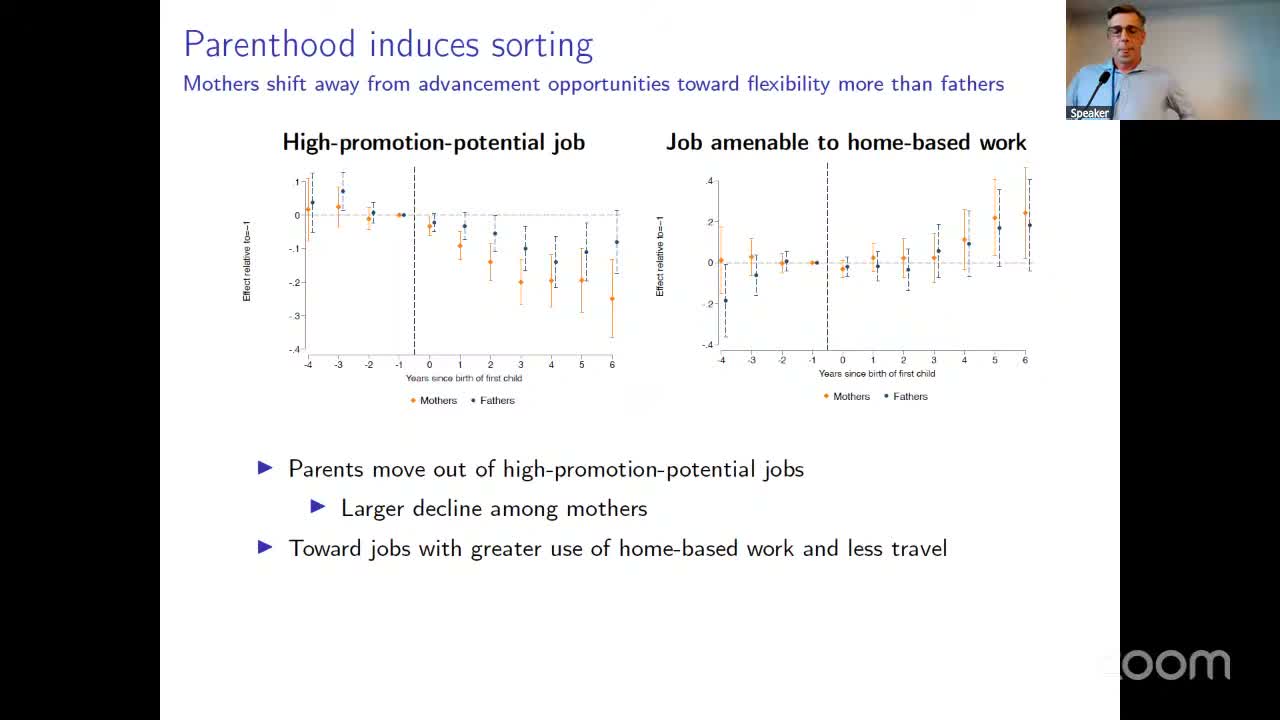
That is a within-organization trade-off between advancement and flexibility, and it is being made by people who never left, never went part-time, and are producing output of undiminished quality.
Why this is worth more than its 3.1 percent
The number is small and the setting is exotic — an elite multilateral in Washington, hardly representative of anything. But the smallness is the point. This is a well-paid, gender-conscious, formally meritocratic employer with a rulebook, and it still produces a motherhood penalty made entirely out of promotions, entirely out of task composition, and not at all out of performance.
Which locates the problem somewhere uncomfortable. Nobody is discriminating in the measured sense. The promotion system rewards visible, travel-heavy, high-stakes leadership, and mothers stop doing those things. Every individual step is a choice, the choices are reasonable, and the output is fine. The institution simply pays for one kind of contribution and not the other, and one kind is easier to make with a small child at home.
(There is an unusual thing about this paper worth noting, which is who wrote it. Rijkers introduced himself, deadpan, as working for the employer being studied. An institution letting its own economists publish the finding that its promotion system disadvantages mothers is not the normal use of administrative access — and if the World Bank ever wants to fix this, the paper has already told it which two things to look at: what counts as leadership, and how much of it requires being on a plane.)