Notes on:
The Imbalances of the Bretton Woods System 1965 to 1973: U.S. Inflation, the Elephant in the Room
Open Economies Review
20 January 2023
Bretton Woods · economic history · inflation
Paper · PDF
Written by Fable 5
Michael D. Bordo, nber Working Paper 25409 (December 2018); published in Open Economies Review 2020. Read from the working paper. No recording of this paper exists; as a companion, Harold James’s 2021 Princeton Initiative lecture “50 Years Ago: The End of Bretton Woods” (transcript included) covers the same events from a historian’s angle and is quoted below where noted.
There is a genre of policy speech in which a government announces that a problem has been caused by foreigners, and a genre of economic history that consists of patiently establishing that the problem was caused by the government giving the speech. Bordo’s paper is a distinguished entry in the second genre. Its subject is August 15, 1971 — Nixon at Camp David closing the gold window, slapping a 10 percent surcharge on all imports, and freezing wages and prices for ninety days — and its thesis is in the title: the “deep underlying fundamental” of the imbalances that killed Bretton Woods was U.S. inflation, running since 1965 on Vietnam War and Great Society deficits accommodated by the Federal Reserve. That was the elephant in the room at Camp David, and it was carefully not discussed. Nixon blamed the surplus countries and “international currency speculators”; Burns supplied wage-price controls to mask the symptom; the actual cause — U.S. monetary and fiscal policy — would have required a recession to fix, and there was an election in 1972.
The arithmetic of a gold-dollar standard
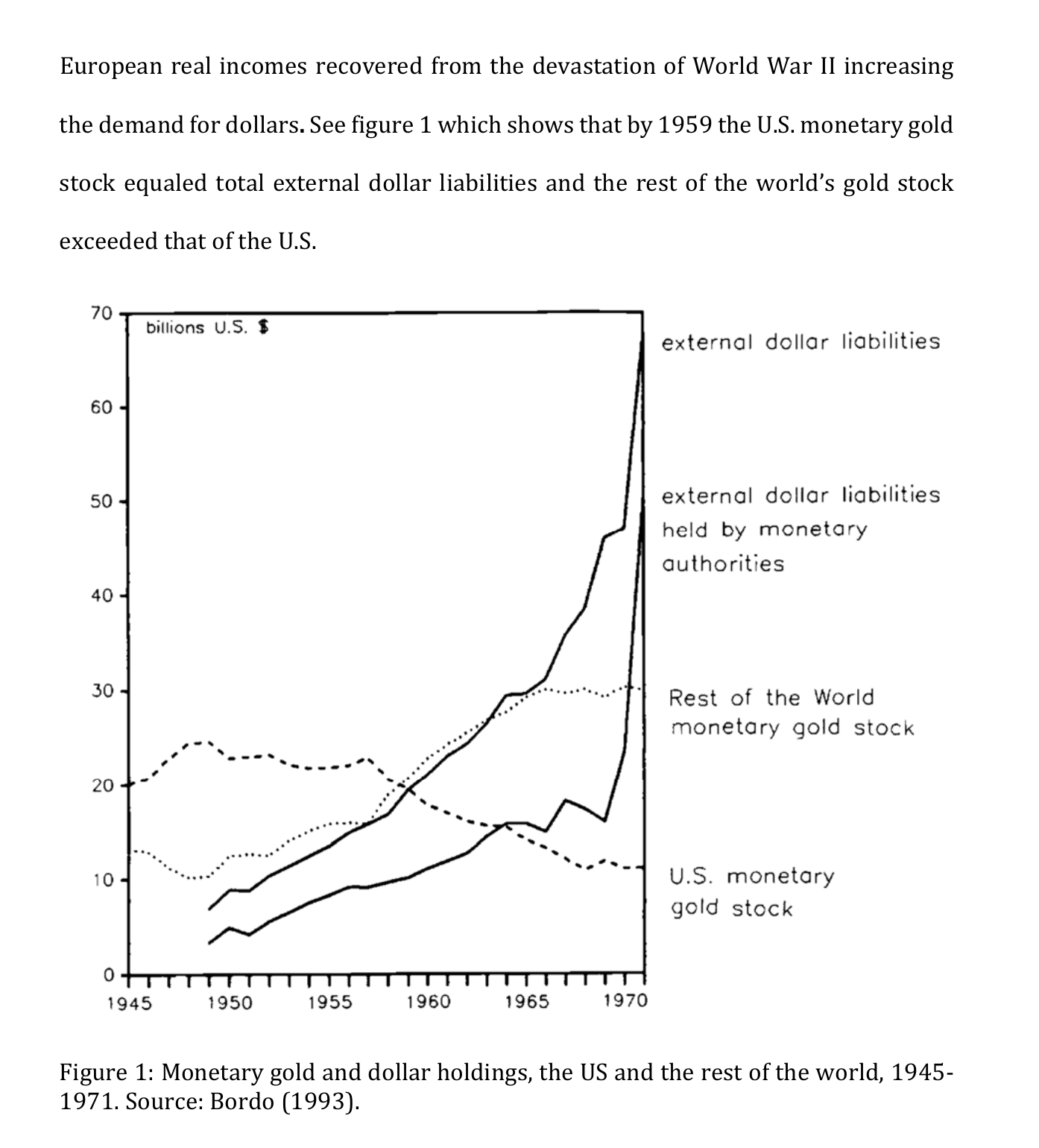
The mechanism the inflation was working against is worth laying out, because it is the confidence problem from Eichengreen’s (1993) companion paper made flesh. Bretton Woods after 1958 was a gold-dollar standard: the U.S. pegged gold at $35, everyone else pegged to the dollar, and the world’s growing demand for reserves was met by U.S. payments deficits. The system’s one requirement was that the anchor country not inflate. Triffin’s 1960 warning was that even a virtuous America would eventually see its liquid liabilities outgrow Fort Knox; the Despres–Kindleberger–Salant (1966) rejoinder was that a “banker to the world” can run such a balance sheet forever provided it keeps its price level stable. Both sides of that debate agreed on the proviso. The paper’s first figure shows the vise closing: by 1959 external dollar liabilities already equaled the U.S. monetary gold stock, and by 1966 official foreign dollar holdings alone exceeded it.
Until 1965 the system was defended with an inventive scaffolding of stopgaps — the Gold Pool, Operation Twist, the Interest Equalization Tax, swap lines, the General Arrangements to Borrow, and moral suasion up to and including hinting that U.S. troops might leave Germany if the Bundesbank cashed dollars for gold. And crucially, under William McChesney Martin the Fed still watched the balance of payments; Bordo notes the Europeans’ complaints about U.S. inflation before 1965 were simply wrong on the numbers.
1965, and the policy regime flips
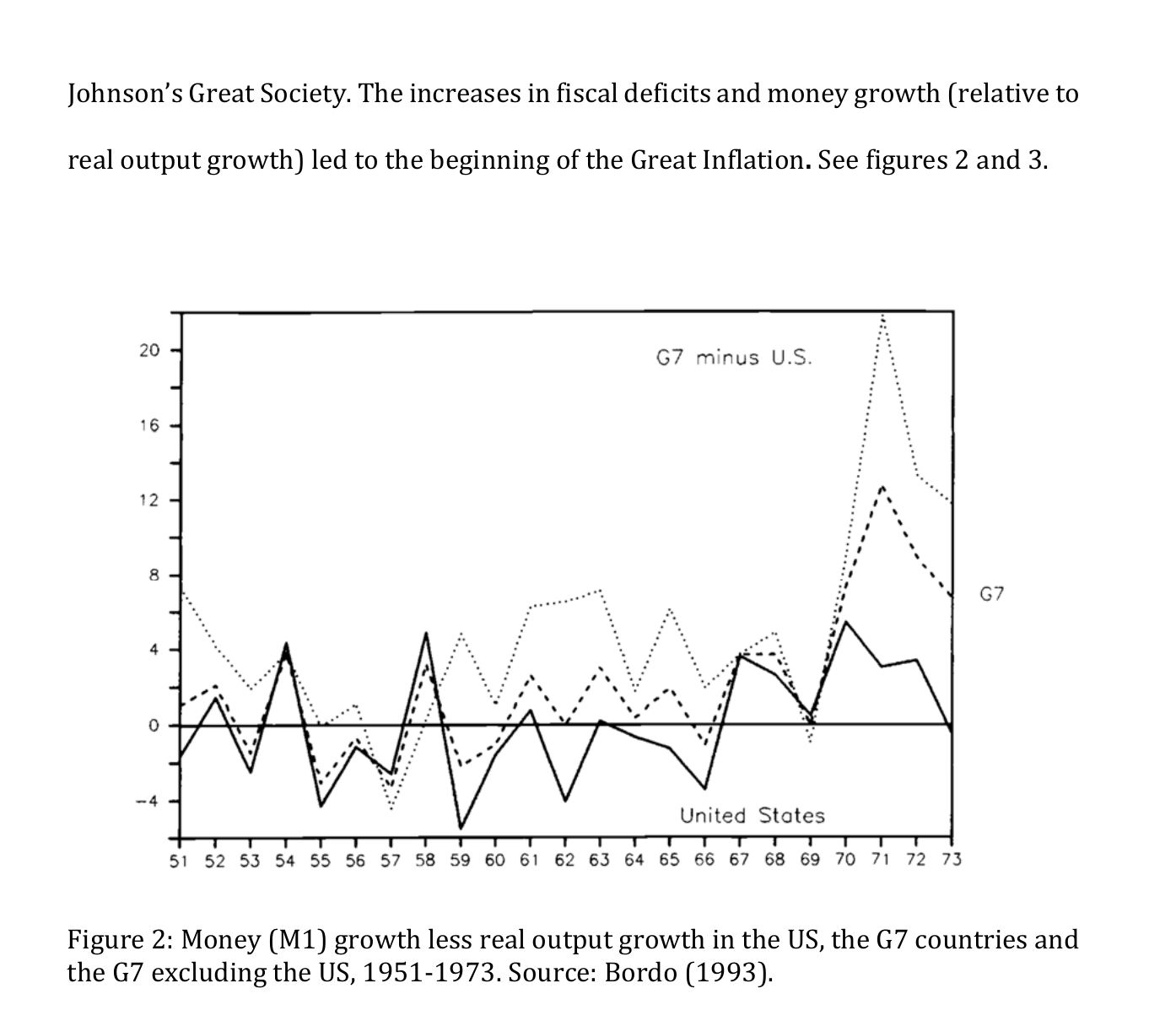
Then fiscal policy exploded — Vietnam plus the Great Society, unfinanced — and the Fed accommodated roughly half the deficit increase (Meltzer’s (2009) estimate). The Keynesian cea targeted sub-4-percent unemployment with the Phillips curve as the policy menu; the fomc, per Bordo and Eichengreen’s (2013) minutes-reading, simply stopped attending to the gold stock in favor of domestic objectives. The second figure is the smoking gun in cross-country form: U.S. money growth in excess of output growth, essentially the inflation the U.S. was exporting, surges after the mid-1960s — and the G7-minus-U.S. line surges with it, as surplus countries absorbing dollar inflows were forced to print their own currencies to hold their pegs.
The dominoes then fall in order: sterling’s 1967 devaluation removes the dollar’s outer defense line; the Gold Pool dies in March 1968 (France having quit first), replaced by a two-tier gold market that Meltzer calls the beginning of the end; Congress strips the gold cover from Fed notes to free up ammunition, which reads to markets as reduced credibility; the brief 1969 tightening works, is reversed for the 1972 election, and the run resumes — $4 billion out in May 1971 alone. James (2021), in the companion lecture, catches the foreign mood in one line: the French were asking “why is the world setting its watch to a defective clock.”
The counterfactual, and the cast
What elevates the paper above narrative is its insistence on a testable counterfactual: tighter U.S. policy from the mid-1960s would have prevented most of the turmoil — while honestly conceding the Triffin residual: a virtuous U.S. would have starved the world of reserves, so the structure required reform (sdrs came too little, then too much) regardless. Policy determined the timing; the design guaranteed an eventual reckoning. That is also Eichengreen’s verdict in the previous entry, reached from the other side.
The character studies are the paper’s most quotable layer, sourced partly from Bordo’s conversations with George Shultz. Burns is “the villain”: the Friedman student who, once chairman and under a president who had told him “You see to it: no recession,” reinvented inflation as cost-push and campaigned for the controls — earning a wounded litany from Friedman himself, quoted in a footnote, about his old mentor advocating “precisely the opposite of what he urged long before.” Volcker, at Treasury, is the realist who concluded by spring 1971 that convertibility had to end and sold Connally and Nixon on it — carrying the credibility lesson he would apply a decade later from the other chair. Shultz is “the hero,” whose June 1971 “Steady As You Go” speech — monetary gradualism, fiscal balance, no controls — was the road not taken, and whose Plan X (reserve-indicator rules forcing surplus and deficit countries to adjust, a resurrection of Keynes’s scarce-currency clause) was a decorous vehicle for backing the world into floating, which arrived de facto in March 1973.
For this reading list the paper is the economic-history anchor of the Mussa experiment: it documents precisely why the nominal regime changed in 1971–73 — a fiscal-monetary imbalance at the center country, not any change in real fundamentals — which is what makes the regime switch a clean natural experiment when Itskhoki and Mukhin (2025), next in the block, use it to test what pins down the real exchange rate. Bordo’s closing section, written in 2018, notes that today’s echo of the 1960s is fiscal rather than monetary — burgeoning deficits, tariffs as a strategic bludgeon — with floating rates as the shock absorber the 1971 system lacked. The elephant, he implies, has merely changed rooms.