Notes on:
Is Software Eating the World? Measuring the Progress and Diffusion of AI
Unpublished manuscript, 29 April 2026
7 May 2026
national accounts · productivity · software · AI diffusion
Talk · Paper · PDF · Transcript
Made with AI: Opus 5 (reading and writing)
Part of AI and Economic Measurement, Spring 2026
“Is Software Eating the World? Measuring the Progress and Diffusion of ai,” by Filippo Bontadini (luiss), Carol Corrado (Georgetown), Jonathan Haskel (Imperial) and Cecilia Jona-Lasinio (luiss Business School). Presented by Corrado at the nber conference on ai and Economic Measurement, Stanford, 7 May 2026; discussant Martin Beraja (mit), who took all three papers of the session together in a single fifteen-minute slot. Written from the preliminary draft dated 29 April 2026, whose title page carries the words “preliminary draft, not for quotation” — so everything below is provisional, and to the authors’ credit they say so more often than most people would.
You are a regional bank.
In 2012 you decide to do something clever with your loan book, so you buy a rack of servers, hire four engineers, and have them write you a risk model. The servers are equipment; you own them; they go on your balance sheet and into the national accounts as gross fixed capital formation. The four engineers writing your own code are producing an intangible asset for your own use — own-account software, inside the System of National Accounts asset boundary for years now — so their salaries also get capitalised, depreciated, and counted as part of your capital stock. Your measured capital income goes up. Statistically, you have invested.
In 2026 you do the same clever thing, except you do it by calling an api. You pay a foundation model provider some number of dollars per million tokens, and you get, functionally, a better risk model than the one your four engineers built. What the accounts record is: an expense. Intermediate consumption. It reduces your value added, reduces your measured capital income, and adds nothing at all to your capital stock, because you did not acquire an asset — you rented one, in slices, from someone who won’t tell you where it physically ran.
Meanwhile the money you paid shows up upstream as revenue to the cloud and model providers, who own the gpus, book the investment, and record your payment as operating surplus. This is the paper’s central observation, and it is the sort of thing that is obvious the moment somebody says it: the accounts record investment where an asset is owned, not where it is used. For questions about ownership that is exactly right. For questions about production, substitution and diffusion — which is to say, for every question anyone currently wants answered about ai — it is not.
The elegant and slightly sinister part is what this does to the aggregate. The two errors are mirror images. The same dollar is missing from the numerator downstream and spuriously present in the numerator upstream, so to a first approximation they cancel, and the economy-wide capital share sits there looking perfectly stable while a wholesale relocation of where capital is actually used goes entirely unrecorded. The draft’s phrase for this is that aggregate stability may be “correct for the wrong reason.” The cancellation only breaks — and the aggregate capital share becomes genuinely biased upward — if the upstream sector earns rents, which, given that a handful of firms sell essentially all of the frontier models, is not a hypothetical scenario so much as a description.
The paper formalises what you actually bought as a shadow capital stock: capital services you consume and do not own, with your cloud bill read as the rental payment on it.
Here is the ai cloud and api spending of downstream firms, is the user cost of one period of ai capital services, and is the unrecorded stock that generates them (equation 13). Add back to measured downstream capital income and you get the corrected factor share the paper wants to look at (equations 14–15). Hold that thought; the discussant is going to pick it up by the handle and hit the paper with it.
A note on the headline number, which is not this paper’s number.
The talk opened with the figures everyone will remember: software capital explaining roughly half of us labour productivity growth since 2012, and a software-producing sector at about 6 percent of the nonfarm economy contributing — Corrado said 43 percent out loud — to the post-2017 acceleration in total factor productivity. Those numbers are real, but they are not results of this draft. They appear in footnote 1 on the second page, cited to a forthcoming aea Papers and Proceedings paper by the same four authors (2026), and the written version says “more than 40 percent,” not 43. This draft contains no growth-accounting decomposition of its own. There is a familiar genre of conference talk in which the punchiest slide is a citation to the speaker’s other paper, and this is a specimen of it; the honest summary is that the framework paper leads with the companion paper’s result because the framework paper’s own result is subtler and takes longer to explain.
The actual result is a price index, and it is a good one.
If ai capital is getting cheaper, the rate at which it gets cheaper is the thing that drives everything downstream through the user cost. So: how fast is it getting cheaper? Nobody official knows, because there is no quality-adjusted price index for ai services anywhere in the national accounts. The it era got away without one because hardware and software were separable — chips could be priced independently of the software running on them, which is what the old adage about what Intel giveth and Microsoft taketh away was actually describing. ai breaks that separability: capability comes out of architecture, training scale, data and silicon interacting, and it improves in discontinuous jumps rather than by sliding along a stable attribute space, which is precisely the condition under which hedonic methods stop working. The paper’s proposal is that the right unit of measurement is the deployed model, and the right price is cost per unit of productive output — “what the frontier model delivereth.”
They then build one, from 21 model releases between March 2023 and March 2026 across OpenAI, Anthropic, Google, DeepSeek and xAI, with blended input-output token prices deflated by the Epoch Capabilities Index (Lee and Emberson 2025). The raw token price index falls 24.5 percent a year. The capability-adjusted index falls 38.5 percent a year. The gap is 14.1 percentage points annually, and it is the whole ballgame.
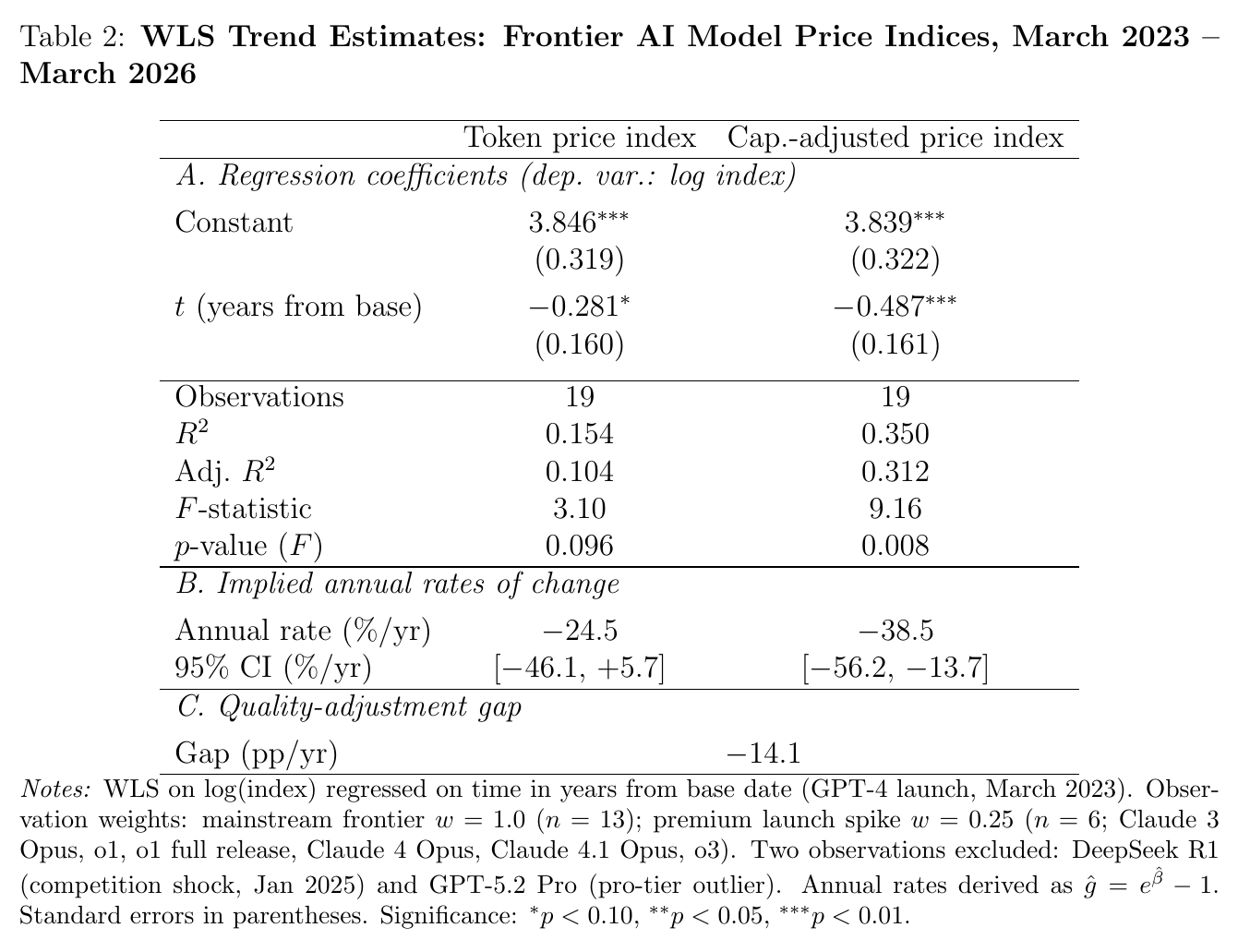
Why the gap is the whole ballgame is equation 10. Writing the acquisition price of a constant-quality unit of ai capital as an observed price divided by a capability index, the relative price decline that matters decomposes into three additive pieces:
is the rate at which ai capital gets cheaper relative to the user’s own output price, is that output price, is the capability index, and is the posted price you can actually look up (equation 10). Official statistics, when they eventually get around to measuring this at all, will see component (iii) and nothing else. In levels, the draft reports the blended frontier token falling from $45 to $21 per million over three years, a 53 percent nominal decline; deflated by capability, from $45 to roughly $8. Corrado’s own gloss in the room was that “there’s nothing that compares with this in the national accounts.”
Two honest wrinkles. The token-price regression is only marginally significant on its own ( = 0.096, = 0.15) — it is the capability-adjusted series that is statistically solid — and the authors call the whole thing a proof of concept, three years and nineteen usable observations being what it is. And the arithmetic drifts a little between formats: the slide put the wedge at about 14.5 points a year, Corrado said “14 percentage point” out loud, and Table 2 says 14.1. Use 14.1. Also worth noticing, since the paper does in a footnote: the deflator is a private ai research organisation’s leaderboard, and turning one of those into an official national accounts price index is a governance problem at least as much as a methodological one.
What could actually be fixed tomorrow.
The nice thing about the diagnosis is that a third of it needs no new theory. The draft splits ai spending into own-account development (already inside the asset boundary), cloud services consumed in current production (genuinely a rental of someone else’s capital, and the case the shadow stock is built for), cloud services consumed in building something durable — a fine-tuned model, a proprietary inference pipeline — and the organisational investment that makes any of it work. That third category is economically an own-account asset that merely arrived dressed as a service fee, and fixing it requires, in the draft’s words, “only that statistical agencies identify and reclassify the relevant portion of cloud service fees.” The concept has been in the accounts for years. What is missing is the plumbing. The 2025 sna revision handles the easy cases — long-term dedicated cloud contracts as financial leases, software licences of a year or more as assets of the licensee — and pointedly does not handle pay-per-use api access and inference compute, which is the fastest-growing and largest slice. The October 2025 compilation guidance goes further and concedes that the conceptually correct treatment is operationally infeasible, because in a pooled cloud workload neither the user nor the statistician can say where the computing physically happened.
The descriptive payoff is three panels of us nonfarm digital asset income shares. The aggregate share accelerates sharply after 2017; split it into software producers and everybody else and the rise is almost entirely the producers, with downstream diffusion looking distinctly slow; add downstream cloud payments back as shadow capital services and the downstream line rises appreciably and the gap narrows.
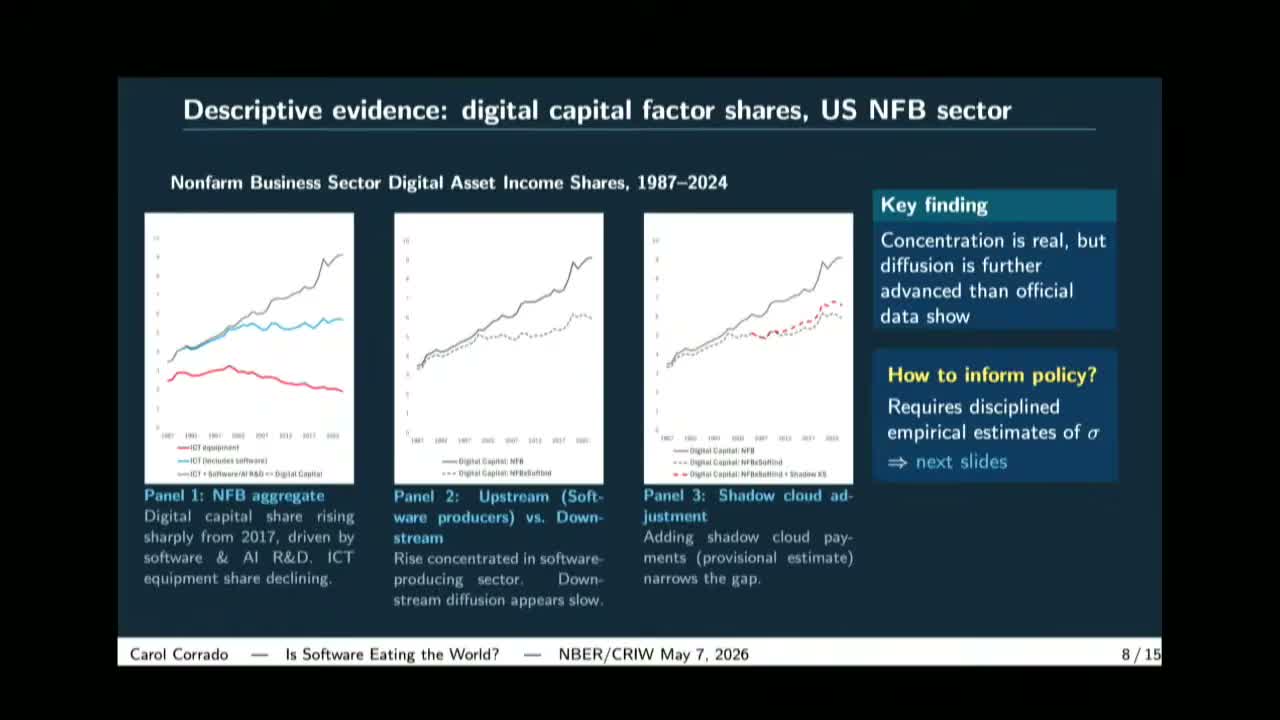
The authors are careful that this is a lower bound and that it makes no attempt to separate ai cloud spending from generic compute, so some ordinary server rental is riding along inside it.
Now the surprising part.
A paper titled “Is Software Eating the World?” concludes, from its own econometrics, that cheap ai raises the labour share and drives ict’s own cost share toward zero.
The mechanism is arithmetic rather than optimism. On eu klems data covering nine industries across twelve countries — pooled into 1998–2007 and 2011–2019 cross-sections, with the software industry itself dropped — the authors estimate a translog cost function and report Morishima elasticities, which are the conceptually right measure once you have more than two inputs. Every single entry comes back below one, ranging roughly from 0.38 to 0.89.
Here and are the cost shares of inputs and , is the price of input , the terms are the estimated translog coefficients, and is the Morishima elasticity: the relative cost share of against rises or falls exactly as that elasticity exceeds or falls short of one (equations 20–21). Below one means firms buy more of a cheapening input but not proportionally more, so the cheapening input loses share and everything else, labour included, gains.
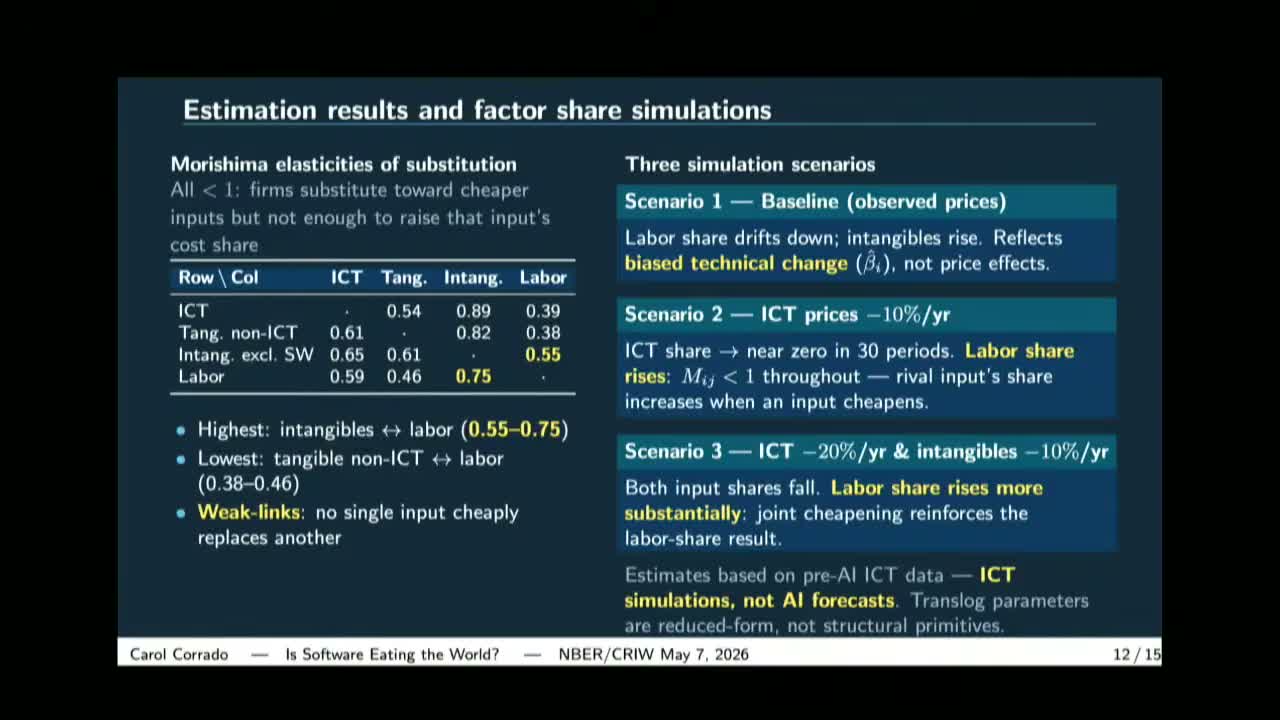
Simulate ict prices falling 10 percent a year — the draft notes drily that this is more than ten times the observed rate in its own data — and ict’s cost share reaches zero within thirty periods, which the paper compares to agriculture in Jones and Tonetti (2026): a sector that became so productive it stopped mattering to the accounts. And the labour share rises. Corrado, deadpan: “we do some simulations that are very labor friendly. Not surprisingly… let me just say they’re labor friendly.”
The caveat she and the paper both press is genuine and load-bearing: these elasticities are estimated on 1998–2019 data, which contains no ai whatsoever, they are reduced-form rather than structural, and they hold fixed the meta-technology of how tasks get combined. If ai changes that — the Amazon logistics possibility the paper keeps circling — the elasticities could go above one and the result inverts. Her formulation was that “if ai shifts the morishima elasticities above unity then the labor friendly results will go away but they haven’t yet.”
Beraja’s punch, which lands on the shadow adjustment.
Beraja’s framing for the session was that ai should be thought of not as a fancy robot that automates tasks but as a technology that accelerates learning across agents, and he was generous about this paper specifically, calling the description of organisational capital as the accumulated stock of solutions to the meta-task coordination problem “a fantastic phrase” and giving Corrado credit for attempting something hard. Then he explained why it is hard, and the explanation is the best objection anyone made all session.
The perpetual inventory method works for machines because what you count on the investment side is what enters the stock. Not so for organisational capital. What you observe — cloud spending, tokens, ai expenditure — is an input into the thing that enters the stock, not the thing itself; the asset is the knowledge produced by combining that spending with managerial and worker time, and you observe none of the latter. And then the sting: “If you have ai that is getting cheaper then what’s going to happen within the companies is we’re going to use a bit more ai and we’re going to substitute away from other things that we were using before to build organizational capital. So if we just count and accumulate all the expenditures of ai, we’re gonna be overstating the actual increase in investment because we’re not seeing all the substitution that is happening say with manager time, worker time.” It works only if ai and manager time are perfect complements; otherwise you are counting a shrinking bill on one input as though it were the whole investment.
Which is to say: the paper’s best result is the precondition for the paper’s method failing. The 38.5 percent annual decline is exactly the thing that triggers the substitution Beraja says you cannot see, and Panel 3 — the crude shadow cloud adjustment that closes the gap — is exactly the exercise that would be biased by it. He also noted, quite independently, that a token bill mixes production with investment, since nobody can tell whether the tokens went into writing emails or into codifying a new process, which is the same seam the paper draws conceptually and cannot yet cut empirically.
None of this was answered on the record. The chair asked, with a minute left, whether any of the authors wanted to react to the discussion; the transcript records laughter, a pause, and then an unidentified voice thanking Beraja for ideas about entrepreneurship — a reference that points at one of the other two papers, not this one. Corrado’s only Q&A contribution came earlier, to an audience member the chair never named who asked whether diffusion is arriving through ai-native entry rather than incumbent adoption, and it restated the two-sector distinction rather than engaging the measurement objection: an ai-native firm operating inside the stack and an ordinary business disrupted by ai “are just serving very different roles in the economy. Both are good. But it’s the diffusion is the first example that I used.” Correct, and not the question Beraja asked.
Anyway. Corrado made one aside in the talk that is worth more than it sounds. Marc Andreessen’s actual 2011 prophecy was that software-driven companies would disrupt and dominate traditional industries, and looking at Panel 2 of her own chart, she said: that hasn’t happened yet. The paper’s answer to its title question is therefore something like we can’t currently tell, and the reason we can’t tell is that the meal isn’t being written down. Which leaves the tidiest joke to the simulations, where an input whose price falls fast enough eventually vanishes from the cost accounts altogether — an outcome that would, at last, give the national accounts a perfectly accurate reading of zero.