Notes on:
The Microstructure of AI Diffusion: Evidence from Firms, Business Functions, and Worker Tasks
NBER Working Paper 35141; Census CES Working Paper 26-25
7 May 2026
AI adoption · firms · Census · measurement
Talk · Paper · doi · PDF · Transcript
Made with AI: Opus 5 (reading and writing)
Part of AI and Economic Measurement, Spring 2026
Kathryn Bonney, Cory Breaux, Emin Dinlersoz and Lucia Foster (us Census Bureau), John Haltiwanger (University of Maryland) and Aditya Pande (Maryland and Census). Presented by Dinlersoz at the nber conference on ai and Economic Measurement, Stanford, 7 May 2026; discussant Martin Beraja (mit), who took all three papers in the session together. Written from the Census working paper (ces 26-25, April 2026), later nber Working Paper 35141.
Two true sentences
Eighteen percent of American firms used ai in a business function during the last two weeks. Thirty-two percent of American employment sits inside a firm that did. Same survey, same firms, same fortnight; the only thing that changed between the two sentences is what you counted. Weight each firm equally and you get 18. Weight each firm by how many people work there and you get 32. The entire fourteen-point gap is the firm-size gradient, and the size gradient is doing so much work because of a fact about America that has nothing to do with ai: roughly 75% of us employer firms have fewer than ten employees. The average firm in this sample has twenty. When you read that “adoption” is 18%, you are mostly reading a statement about dental practices and two-truck landscaping outfits, which is a perfectly good thing to read, as long as you know that is what you are reading.
This is the useful thing about the Census Bureau’s Business Trends and Outlook Survey. It is nationally representative of the universe of us employer firms, biweekly, and enormous — the second ai supplement went out to the whole 1.2 million-business sample between 17 November 2025 and 8 February 2026, and the analysis pools more than 117,000 distinct firms, none of them sampled twice. (The presenter said “about 120,000 firms,” which is the same thing said out loud.) A survey that big does not have to choose between the interesting firms and the representative ones.
The instrument is the paper
You would like to know whether a business uses ai. The cheap version is one yes/no question, which is what every survey has been asking, and which cannot tell a firm running ai in one function from a firm running it in twelve, and cannot tell you whether anyone who works there has ever touched it. So this supplement asks the same firm three nested questions instead: a firm-level dummy (did this business use ai in any business function in the last two weeks), then a matrix of 15 named business functions — production, services, strategy, finance and accounting, sales and marketing, customer service, R&D, it, hr, communications, management, supply chain, quality, distribution, legal — and then a matrix of 9 worker task types, lifted deliberately from Bick, Blandin and Deming’s (2024) worker survey so the numbers can be laid alongside it. Every layer is reported twice, once firm-weighted and once employment-weighted.
The authors describe the function and task lists as providing “multiple entry points for identification,” which, translated, means that people are bad at answering an abstract question about their own behaviour until you show them a list of things they do. Hold that thought.
A five-word edit, worth more than two years of diffusion
From September 2023 the survey asked whether the business used ai “in producing goods or services.” This was not sloppiness; it was a filter, inherited from the 2019 Annual Business Survey and designed to catch economically material integration while excluding the smart thermostat and the onboarding chatbot. Over two years of the ChatGPT era, that question walked the firm-weighted number from 3.5% to about 10%.
Cognitive testing in 2025 found the problem. Respondents in marketing, intermediation and admin-heavy businesses could not map their ai onto the word production — they said no, and then in follow-up interviews described ai throughout their marketing, accounting, project management and R&D. So effective 17 November 2025 the Bureau replaced “in producing goods or services” with “in any of its business functions,” holding every other word fixed, including the definition and the examples. As the presenter put it, “we simply replaced in producing goods or services with any of its bisness functions in both of the questions keeping everything else intact and this this has had an effect on our estimates as we’ll see shortly.”
The number went to 18%. Five words moved the national ai adoption rate further than two years of measured diffusion had. The authors are honest that the wording is not the whole jump — a lapse in federal funding meant no collection happened for a stretch while adoption continued, and the supplement itself primed respondents — but they also have an internal check. Two of the 15 functions, production of goods and provision of services, exist precisely as a bridge to the old wording, and their union comes to just 6%. The old question, in other words, was already picking up considerably more than literal production. It was not measuring what it said; it was just measuring less than the new one.
Where the ai actually is
Concentrated, and narrowly used where it is concentrated. Firms with 250 or more employees are at 31% current use against about 18% for firms under 20; firms with 1,000-plus in ai-heavy sectors reach 57% now and expect 68% within six months, and if you further restrict to respondents who are top executives and owners you get to the seventy-percent range — which is roughly where the other business surveys live, and that is the point.
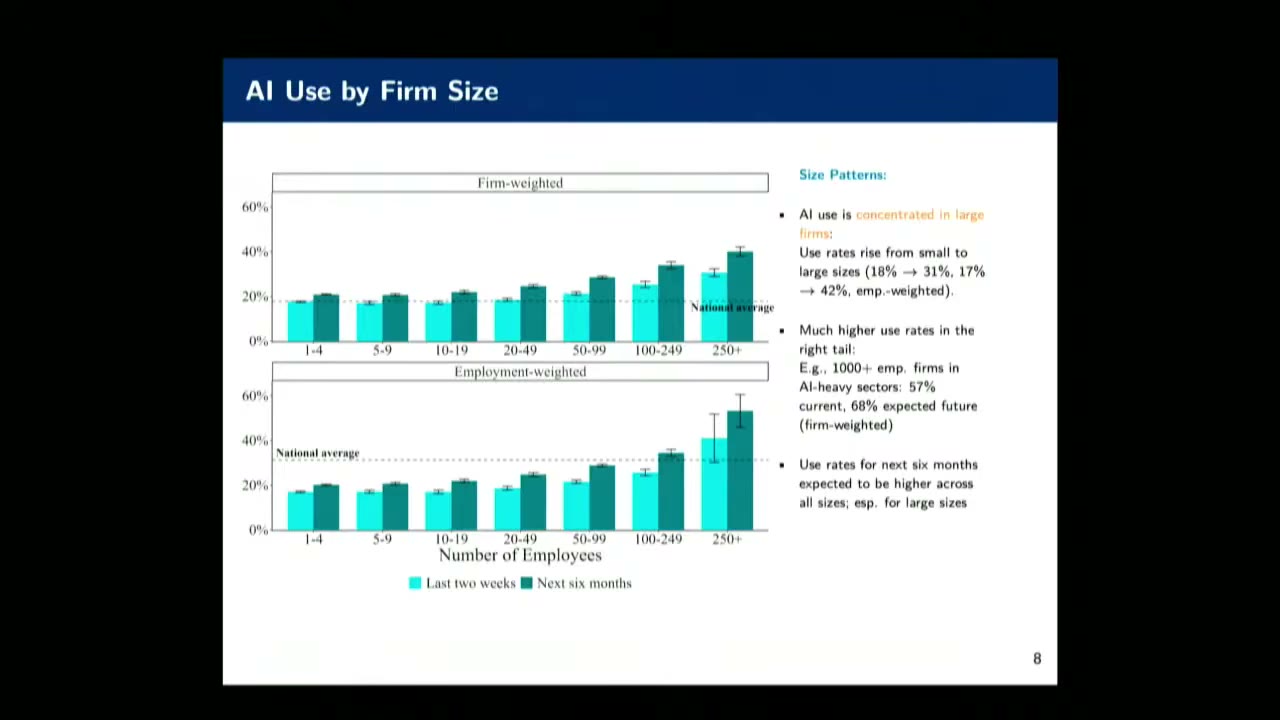
Within adopting firms, the footprint is thin. Sales and marketing is the most common function at 52% of functional adopters, then strategy and business development, it and R&D; 57% of functional adopters use ai in three functions or fewer, and 65% of firms limit worker generative-ai use to three task types or fewer, dominated by writing and editing. Sixty-four percent of ai-using firms report making no organizational adjustment at all to accommodate it. The single most common reason non-adopters give for not adopting is that ai “is not applicable to this business,” at 65% of firms — a much larger obstacle than cost, privacy, or regulation, which sits near the bottom.
The decoupling, which is the actual finding
Firm-level adoption is 18%. Worker-task use, as reported by the firm, is 23%. These are not nested.
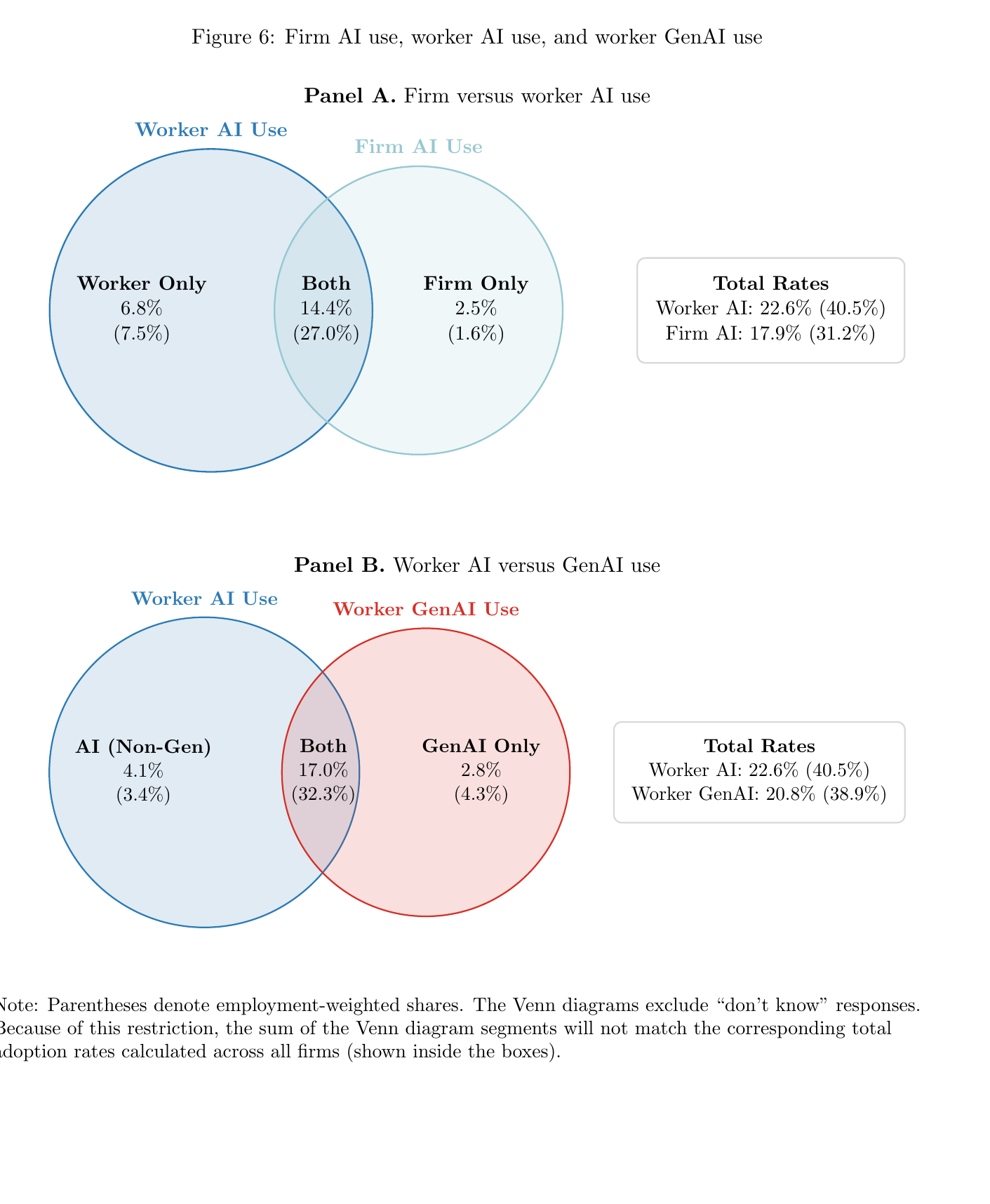
So 6.8% of firms have workers using ai while the firm reports no formal adoption, against 2.5% running the other way, with 14.4% doing both. Put conditionally, 36% of firms where workers use ai report no firm-level adoption, and 19% of formal adopters report no worker use. The authors read this as two diffusion channels operating at once, top-down and bottom-up, and are immediately honest about the limit: “we have no data on the dynamics of adoption and and the mechanisms directly. Uh no questions on those.”
One caveat is load-bearing enough that the presenter led with it: the worker answers come from a firm-level respondent, usually an owner or executive, not from workers. “btos is not a worker level survey only a firm level survey.” That cuts both ways — an enthusiastic respondent assumes workers use ai because the firm does; an out-of-the-loop one misses the person quietly running documents through ChatGPT.
The two channels have opposite labour signatures
Here the paper stops describing and starts regressing, carefully. It builds three scaled indices — , the share of the 15 functions using ai; , the share of worker tasks; , the share of nine operational investments and organizational changes made to implement ai — and runs two specifications:
where is a binary firm outcome — above-average performance, a sales increase, an employment decrease, current or expected — and , , , are fixed effects for size class, three-digit industry, state and survey period. Specification (1) is just (2) with the three forced equal. The entire labour finding is what happens when you unrestrict it.
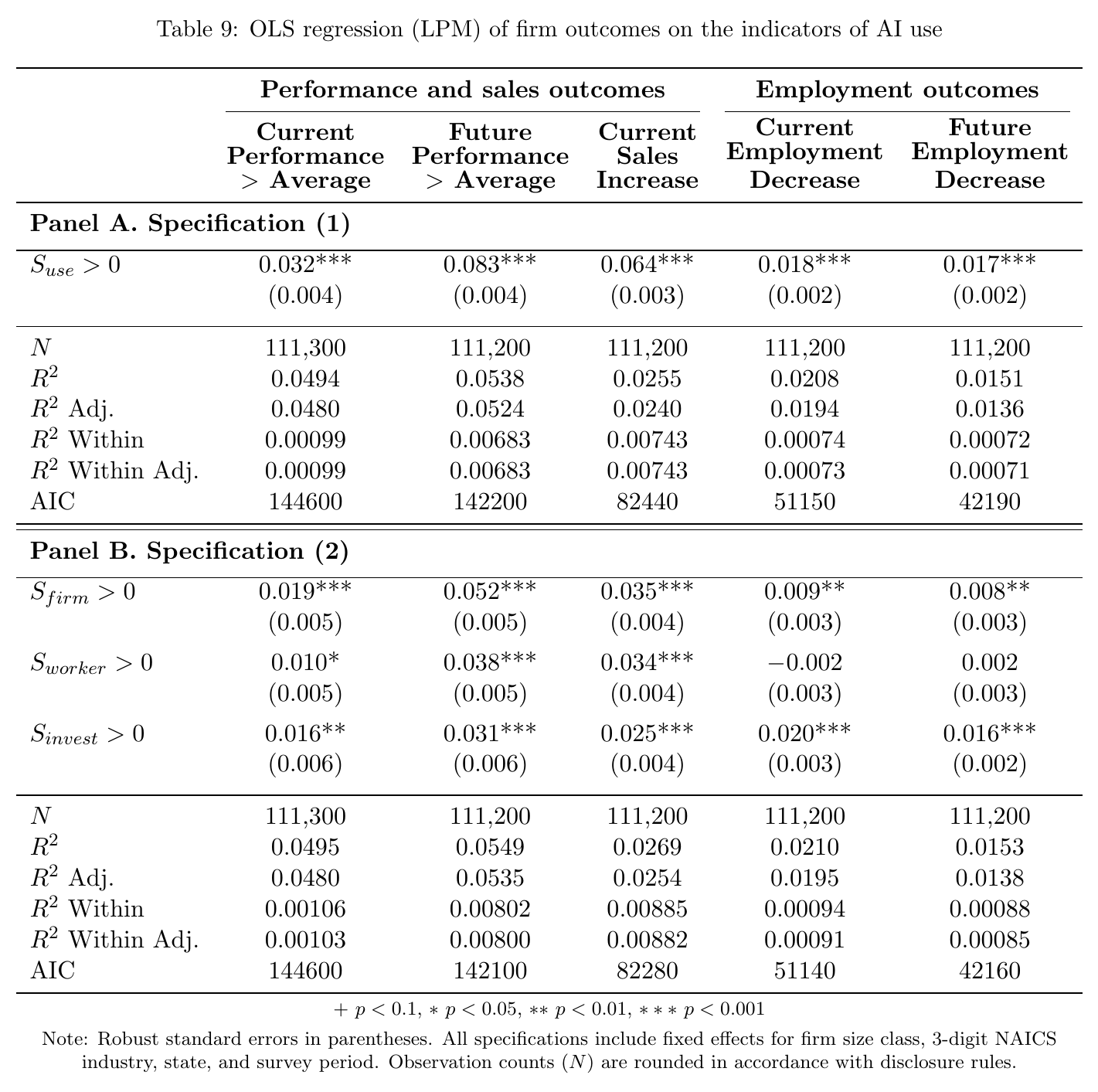
All three predict good commercial news: functional breadth is worth 1.9 points on above-average current performance, 5.2 on expected future performance, 3.5 on a current sales increase. But on employment declines the three separate cleanly. Operational investment carries the largest coefficients, 2.0 and 1.6 points against a base rate of about 10%. Functional breadth carries 0.9 and 0.8. Worker-task breadth carries −0.002 and 0.002, neither significant. Buying the compute, retraining the staff and redesigning the workflow is where the headcount reductions are; your employees using a chatbot is not. The presenter’s own reading was that “broader functional use and operational investment may capture top-down structural redesign aimed at capital labor substitution while worker task use may operate as a productivity output enhancer without replacing workers,” followed immediately by “of course there’s no causal association here.” Take that seriously: management quality is unobserved, and firms doing well can afford to retool.
The other displacement result is that the thing ai is displacing is software. Sixteen percent of ai-using firms report substituting ai for operations previously performed by existing software or equipment, roughly three times the share reporting any ai-driven employment change in either direction. The labour-market discourse is loud; what actually shows up in the microdata is a cancelled licence.
What Beraja pushed on
Beraja had fifteen minutes for three papers and spent them proposing one theory for all three: that ai is not a fancy robot that automates production tasks but a technology that accelerates learning, and that the organizing question is “not going to be is ai being adopted which can be you know read as a bit shallow but does ai change how agents learn and use uh information.” He liked this paper’s functional cut specifically because functions “align in my mind better with what is organizational learning,” and he did something generous with its most deflating result: the narrowness is not a sign that ai is a damp squib but “just early evidence for organizational learning the firms are still figuring it out.”
His actual ask was to measure the transition between the layers rather than the layers. “I would commend the authors to really like push this idea of how is it that we move from one layer to the to to the other layer. I thought that was the most interesting part of of the paper, not just oh here’s another survey where we’re measuring ai use within firms.” His second ask, aimed at the intangibles paper in the session but routed explicitly back to this one, was the investment-versus-production problem: when you observe ai use, “we don’t know where those tokens were used for writing emails which would be like a production task or they were used for you know ideating new products or codifying information anything that looks more like a like an investment.” Which is a nice thing to say in front of this particular paper, because is about as close as anyone currently has to that split, and it is precisely the index that predicts employment declines.
The authors did not answer on stage. Given a minute at the end, one of them — the chair did not name who — said “I just want to thank you. It was really nice and you gave us some new ideas to exploit entrepreneurship,” which got a laugh. The substantive answer had already happened in the Q&A, to a questioner nobody named who pointed out that a survey of incumbents cannot see diffusion that happens by ai-native firms being born: “we’re um in Silicon Valley right now, the home of startups.” Dinlersoz’s reply was that the btos is being matched to the Longitudinal Business Database, that the match is almost done, and that firm age is the variable that lets them look at young firms versus old. A second panellist, whom the chair called Carol — captions mangle names, so treat that as uncertain — added the distinction that matters: a firm using ai to disrupt a traditional business and an ai firm operating in the ai stack are different animals, and only the first is diffusion.
Anyway
The paper’s closing service is a section reconciling its 18% with the Survey of Business Uncertainty’s 69%, and it does this by stacking the filters — top executives, ai-heavy sectors, large firms — until btos reaches 58% firm-weighted and 76% employment-weighted, against 69% and 78%. The surveys were never inconsistent; they were counting different Americas. The bound the authors offer is the cleanest line in the paper: even if every btos respondent had been a top executive or owner, the firm-weighted use rate would have been at most 21%.
Which leaves the wording. The single largest jump in measured American ai adoption in three years was produced not by a model release but by the Census Bureau’s own copy editor, and Bick and coauthors (2026), looking at the European instrument where firms using ai for any business purpose outnumber firms using it for production by about five to one, think the revised btos question is still too narrow. There is presumably a version of this question that finally describes what firms are doing, and when someone writes it the number will go up again, and none of that will be diffusion.