Notes on:
The Inflation Accelerator
American Economic Review (forthcoming)
4 December 2024
Phillips curve · inflation · price rigidities · monetary policy
Talk · doi · PDF · Transcript
Written by Fable 5
Andres Blanco (Atlanta Fed and Emory), Corina Boar (nyu), Callum Jones (Federal Reserve Board) and Virgiliu Midrigan (nyu). Presented by Midrigan at the cebra webinar series “Inflation: Drivers and Dynamics,” Session 26, December 3, 2024 — a brisk fifteen-minute slot with no discussant and a shared Q&A. Written from the February 2026 draft, which is forthcoming at the American Economic Review; the talk covered an earlier version, and where the two differ (the draft’s headline slope peaks at 0.13, the talk’s at 0.12) this digest follows the paper.
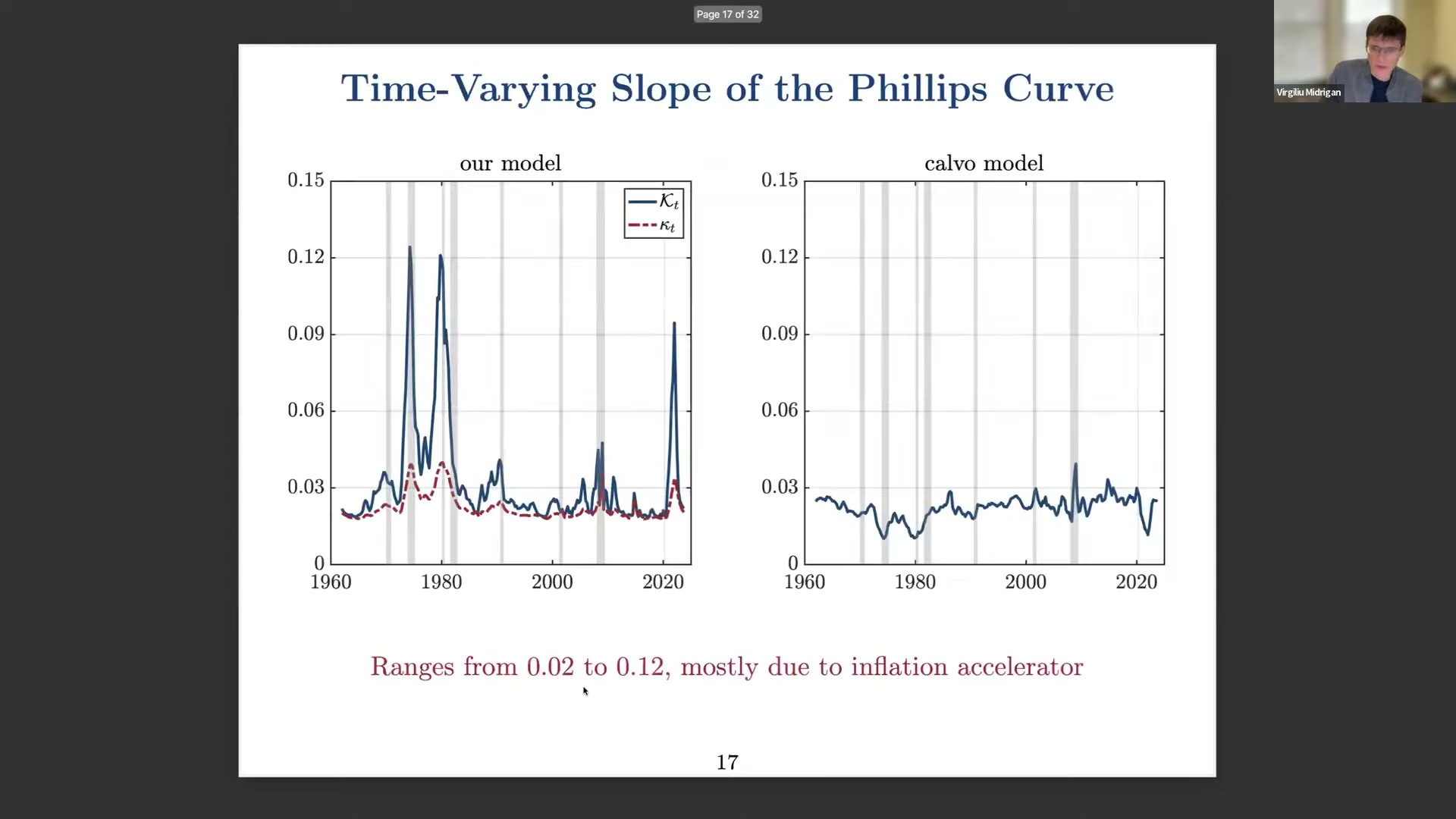
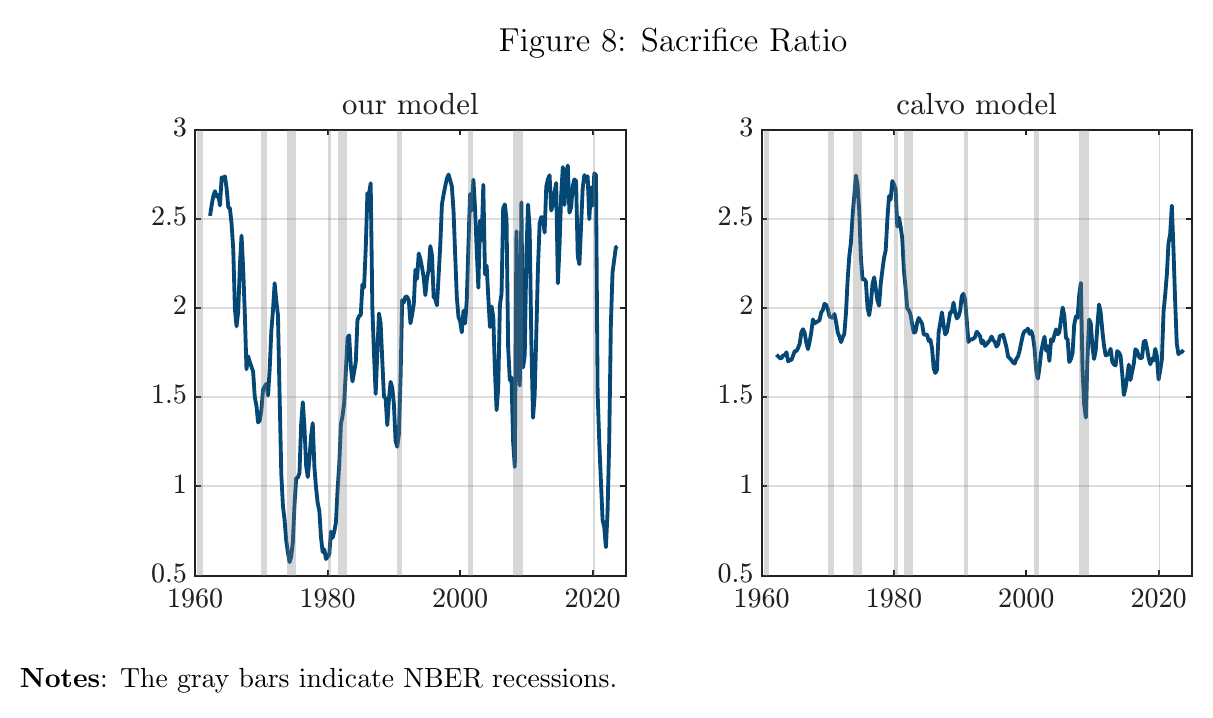
The slope of the Phillips curve — how much inflation you get per unit of economic slack, and therefore how much recession it costs to disinflate — is one of the most consequential numbers in macroeconomics, and the standard workhorse model treats it as a structural constant. This paper’s claim is that it is nothing of the sort: it is a dial that the inflation rate itself turns. In their model fitted to us data, the slope sits around 0.02 in quiet decades and reaches 0.13 in the late 1970s — roughly a factor of five — and the “sacrifice ratio” moves inversely: shaving a percentage point off inflation costs about 2.5 percent of output when inflation is low and about 0.5 percent when inflation is high. Disinflation is cheapest precisely when you need it most, which is either a deep irony or a mercy, depending on which side of the output gap you work.
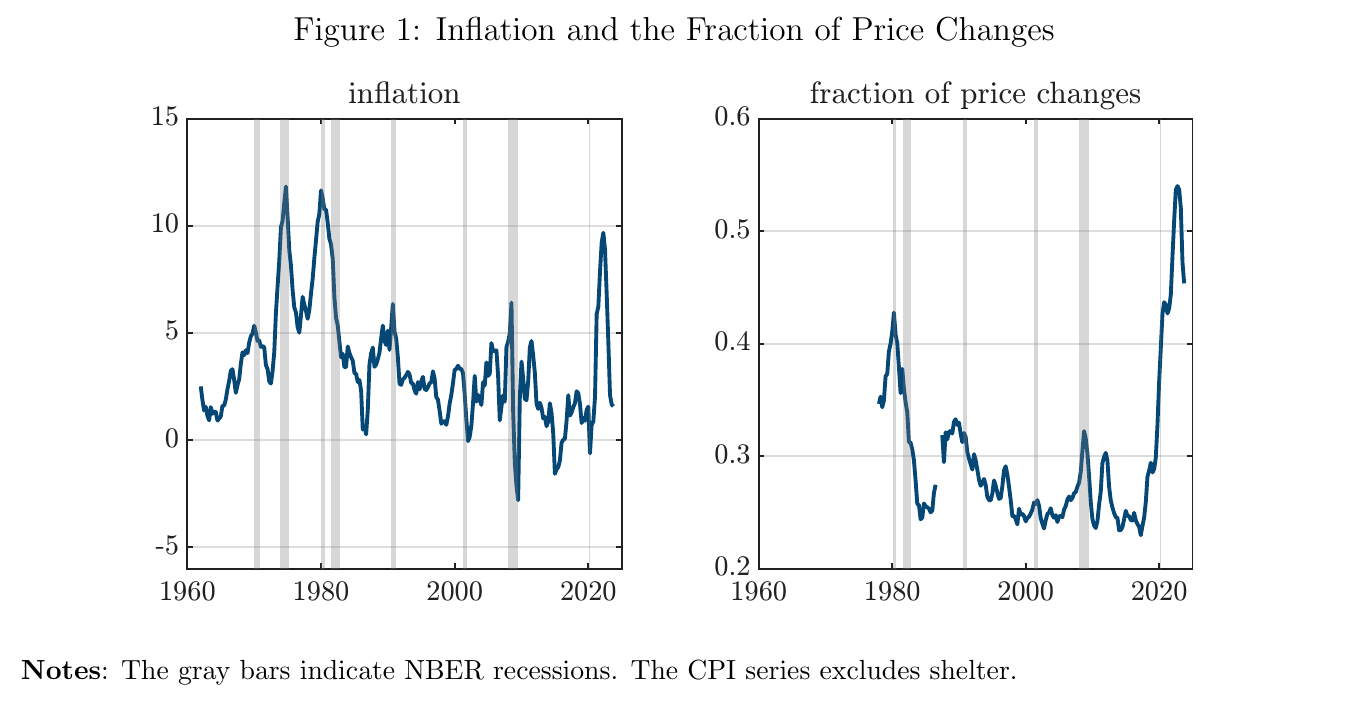
The fact the model is built around. The fraction of us consumer prices that change in a given quarter is not constant. In normal times it is about 25 percent. In the early-1980s inflation it hit roughly 40 percent; post-Covid it spiked past 50. This is one of the better-documented facts in the price-setting literature, and it is fatal to the standard Calvo model, in which the adjustment frequency is a fixed parameter — the model is calibrated to a world that stops existing exactly when inflation becomes interesting.
The existing menu of models handles this badly from both ends. Time-dependent models (Calvo, Taylor) are tractable because the frequency is exogenous — which is exactly the margin the data says moves. Menu-cost models endogenize the frequency, but at the price of carrying the entire cross-sectional distribution of prices as a state variable, because a firm’s decision to adjust depends on how far its own price has drifted; with aggregate shocks moving that distribution around, the models become numerically heavy and rarely make it into policy work. And — the authors are well placed to say this, having written the earlier paper (Blanco et al. 2024) — a menu-cost model disciplined by the micro data on price changes turns out to generate very little movement in the adjustment frequency anyway. Midrigan told the webinar the origin story plainly: they had started out trying to get sectoral shocks to move the frequency in a menu-cost framework, found it “a bit disappointing,” and wrote this simpler thing instead.
The trick. The tractability problem in menu-cost models comes entirely from selection: firms choose which prices to fix, namely the most misaligned ones, so you must know the whole distribution of misalignment to know anything. The authors’ move is to legislate selection away. Firms sell a continuum of products and each period choose how many prices to reset — subject to a convex adjustment cost — but not which: the adjusted products are drawn at random, Calvo-style, within the firm. With no selection, the distribution of prices stops mattering for anyone’s decision; two summary statistics per firm (its price index and a misallocation index) suffice, firms end up symmetric, and the whole economy aggregates exactly. The model collapses to the standard Calvo system plus one equation — a marginal-cost-equals-marginal-benefit condition for the fraction of price changes, eq. 13 in the paper — and nests Calvo itself as the limit where the adjustment cost goes to infinity. Is assuming away selection a cheat? Less than you’d think: the paper points to a body of evidence (adjustment hazards that are surprisingly flat in the firm’s own price gap, and their own Appendix using NielsenIQ data showing that movements in the aggregate frequency come from firms adjusting more of their prices, not from more firms adjusting) suggesting selection is weak in the data. This was also the first thing the webinar Q&A probed — what micro evidence would validate the multi-product assumption — and Midrigan’s answer was candid: the assumption is there for tractability, what matters is that within-firm hazards are roughly flat in the price gap, and the indirect evidence (kurtosis of price changes, weak correlation of adjustment with price gaps) is comfortingly consistent with that.
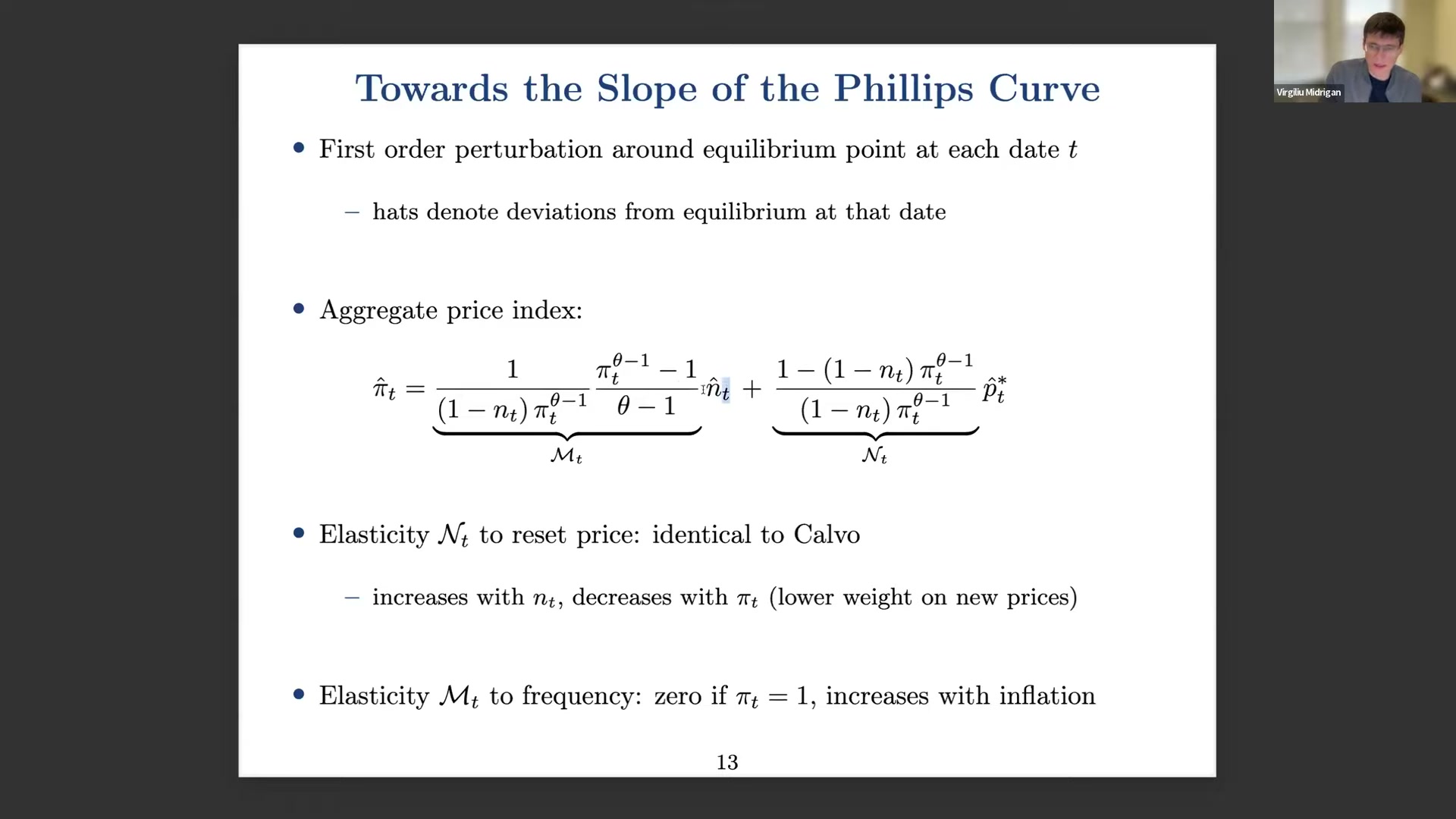
The accelerator. Here is the mechanism, and it fits in one identity: inflation is (roughly) the fraction of prices that change times the average size of a price change. Log-linearizing the price index gives eq. 15 of the paper:
where is inflation, the fraction of price changes, the relative reset price, trend inflation and the demand elasticity. The term is pure Calvo. The term is the new one, and its crucial property is that it vanishes at zero trend inflation and grows with it. The intuition is the identity above: at zero inflation the average price change is zero, so it doesn’t matter how many extra firms adjust — they adjust by nothing, on average. At 8 percent trend inflation, every marginal adjuster arrives carrying the full backlog of accumulated inflation, so a small rise in the frequency releases a large amount of pent-up repricing into the index. (Readers of Caplin and Spulber (1987) will recognize the flavor: the extensive margin of price adjustment is idle ammunition at low inflation and live ammunition at high inflation.)
Now close the loop. Inflation raises the benefit of adjusting, so the frequency responds to inflation with an elasticity (eq. 16); the frequency feeds back into inflation with elasticity . Solve the fixed point and the slope of the Phillips curve (eq. 17) is
where is the returns-to-scale parameter governing strategic complementarities and is the frequency’s elasticity to the reset price. The signature of the accelerator is the denominator : a genuine feedback multiplier — higher reset prices raise the frequency, which raises inflation, which raises the incentive to adjust, which raises the frequency — that compounds geometrically, and both and grow with trend inflation, so the multiplier is roughly inert at 2 percent inflation and ferocious at 10. Setting recovers the Calvo slope with trend inflation, and the gap between the two is the accelerator: as trend inflation goes from 0 to 8 percent, the full slope triples from 0.02 to almost 0.06 while the no-accelerator slope crawls from 0.02 to 0.03.
Fitted to history. The authors back out the monetary shocks that make the model reproduce us inflation from 1962 to 2023, check that it also reproduces the observed path of the adjustment frequency (well for the 1980s; it undershoots the post-Covid frequency spike, which they attribute to sectoral shocks the single-shock model lacks), and then read off the slope date by date. It ranges from 0.02 in the 1990s to 0.13 at the inflation peaks; without the accelerator — feeding the same frequency path into an otherwise-Calvo mechanism — it would only reach 0.04. Around Covid the slope quintuples from 0.02 in early 2019 to 0.10 in early 2022. In the Calvo model the slope not only barely moves but actually falls when inflation is high (newly reset, higher prices carry less weight in the index), which is exactly backwards relative to their model.
The sacrifice ratio follows. Reducing inflation by one point over a year costs about 2.5 percent of output in placid times and about 0.5 percent at the 1970s–80s peaks; the model puts the post-Covid sacrifice ratio at 0.6 in 2022, down from 2.7 pre-pandemic — a model-based gloss on why the 2022–23 disinflation was so much cheaper than the pessimists’ Calvo-flavored arithmetic predicted. In the Calvo model the sacrifice ratio rises with inflation, again backwards.
What it buys for policy analysis. An estimated, richer version — cost-push and productivity shocks, time-varying Taylor-rule coefficients and inflation target from Coibion and Gorodnichenko (2011) — delivers a pointed reading of the Great Inflation: cost-push shocks drove the early-1970s spike, a drifting inflation target drove the late-1970s one, and, because accommodative policy raised trend inflation and therefore the slope, the same adverse shock was far more inflationary in 1980 than in 1995. To the old “bad policy or bad luck” question the model answers: an interaction — bad policy is a bad-luck amplifier. Two more results run against the standard model’s grain: the Taylor-principle determinacy region widens with trend inflation (in Calvo it shrinks, alarmingly so at high inflation, because the curve flattens; here the endogenous frequency steepens it), and the welfare costs of inflation are smaller than Calvo’s and grow more slowly, because the economy defends itself — when inflation rises, more prices adjust, and misallocation grows less than it otherwise would.
The honest caveat, which the paper states rather than buries, is that the post-Covid episode only half-fits: the observed frequency spike (to over 50 percent) exceeds what the model produces from a single aggregate shock, because the pandemic featured simultaneous price increases and decreases across sectors that a one-shock model cannot generate. The mechanism is right; the shock structure needs enriching — which, since the whole point of the paper is that the model is a one-equation extension of Calvo that estimates in minutes rather than a distribution-lugging menu-cost behemoth, is now a feasible to-do rather than a research program. That is the real contribution here: not a new fact, and not even a new intuition (Caplin and Spulber had the seed in 1987), but a new price point — state-dependent pricing at Calvo’s computational cost. Cheap tractability, it turns out, is like disinflation: everyone wants it, and the trick is noticing when the model is offering it to you at a discount.