Notes on:
Overview of the U.S. Census Bureau's Frames Program
NBER EMRI conference presentation
18 September 2026
Census Bureau · data infrastructure · record linkage · official statistics
Talk · Slides · Transcript
Made with AI: Opus 5 (reading and writing), GPT 5.6-Sol (reading), Fable 5.1 (adjudication), Sonnet 5 (verification)
Part of Innovations in Measuring Employment, Fall 2026
There is no paper for this one. Deirdre Dalpiaz Bishop, who has been the Census Bureau’s Associate Director for Economic Programs since January, came to the session with nine slides and called what she was giving “a sneak peek of the frames program.” So treat what follows as institutional intent with dates attached rather than as evidence: nothing here is estimated, nothing is benchmarked, and no official series is revised. It is also worth saying at the top that her deck carries no numbers at all beyond a few citations. Every figure below was spoken aloud, and exactly one of them is corroborated on a page of anything — a public Census briefing from May 2023, which is a different document by a different presenter, flagged where it appears.
The thing being fixed is an org chart. You are a statistical agency. Over thirty years you build four inventories, one for each object you have to count: addresses, businesses, jobs, people. Each gets built by a different directorate, for a different programme, on its own identifiers, on its own schedule, in its own language. Bishop’s account of the result is unusually plain for an agency talk: “For decades though, these frames of information have been maintained in silos. By separate entities, separate directorates at the Census Bureau, with really little collaboration or communication across directorate.” What that cost, in her words, was “a comprehensive nature to the strategy and to the coverage,” and what it produced was “a lot of duplication across the Census Bureau and in some instances, differences in statistical measurement.”
That last clause is the whole conference in miniature, delivered by the person who owns the data the rest of the room spends two days disagreeing about. The four assets are all things this audience already uses. The Master Address File, merged out of the 1990 Census address list and usps delivery files and continuously updated since the 2000s, with every address carrying a lat/long in tiger. The Business Register, and the Longitudinal Business Database built on top of it to track establishments over time. lehd, assembled from state ui wage records by linking a person key to a state business identifier. And the Person Identification Validation System, which validates ssns, swaps them for piks, and attaches those piks to anything with demographics on it.
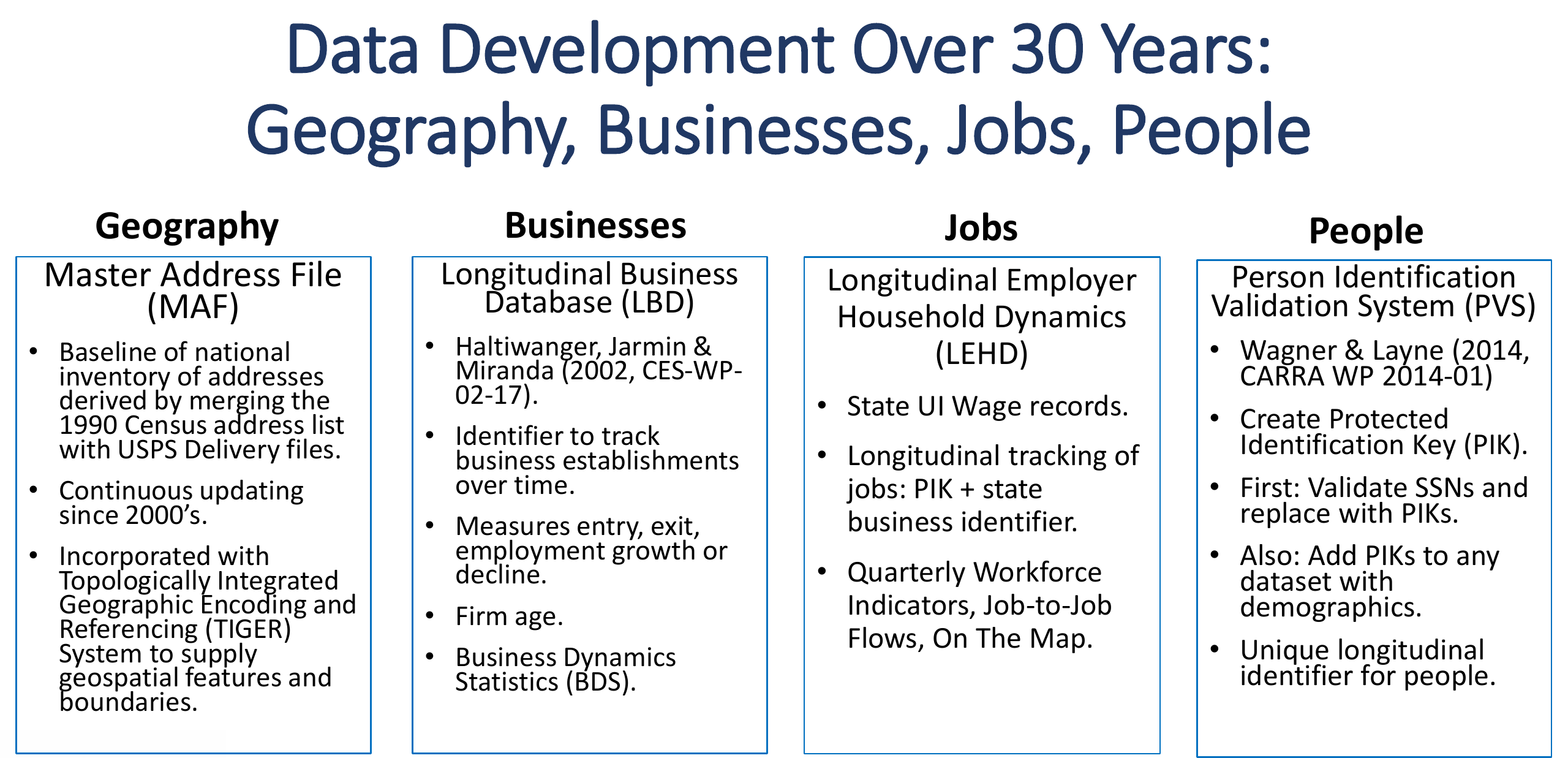
The programme’s move is to promote each of these from a programme-specific dataset into an enterprise frame and make the four linkable by construction, so that a person record carries a pointer to a job, a job record to a business, and every record of any kind to a location. Bishop’s scale numbers for what that covers, all spoken: over 331 million people, 146 million housing units, approximately eight million business establishments, and over 14 billion job records — where a job record is “a relationship between a person and a business in which at least $1 in wages was paid in a given quarter,” which is to say person–business–quarter observations accumulated over lehd’s life, not 14 billion jobs. The 14 billion is the one count that also appears on a page of the 2023 briefing.
And then there is the good part. The Master Address File exists to find people. It was built so the Bureau could count everyone once, only once, and in the right place; the address is the instrument of the right place. Businesses lived in a different directorate, on a different list, and so, in Bishop’s words, “we never focused on the businesses on the geospatial side before.” Eventually somebody ran the match. “We were pleased to discover that we already listed 93% of the addresses in the business register within the master address file.”
Sit with that for a second. The national address file had been quietly carrying almost the entire business landscape of the United States for two decades, and nobody had checked, because addresses were one directorate’s asset and businesses were another’s. This is the single hard empirical fact in the talk and the justification for extending maf/tiger to non-residential and mixed-use addresses, and it is worth being precise about what it is: an overlap rate. It says 93% of Business Register addresses were already in the file. It says nothing whatever about whether those addresses are right, which — as the rest of the session spends an hour demonstrating — is the question.
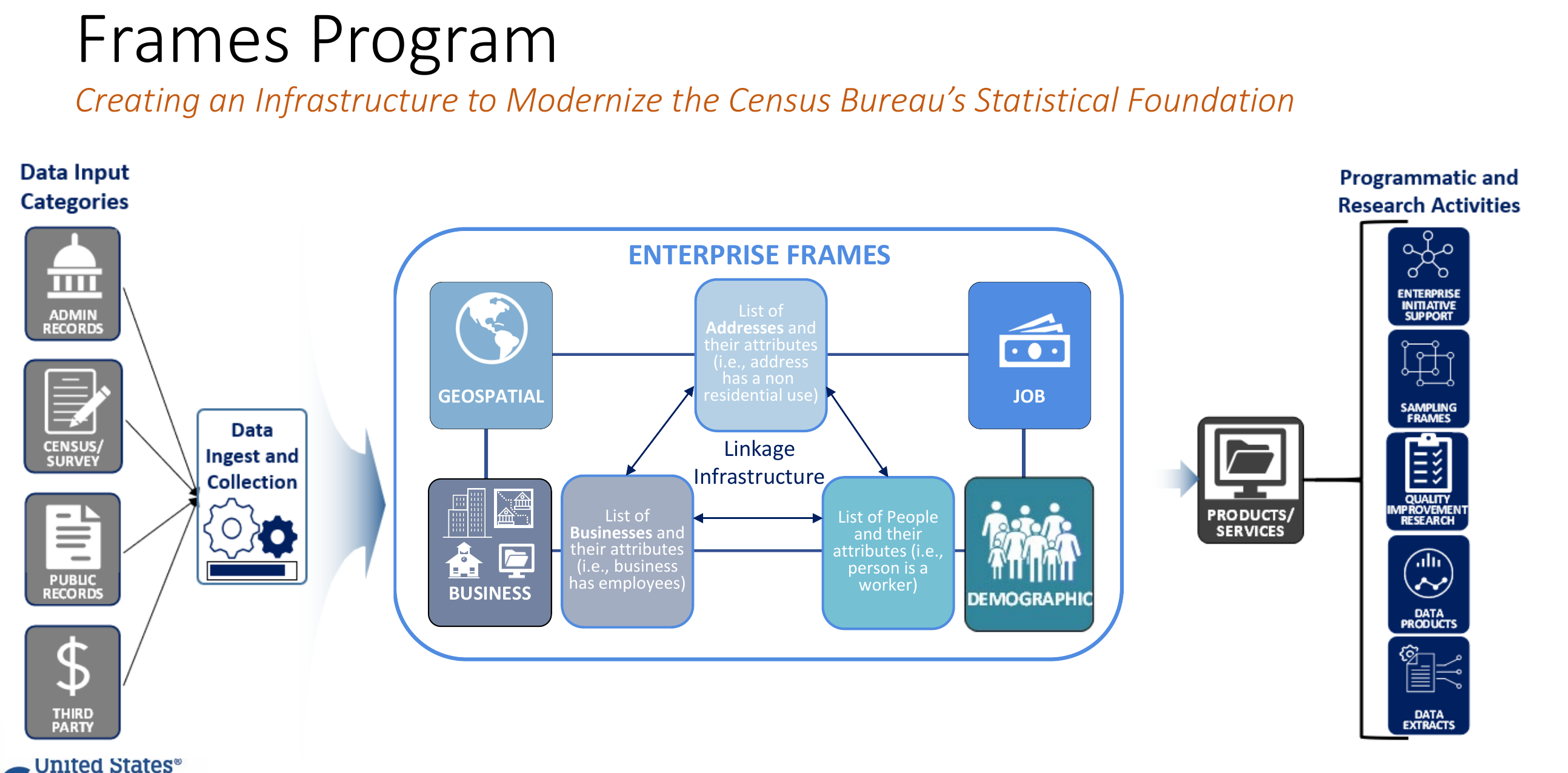
The payoffs claimed are roughly what you would guess. A business frame enriched with irs, ssa and third-party records — she names point-of-sale data — to date company births and deaths “in a timelier manner,” which is the exact quantity the next two papers fight over. A job frame that folds irs earnings records for self-employment in alongside the ui wage records, with self-employment dynamic statistics promised for the December meetings. A demographic frame, the newest of the four, built because “we have geospatial, we have businesses, we have jobs, but we don’t really have people,” whose distinctive trick is predicting a person’s most likely residential address nearly on demand. Smaller and better-targeted samples. And the pitch she clearly thinks is the crowd-pleaser: “as the central source for the data, it ensures consistency in measurement and sources. I hope that’s music to your ears.”
Benjamin Pugsley, discussing the session, did not attack any of this. He specified it. His useful observation is that the two business universes do not actually disagree about employment — total and private payroll employment in qcew and the Business Register “largely agree… they’re not diverging. What’s diverging is the number of establishments,” which means “they disagree over the allocation of this employment across places.” That is a geospatial problem wearing a business-dynamics costume, and it is precisely the thing a geospatial frame is nominally for. Split by size and it localises: bds and bed track each other tolerably for establishments with five or more employees, while for one-to-four-employee units “there’s a huge difference,” with the very small ones growing fast in the qcew frame and much less fast on the Census side. Asked which is right, he refused the question in the correct way — “There’s both right to some extent.”
His candidate mechanism is remote work. ui tax is paid to the state where work is performed, so a fully remote employee in another state generates a reporting unit that is not an establishment — “it’s just somebody who is a coder… working in New Jersey, but actually living in Michigan.” Multiple worksite reporting tries to net these out and cannot always resync them. Remote work triples after 2020 on the Census paper he cites, naics 54 and 56 were the early adopters, and those are the industries carrying a large part of the gap. The Business Register ingests locations differently and would not be contaminated the same way. His closing wish lands directly on Bishop’s programme, and it is the opposite of a complaint: less interest in a Hopenhayn–Rogerson model fitted to a contested size distribution, more in “a user guide for how to harmonize the data. That we have these two data sources that are both providing signal, not just one adding noise” — with the higher-frequency ui flow used “to help us more precisely measure business locations in the geospatial frame.” He is also candid that the Census side has its own defects: timeliness, and birth and death dating that is only really precise “in years that end in two and seven.”
Then Henry Hyatt opened his reply by detonating the headline count, including his own. “I was saying like census publishes seven and a half million employer establishments, Deirdre said eight million… I am gonna say the Census Bureau doesn’t publish seven and a half million establishments. It doesn’t publish eight million. It publishes 32 million establishments operating in 2023” — because once you add non-employers, and the Bureau does call non-employers establishments, that is the number. A non-employer establishment “is generally just a sole proprietor, it’s one person.” A qcew home health aide, one person attached to one household, “looks very similar to a non employer.” The published employer universe, in other words, is about a quarter of the Census Bureau’s own establishment count, and the line between the two quarters is a convention, not a fact about the world. Ryan Decker had already circled the same object from the other side — about half the excess sitting in naics 624, reclassified out of private households in 2013 without revising history, units that “look to be like basically individuals who have some sort of employer business records, but in some ways are acting a little bit more like non-employers,” and behind all of it “the real elephant in the room which is the non-employer universe.” His verdict on the easy fix: “I think we have a much bigger mess on our hands.”
Only one question from the floor was actually addressed to Bishop. John — the chair used his first name and the recording does not supply a surname — called the programme fantastic and then asked the obvious thing: a timeline for new products, and specifically whether any of this speeds up the Business Register and therefore cbp and the bds. She gave no timeline. She reframed, correctly and institutionally: the work “is primarily concentrated on the foundational elements that are used to create these new products,” the residential and non-residential and mixed-use flags propagated across three frames, “foundational pieces that are strengthening what we release next.” The one dated deliverable is December’s self-employment statistics. Her other lever is infrastructure, illustrated by two criminal-justice products that moved off Access db to R and Python with code in GitLab and went from three weeks of production time to four days, and from one month to one week — which are, to be clear, not Frames outputs and not Business Register, cbp or bds results. On coordination she was disarming: “especially after reading Henry’s paper and sitting here with all of you, we need to do better at that… But we also need to talk more within agency.”
Which is the honest shape of the thing. Bishop’s promise is consistency — one central source, so the Bureau’s products stop quietly contradicting each other — and it is a real promise, because a great deal of the duplication genuinely is plumbing. But the disagreements this session actually surfaced are conceptual. Whether a remote coder’s apartment is a worksite, whether a home health aide is an establishment, whether the count is eight million or thirty-two, are not questions that a shared linkage key answers. They are questions it makes unavoidable, by putting two defensible answers next to each other in the same database for the first time. Her own instinct about the institutional work was the right one, and she said it earlier in the talk without meaning it this way: “there are a lot of people who think business the old way is business the best way, and we’re having to twist some arms.”