Notes on:
Green Subsidies with Demand Distortions
Working paper
28 July 2026
development · environment · energy
Talk · Paper · PDF · Transcript
Written by Fable 5
Part of NBER Summer Institute 2026 — Development Economics
Susanna Berkouwer (Wharton) and Joshua Dean (Chicago Booth), presented by Berkouwer as the closing paper of nber Summer Institute Development Economics, July 28, 2026. Paper: from the author’s website. Timestamps refer to the session video.
Pigou’s (1920) rule is the closest thing environmental economics has to scripture: correct externalities at the margin. Price the harm, subsidize the benefit, per unit. A gasoline tax is the canonical instrument because it disciplines every margin at once — heavy drivers self-select into efficient cars (selection) and everyone drives a bit less (treatment effect). Fixed-cost subsidies — knocking money off the sticker price of the heat pump, the ev, the electric stove — are the vulgar cousin: they move only the adoption margin and pay inframarginal adopters for doing what they’d have done anyway. This paper’s heresy, delivered with a straight face and an rct, is that in poor-country capital markets the vulgar cousin wins — and that the very distortions economists usually lament are what make it win.
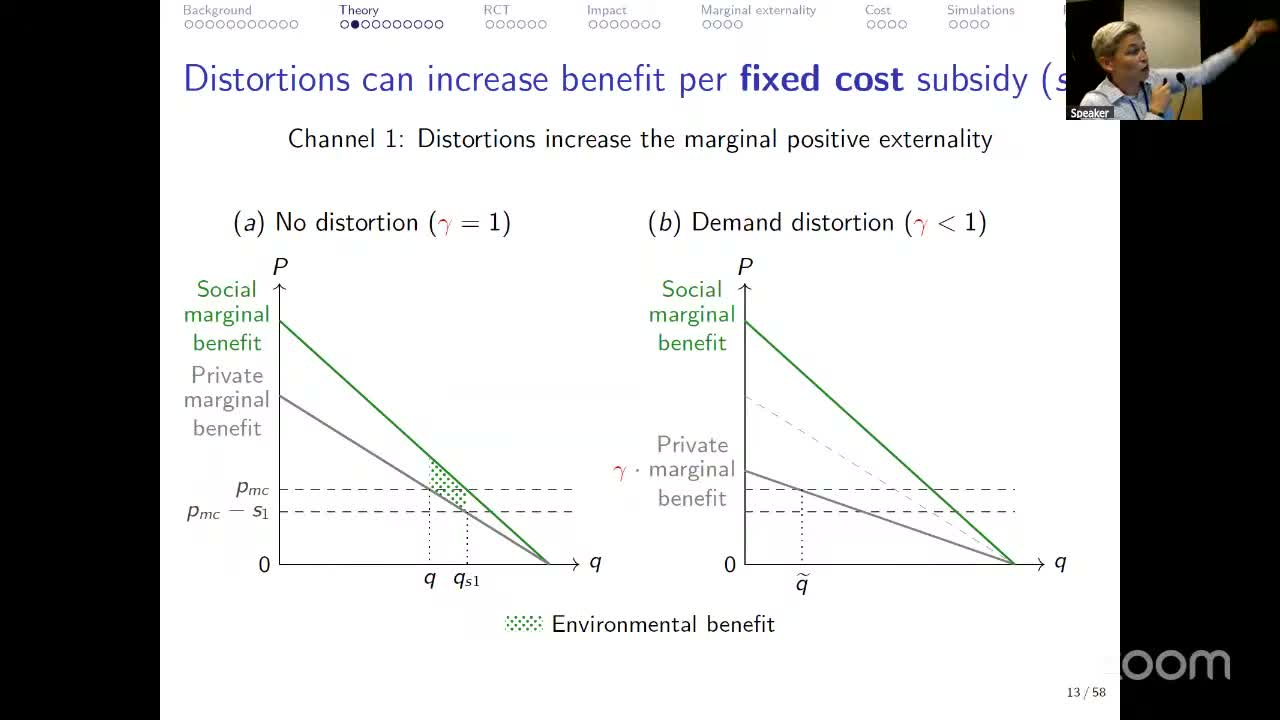
The setup: model any demand distortion as a wedge , so that observed willingness to pay is times the true private benefit, . Credit constraints are the leading case (inattention and present bias work too): you’ll save $184 in fuel over the stove’s life, but you can’t borrow against those savings, so today you’ll pay $20. Crucially, the paper does not try to fix the distortion — informality and weak institutions make it “ingrained” — and instead asks the Lipsey–Lancaster (1956) question: given the wedge, how should a subsidizer subsidize? Two channels make fixed-cost subsidies work better in distorted markets. First, selection: if private and social benefits are positively correlated (the person who burns the most charcoal both saves the most money and abates the most carbon), then a wedge that suppresses everyone’s willingness to pay means the marginal adopter at any price is a higher-use, higher-externality person than in the undistorted world. Second, elasticity: compressing willingness to pay toward zero makes demand more elastic around any price, so each marginal adoption costs less in subsidy outlay — less money wasted on inframarginal adopters.
The empirical setting is chosen for stakes as much as convenience: an average Kenyan household cooking on charcoal emits four to five tons of CO2 a year — about what an average American household emits driving — so biomass cooking is, in aggregate, billions of gasoline-cars-worth of carbon. Around 2,100 charcoal-using households in Nakuru County were offered an induction stove (market price $82, with pots) through a bdm willingness-to-pay elicitation, with three things cross-randomized: the fixed-cost subsidy (10% or 75% off), a marginal-cost subsidy (cheaper electricity for stove usage, delivered as sms tokens keyed to the stove’s remotely-reported kilowatt-hours — mimicking how Kenya Power actually runs subsidy programs), and the distortion itself, via credit: pay upfront, or $12 down with a 90-day loan.
The stove works. Temperature sensors strapped to the charcoal stoves show an immediate ~30-minute daily drop in charcoal cooking; energy spending falls $9/month; and total emissions fall about 2.5 tons of CO2 per stove-year — more than the best estimates for a us household switching from gasoline car to ev, at four hundredths the hardware price. (Kenya’s grid is ~90% renewable, but even on us grid emissions the electricity offset barely dents this — induction is just that much more efficient than burning charcoal.) The distortion is enormous and measurable: without credit, average willingness to pay is $20 — 11% of the $184 private benefit (); with the loan it nearly doubles to $35 (). And the marginal-cost subsidy — Pigou’s own instrument — does nothing: no effect on willingness to pay, no effect on usage, despite flyers spelling out the per-meal cost of ugali and rice under subsidy. Households’ point-estimate valuation of a dollar of usage subsidy is roughly zero (upper bound: 16 cents). Usage, once you own the stove, is simply inelastic — you cook the meals you cook.
Both theoretical channels show up in the data. The more-constrained (cash-paying) group’s marginal adopters save more privately ($200 vs. $154) and abate more (5.0 vs. 4.2 tons; 2.6 vs. 2.2 in the IV specification) — selection. Their demand elasticity is −2.3 against −0.9 for the loan group — the expenditure channel. Combined: welfare per subsidy dollar is 78% higher in the more-distorted group, and the subsidy cost of abating a ton of CO2 falls from $22 to $13. Then the gmm-estimated model asks the question the experiment can’t: what if there were no distortion at all?
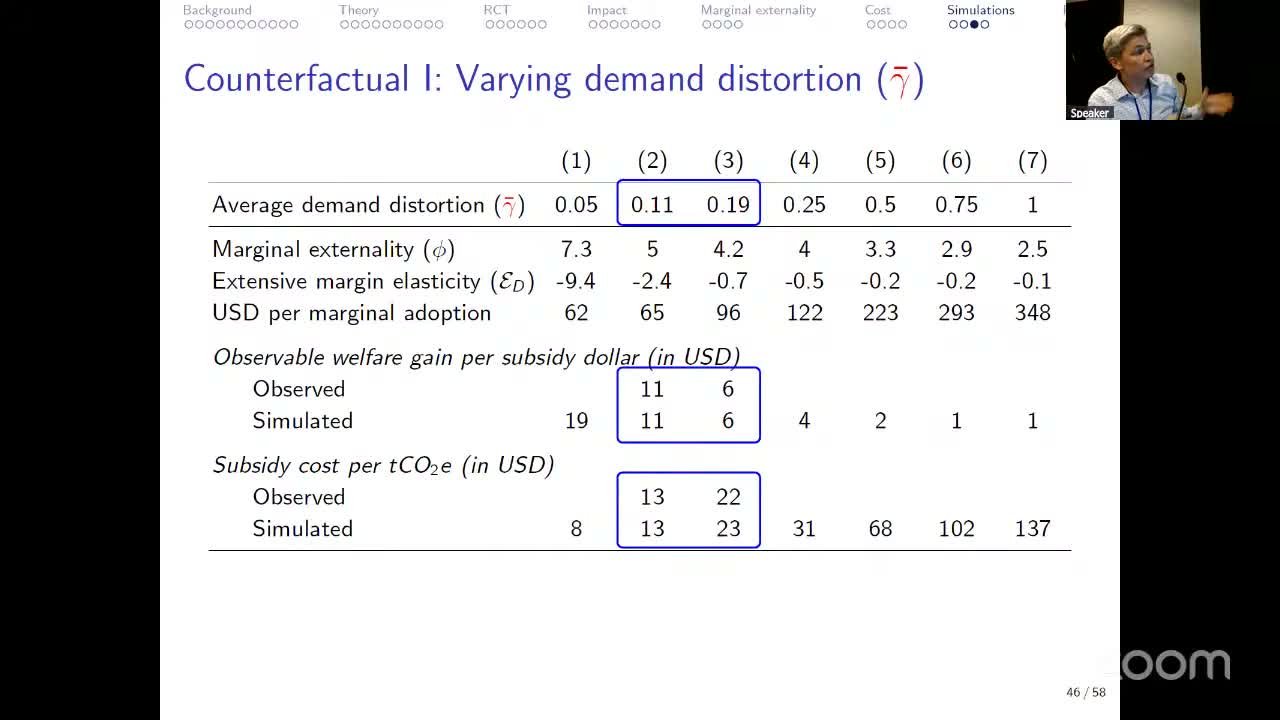
Thirteen dollars a ton, note, is cheap in absolute terms — the resource cost is actually negative (the $82 stove saves ~$200 in fuel, the below-zero part of the McKinsey curve), and at a $120 social cost of carbon each subsidy dollar generates about $11 in social welfare. For calibration, the equivalent us calculation for subsidizing an ev purchase runs about $1,300 per ton — a hundredfold gap, part technology, but partly (this is the paper’s argument) the fact that 80% of American cars are financed at 6% apr while an induction stove bought on credit in a Kenyan shop, even with digital collateral and remote shutoff, carries an apr of 224%.
The Q&A pressed exactly where you’d want: why not subsidize the interest rate instead of the stove? Berkouwer’s answer is that at these default rates the arithmetic collapses — subsidizing credit means eating default, which raises rates, which raises default, and there’s no interest rate at which a credit subsidy beats simply cutting the stove’s price; “for every dollar you might as well just subsidize the dollar itself.” Pressed further (Olken, by the transcript’s account, wanted the first-best comparison made explicit): yes, these results are conditional on capital markets as they are — if functioning credit markets existed, fixing them might dominate. The 224% is doing the work, and the authors embrace it as a sufficient statistic for where green money goes furthest. There’s also an honest asymmetry flagged at the end: channel one flips sign under adverse selection (if private and social benefits were negatively correlated), but channel two — the elasticity channel — survives any correlation, and in this setting it dominates.
The closing implication is aimed at the trillion dollars a year now flowing into carbon mitigation from governments, offset markets and philanthropy: the cheapest points on the global abatement curve are plausibly hiding exactly where demand distortions are worst, which is to say in poor countries’ capital markets — and this may explain why abatement looks so much cheaper there than under, say, the Inflation Reduction Act. There is something almost thermodynamically pleasing about the result. A credit market failure suppresses poor households’ ability to buy a thing that would save them money; a donor’s subsidy dollar therefore lands precisely on the people who use the thing most; and the worse the financial system, the better the carbon math. Second-best economics usually counsels resignation. Here it hands out a bargain.