Notes on:
Tracking China's Growing AI Innovative Capacity Using Publications, Patents, and People
Working paper
23 September 2026
AI · patents · innovation measurement · China
Talk · Paper · PDF · Transcript
Made with AI: Opus 5.5 (reading and writing), GPT 6-Sol (reading), Fable 5.1 (adjudication), GPT 6-Astra (verification)
Part of Economics of Artificial Intelligence, Fall 2026
Sagar V. Baviskar, Lee G. Branstetter, Cameron Drayton, Douglas Hanley, Eduard Hovy, Lei Li, Xibao Li, Prasanna Tambe, Jiarui Wu, Liujie Wu and Huiyan Zhang (Branstetter, Tambe, Hovy and eight co-authors below), “Tracking China’s Growing ai Innovative Capacity Using Publications, Patents, and People.” Presented by Lee Branstetter on 23 September 2026 at the nber Economics of Artificial Intelligence conference (Fall 2026, Toronto), the final paper of day 1. Discussant: Daniel Trefler. Version used: the 12 September 2026 conference draft, marked “Preliminary and Incomplete”; no slide deck is public.
The ruler
China’s ai patent counts have stopped measuring Chinese ai and started measuring Chinese ai policy. That is the whole paper. Branstetter, Tambe, Hovy and eight co-authors open the September 2026 draft with Goodhart’s line, “When a measure becomes a target, it ceases to be a good measure,” and in Toronto Branstetter said it plainly: “in China, ai patents are a great example of Goodhart’s law, which is interventions have induced a patent surge that is at least somewhat disconnected from underlying inventive capacity.”
Start with the chart that motivates the paper: a broad, textbook definition of ai, an llm classifier run over both patent corpora, grants counted by year. The two lines meet around 2017. By 2025 China’s patent office is granting 173,255 ai patents a year and the uspto about 36,000 (Figure 1 of the draft). Narrow the definition to “core ai” and the gap survives: 25,381 against roughly 7,000 (Figure 2). Branstetter says Lerner reads it as a possible Chinese “Sputnik moment, a Promethean burst of Chinese innovation dramatically outstripping anything in the West.” (In a nice bit of symmetry the draft uses “Sputnik moment” the other way round, for how Chinese officials took AlphaGo’s 2016 win over Lee Sedol.) If you took these lines at face value, as Branstetter put it, “China’s winning hands down.”
The authors do not think China is winning hands down, and they are also careful to say they do not think China is losing. Their conclusion is about the measuring stick, not about the thing being measured: “If an overwhelmingly one-sided Chinese victory in an ai race seems inconsistent with these new facts, so does any hubristic notion of an enduring and significant American ’lead.’” Chinese capability is, in Branstetter’s closing words, “very impressive, but … not well reflected in the patent data.”
How you make a patent that isn’t about an invention
The mechanism, built over three sections of the draft, is a stack of reasons to own a patent that have nothing to do with excluding anyone from anything.
You are a local official in China after wto accession. The centre worries that foreign multinationals will use newly strengthened patent rights to build walls around Chinese markets, so it wants a “defensive indigenous patent wall,” and it hands you a patent target. You hit it the obvious way: you pay people to file. Shanghai pioneered this, everyone copied it, and by 2008 all 31 provincial-level divisions had cash-back programmes, some paying out more than filing actually cost. When the subsidy is larger than the fee, a patent application stops being a cost and becomes a product.
That was the old regime, and in 2021 cnipa started dismantling it: direct application subsidies cut almost immediately, grant subsidies capped at 50% of filing costs, all local financial aid for grants and licensing to end by 2025. The paper’s point is that the direct subsidy was only the most visible of the reasons to patent. If you are a small firm, the High and New Technology Enterprise designation cuts your corporate income tax from 25% to 15%, you have to requalify every three years, patents are an important input into qualifying, and the scoring system gives extra points for invention patents in strategic fields such as ai. If you are a professor, patents count toward promotion (now only if “commercialised”). If you want a hukou in Shenzhen, Guangzhou, Nanjing, Suzhou or Shanghai, a patent earns you points. If you want a bank loan, patents in priority areas are collateral. If you want money from a Government Guidance Fund, ai patents are a signal it looks for. And if you are a local official in the 14th Five-Year Plan, your kpi is “high-value invention patents per 10,000 population,” where “high value” officially includes strategic emerging industries like ai.
Then in July 2017 the State Council’s Next Generation ai Development Plan made ai the central target, the draft cites more than 6,000 local policies mentioning ai in its wake, and every one of these incentives tilted toward ai. At the same moment TensorFlow, PyTorch and AutoML made it possible for a master’s-level engineer to write an ai patent that used to need a PhD from a star lab. So the demand for ai patents went up at exactly the moment the cost of producing them went down. You would expect a lot of ai patents, and you get them.
The draft also sketches how the commercialisation rule could be gamed: a professor could transfer a patent to an sme for equity, which would count as commercialisation for a tenure file; the sme could use it toward hnte status and as loan collateral. That passage is written entirely in “could”: a demonstration that the pieces fit together, not a documented practice with a count attached.
Separating wheat from chaff with people
Knowing that some patents are policy artefacts does not tell you which ones. The identification idea is that ai invention grew out of recent academic science, so ties to an elite expert network can serve as “ground truth” for real capability. The authors build citation profiles at elite ai conferences across 10 subfields, and they build people networks: more than 10,000 us experts and their advisees tracked through ProQuest, Revelio/LinkedIn and Compustat, and more than 3,000 Chinese experts assembled from company leadership teams, conference keynotes, China Computer Federation committees and AMiner’s ai 2000.
Then they sort Chinese core-ai applicants into bins. Small companies with fewer than 10 core ai patents that have never employed an identified network member. Universities below a threshold of 30,000 cumulative elite-conference citations. State-owned enterprises with no network member. And on the other side, universities above the threshold, large private Chinese companies, soes that have hired an expert, foreign firms. The 30,000 line comes with a us reference point: the marginal American university just above it is the University of Central Florida. Branstetter, with the tact of a man about to insult a university, acknowledged ucf as “an important source of Stem education in the Sunshine State,” adding “we don’t think of it as a driving force in the world of ai.”
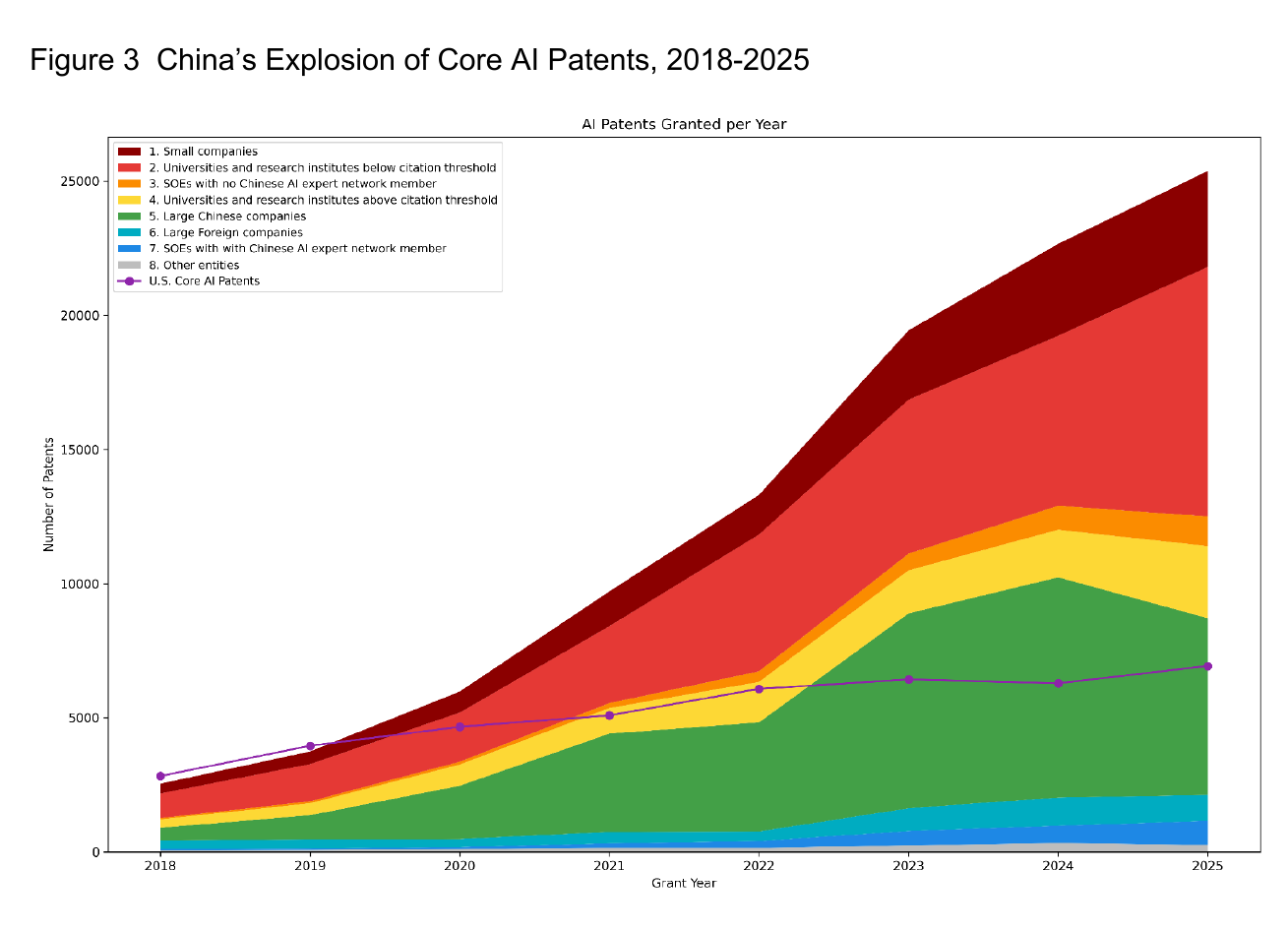
Figure 3 is the paper’s first result. Of roughly 25,300 Chinese core ai grants in 2025, about 3,400 go to small companies, about 9,400 to sub-threshold universities and about 1,100 to expert-less soes. That is roughly 13,900, or about 55%, going to the three “disconnected” classes, which matches Branstetter’s statement that “by 2025 a majority of ai patents granted in China” go to applicants “largely disconnected from the expert network.” Large Chinese companies hold about 6,600 in 2025 (down from about 8,200 in 2024), above-threshold universities about 2,700. Keep only the classes the draft trusts most, top universities and large private firms, and the Chinese number is, in the draft’s words, “much closer to U.S. patenting levels” than the headline: large Chinese companies alone sit just below the us total of about 6,900. Flipping to the us decomposition (Figure 4 of the draft), Branstetter’s comparison is that Chinese companies with non-trivial portfolios roughly match all uspto core-ai grants by 2025, “rough parity by 2025 rather than a blow up that favors China.”
The us decomposition looks nothing like China’s. Most uspto core ai grants go to big us firms and to non-Chinese foreign firms; us universities are a sliver. In the talk Branstetter put a number on the university gap: Chinese sub-threshold universities are “generating 93 times as many patents as similar universities in the United States,” and the elite Chinese universities “nine times as many patents as their us counterparts without generating nine times as many papers or citations.” Both ratios are the speaker’s, from the talk; the underlying counts are not in the draft. The draft’s own phrasing is looser: few observers would conclude the Chinese institutions are “ten times better or 30 times better than their North American peers, as a simple comparison of patent totals might imply.”
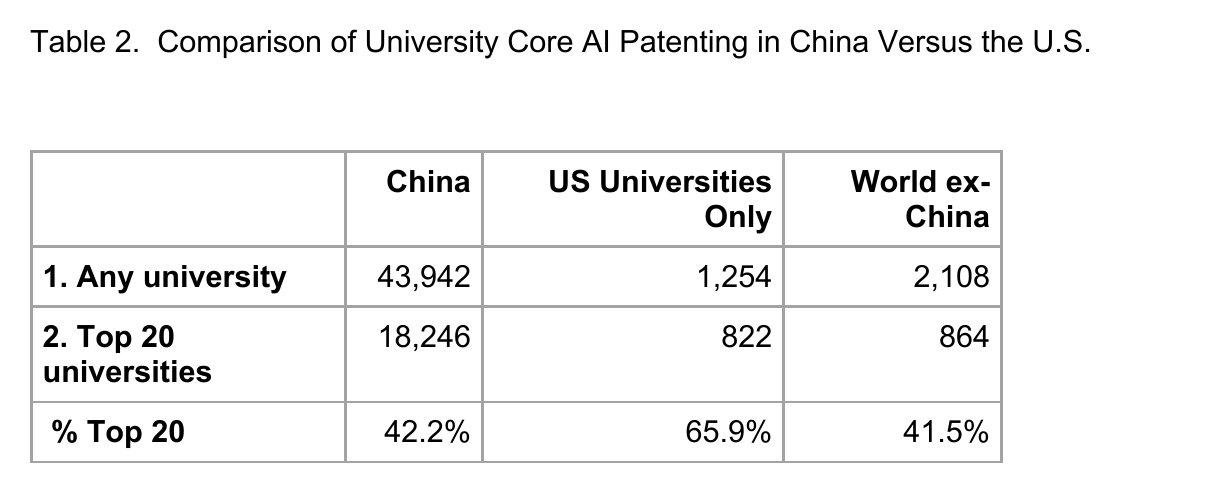
What the draft does print is Table 2. Over 1990–2024 Chinese universities hold 43,942 core ai patents against 1,254 for us universities and 2,108 for universities everywhere else outside China; the top 20 hold 18,246, 822 and 864 respectively. One housekeeping note: the table’s printed “% Top 20” row does not match its own counts. Dividing the counts gives about 41.5% for China, 65.6% for the us and 41.0% for the rest of the world, so the printed row looks shifted, and the counts are the thing to trust. Done properly, the arithmetic is a little more interesting than the text makes it sound. The draft stresses that China’s top-20 share is “significantly smaller than the U.S.” True, but the rest of the world has about the same top-20 share as China. The outlier in concentration is America, where university patenting is small and sits almost entirely at the top. The Chinese outlier is volume.
The surprising thing: the reversal
The second screen is the one the draft says “flips the picture.” Patents are national, so if an invention is worth protecting abroad you pay to patent it abroad, and innovation economists since Lanjouw and Schankerman have used multi-country filing as a quality signal. Chinese inventors’ foreign-filing propensity is about 3.5%, against 40% for us and Japanese inventors, 20% for Korean and 60% for German, per Lerner et al. The authors bought epo patent-family data (Branstetter said they matched “roughly 99%” of both countries’ ai patents to it, a talk-only figure) and kept only core ai patents granted in more than one country.
In China the total “falls by more than 90 percent.” With all applicants included (Figure 5a of the draft), about 1,380 Chinese core ai grants in 2025 were also granted elsewhere, and the biggest block of those, about 830, belongs to large foreign companies patenting in China. The soes become, in the draft’s words, “virtually invisible.” Strip out foreign applicants and you get the picture below.
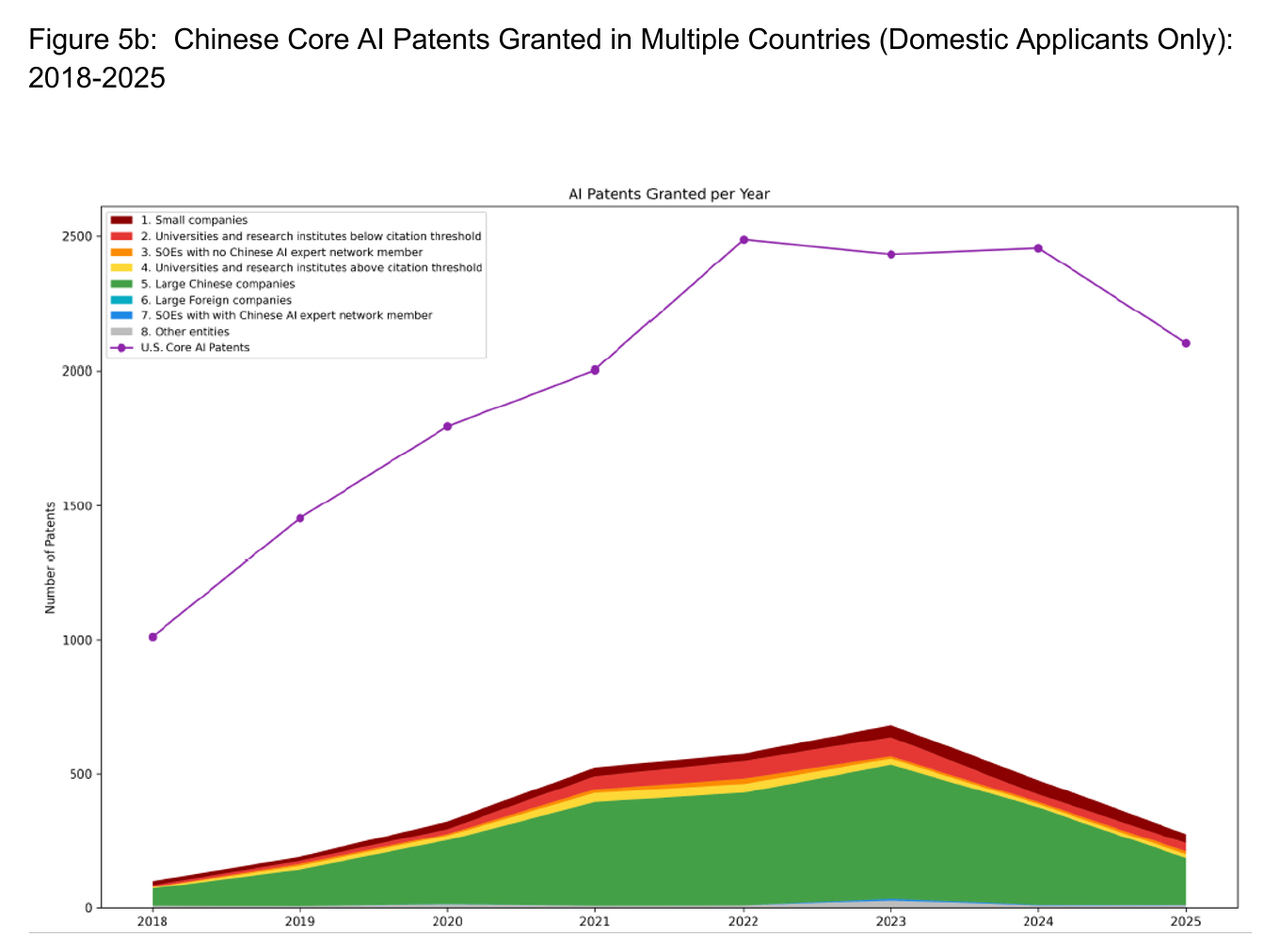
Chinese domestic applicants hold roughly 270 multi-country core ai grants in 2025, about two-thirds of them large Chinese companies, against about 2,100 for the uspto’s multi-country core ai grants. The 25,000-to-a-few-hundred shrinkage is what the discussant’s slide put as “the Chinese number of 25,000 falls to 300 patents and the us number of 6000 falls to just 2000.” (Trefler’s 300 is this domestic-only figure; with foreign applicants included the draft’s China number is about 1,380, which is the version its “more than 90 percent” sentence refers to. Trefler’s us 6,000 is a bit below the draft’s roughly 6,900.)
There is a real caveat, and the paper states it: under the Patent Cooperation Treaty an applicant can wait up to 30 months before entering foreign national phases, so “the last two years of data shown in Figures 5a and 5b should be viewed skeptically.” That means 2024–2025, which includes exactly the 2025 endpoint everyone quotes. The fall from about 680 to about 270 is at least partly truncation. But in the years the paper does not flag, through 2023, the gap is still enormous: at its 2023 peak the domestic Chinese stack is under a third of the us line.
The us side is its own small surprise. Multi-country uspto grants fall by “more than 50%” (about 70% by read-off, from about 6,900 to about 2,100), and in 2025 the largest block (about 1,000) is non-Chinese foreign firms, European and Asian. So the screened chart measures “Western” strength rather than American strength, and the draft says it “challenges the common narrative of an exclusively Sino-American ai race.” The race turns out to have more runners than the people talking about it.
A third screen, text-based novelty (the Kelly et al. kpst measure on titles and abstracts), finds novelty falling across all applicant classes toward 2022, contradicting Lerner et al.; the authors call it “preliminary and subject to revision” and float a possibly mechanical cause: in a flood of similar patents, each new one resembles what came just before.
What Trefler pushed on
Trefler fully endorsed all of the adjustments (“all of which are very sensible and I fully endorse”), summarised the result as China falling to 300 and the us to 2,000, and added, “now the picture is maybe China is really bad. I’m not sure.”
Trefler’s most useful contribution was an analogy from their own work on the llm market. By tokens processed, ChatGPT dominated in early 2025 and Chinese models dominate “today.” But Chinese models need on average about 10 tokens per us token (sometimes 40), so divide by 10 “and suddenly it looks like the us is dominant again.” For tokens you can pull an engineering conversion factor from the computer-science literature. For patents there isn’t one. So Trefler proposed building it: train a neural classifier on us filings with grant/no-grant as the outcome, run Chinese filings through it, and estimate what share would have survived the uspto. (Trefler then announced a patent-consulting startup with Branstetter, term sheets in the briefcase.)
The rest was framing. The paper documents what Trefler called “absolutely horrifying second best policies,” which raises the question of the best implementable second-best, and they do not think the us is the benchmark. And the paper is about the frontier race, whereas the adoption race matters too: they cited ai form-coaching in Chinese gyms against a $70–100-an-hour trainer in Toronto, and bet on China winning adoption within 10–20 years.
The Q&A, and what was left unanswered
One questioner raised home bias: patenting abroad is expensive, so a natural bias toward domestic filing is expected; can it be corrected for? The same questioner asked how to square the paper with publication-based reports (apparently including aspi’s Critical Technology Tracker) showing China leading in most critical technologies. A second commenter, who appears from context to be Hanming Fang (co-author of the Fang et al. paper Branstetter had cited, though the chair did not name them), said stock-market reactions to Chinese patent grants have the same numbers as us reactions but in renminbi, putting Chinese patents at about a sixth or seventh of us value; but patents of non-listed Chinese entities, universities included, are cited as often as listed firms’ patents, so citations show no quality gap. A third noted that most patents everywhere are junk, so if Chinese policy produced even a few first-order innovations it was not obviously a bad idea, and asked whether the us is the right counterfactual and whether there is still signal in the 300. An organiser, whom Branstetter addressed as “Avi,” asked whether a us frontier race and a Chinese diffusion race means everyone wins.
Branstetter answered with a slide there had not been time to show: the share of elite ai conference papers with a Chinese institutional affiliation went “from almost zero to about 50%” in a few years (talk only, not in the draft). The capability is real, and “we can’t say that it’s all bad,” but it sits in elite universities and leading firms, and “you just can’t make much inference about them based on the patent data.” Branstetter agreed with the one-seventh discount and discounted the citation result, since most Chinese citations are added by examiners. On diffusion, the acid test would be accelerating productivity convergence with the us, and instead convergence “seems to have decelerated rather than accelerated” over 15 years, though “maybe it’s too early.” Branstetter closed on China’s mobilisation of a huge fraction of the world’s frontier-capable inventors, and on the worry that distorted incentives misallocate them: “That’s a human problem.”
Two questions went unanswered as time ran out: the home-bias correction for the multi-country screen, and a quantitative answer to whether the 300 still carries signal.
What to keep in mind
The applicant bins are a classification, not a causal design: small firms, sub-threshold universities and expert-less soes are presumed low quality, and the draft neither tests that patent by patent nor apportions the surge across incentives. “Disconnected” is partly by construction and inherits the network’s coverage (more than 10,000 people on the us side, more than 3,000 on the Chinese), so every Chinese expert the network misses pushes an applicant into a disconnected bin; expanding it is the next step. Cumulative citations, the authors concede, favour older us departments. And the decomposition uses only the core-ai definition, whose classifier has 83.33% precision on hard boundary cases and no reported recall.
None of that rescues the raw count. When a measure is a target it stops being a measure, and it turns out it can at the same time go on being a very large number that everyone quotes. What the paper really claims is that China has built serious ai capability, and that the patent office is the worst place to go and count it.