Notes on:
Family Planning, Now and Later: Infertility Fears and Africa's Stalled Contraceptive Revolution
NBER Working Paper 32735
29 July 2026
gender · health · development · field experiment
Talk · Paper · PDF · Transcript
Written by Opus 5
Part of NBER Summer Institute 2026 — Gender in the Economy
Natalie Bau, David J. Henning, Corinne Low and Bryce Steinberg — presented by Steinberg, with Low in the room, at the nber Summer Institute, Gender in the Economy, on 29 July 2026. The talk was billed as “Family Planning, Now and Later: Infertility Fears and Africa’s Stalled Contraceptive Revolution”; the circulating version, nber Working Paper 32735 (revised November 2024), is subtitled “Infertility Fears and Contraceptive Take-Up,” and is what the numbers here come from except where a slide is cited. No discussant; questions ran throughout. (Names of questioners and of Low are hedged — the captions mangle them.)
Suppose you are a 20-year-old woman at the University of Zambia. Here is what is true about you, on average, in this study’s baseline data.
You do not want a child. The researchers asked in several different ways and you were emphatic. Hormonal contraception is available free on campus, so cost is not a constraint; you live apart from parents and partner, so stigma is muted; you are having a good deal of unprotected sex. Contraception at the pharmacy costs about two dollars a pack if you’d rather not use the clinic, and someone will deliver emergency contraception to your room if you text a number on a flyer.
And you are not on hormonal contraception. Only 5 percent of women in this sample are. In the United States the figure would be around 60 percent; in Northern Europe, higher.
The consequence shows up in the pregnancy data: 5.3 percent report a pregnancy over a six-month window, which annualizes to about 10 percent, in a population telling you emphatically that a pregnancy would be a disaster. Most of those pregnancies end in abortion, in a place where abortion is not safe.
So access is not the constraint. What is?
The asset you are protecting
Sixty-four percent of these women believe hormonal contraceptives cause infertility. Not side effects in the Western sense — when you probe the qualitative work, “side effects” does not mean weight gain and acne, it means damage to the reproductive tract. And the timeframe is not next year. As Steinberg put it, the story they tell is: I take this now, and in six years when I am married and want a child, I will be infertile.
Once you see that, the low take-up stops being a puzzle and becomes an entirely rational response to a false premise. In this setting a woman’s economic and social standing is tied to her fertility; infertility can mean divorce, polygamy, in some places accusations of witchcraft. So contraception, as these women understand it, is not a cheap good with a small price. It is a trade: you buy control over your fertility now by writing an option on your fertility later. And the later option is the one that determines your life.
Which also explains why nobody found this before. As Steinberg noted, the family-planning industry in sub-Saharan Africa focuses almost entirely on married women who already have children, thinking about total fertility and birth spacing. But the American evidence — Goldin and Katz (2002), Bailey (2006) — says the pill’s effect on total fertility was modest; what it did was let women delay a first birth, finish school, and enter the labor market. The women that mattered were the ones without children. And the women without children are exactly the ones who have not yet proved they are fertile, and so have the most to fear from a rumour that says you might not be.
The fear is not baseless either, and the paper is careful about this. There is a real history here: coercive sterilization campaigns, and the Dalkon Shield — an iud withdrawn in the United States after causing pelvic inflammatory disease, and then exported. The belief is wrong about hormonal contraception, but it is not stupid.
A workshop, a voucher, and an orange
1,500 female undergraduates, recruited on campus, randomized on the spot into three arms, then invited to a workshop about “women’s health” without being told which kind.
The control arm is deliberately active. They got the survey introduction, they were told about a partner clinic off campus (less stigmatized than the campus service), and they were handed a “guaranteed no waiting” card — the researchers paid a nurse to work extra hours — which doubles as a tracking device.
The voucher arm got all that plus four dollars to hand the card in at the clinic. This is not pocket change: rent for a shared room runs about forty dollars a month, and total living expenses are eighty to a hundred. The point was to drive the access cost, including the behavioral kind where you keep meaning to go and don’t, as close to zero as money can.
The infertility information arm got everything in the voucher arm plus about thirty extra minutes. Facilitators told their own stories of using long-acting contraception and then having children, with photographs. And then — Low’s idea, per Steinberg — a demonstration. Blindfold a volunteer, hold an orange under her nose, ask what she smells. Orange. Now hold mint oil in front of the orange. Mint. The audience can see the orange is still there. Take the mint away, wait. Orange again. The orange is your fertility. It was there the whole time; it was only being covered.
That is the entire treatment. Thirty minutes and a piece of fruit.
What the voucher bought: a walk to the clinic
The voucher worked, in the sense that it got people through the door. Clinic attendance: about 19 percent in control (the no-wait card was not nothing), around 70 percent in both voucher arms. As Steinberg put it, plenty of them handed in the voucher and turned around and left.
Then look at what happened to actual usage over six months of biweekly smartphone surveys.
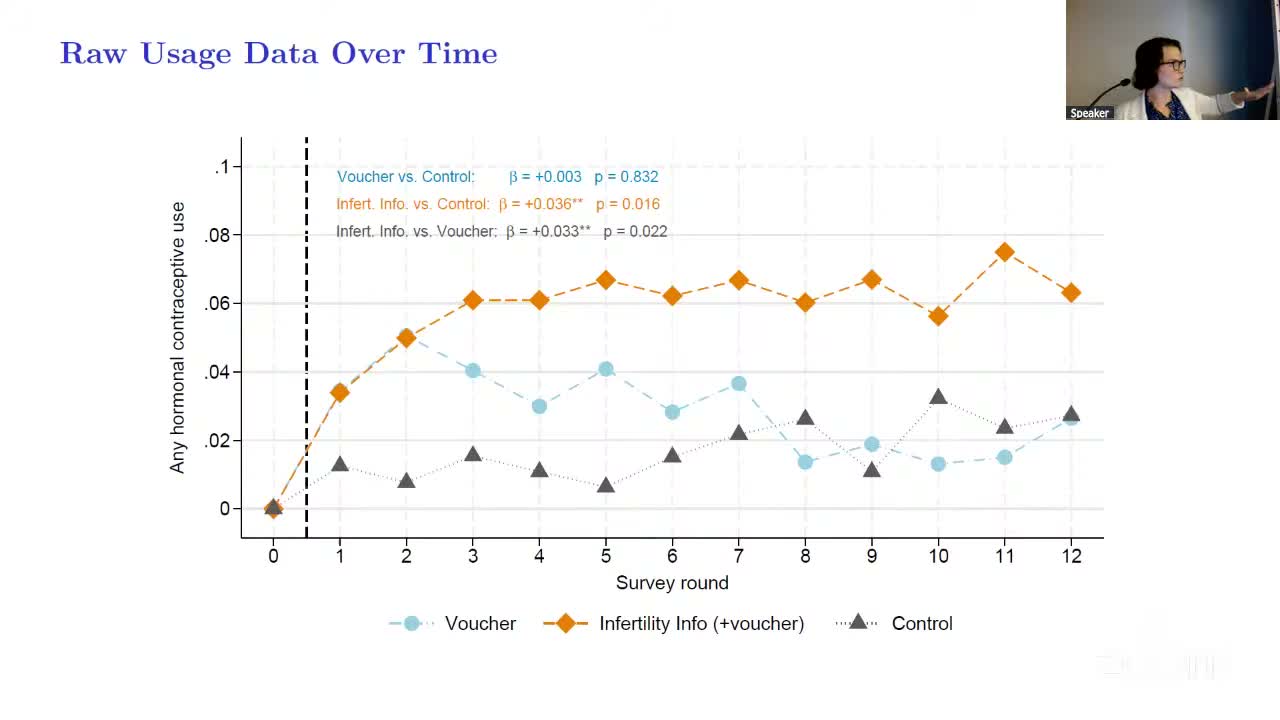
The voucher arm and the information arm rise identically for the first two surveys — the window in which everyone was walking to the clinic. Then they separate. The voucher effect decays back toward baseline; the information effect holds and if anything grows. Against control, the voucher does nothing — a coefficient of 0.003 with a p-value of 0.83.
A questioner put the puzzle sharply: if misinformation were the barrier, shouldn’t it have suppressed initial take-up too? Steinberg’s answer is about method choice, and it is the most persuasive detail in the talk. Voucher women took a pack of pills and often never came back. Information women moved toward injections and implants — methods with mechanical persistence, where being on it at week three means being on it at week twelve. Frequently a woman would take a pack of pills first and then, a month later, return for an implant instead. The hypothesis: the more invasive the method, the more it is feared, and the belief treatment moved the long-acting methods most.
The beliefs data say exactly that.
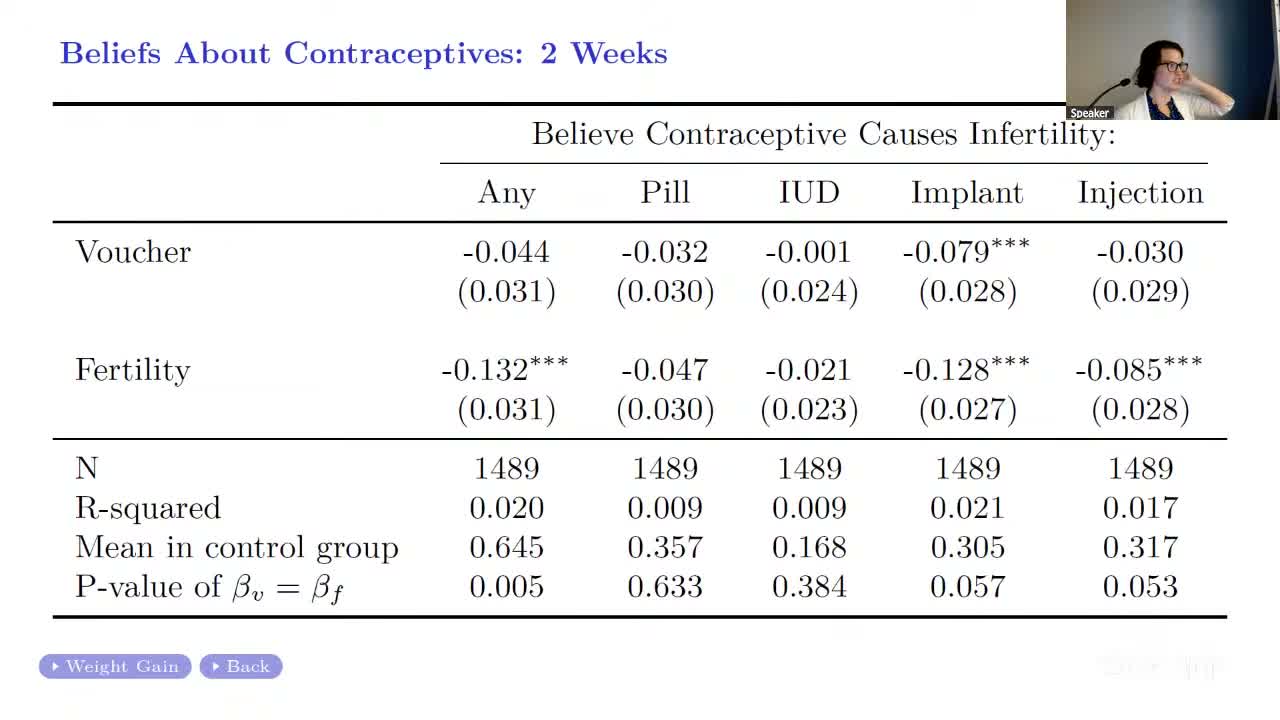
The information treatment cuts the belief that any method causes infertility by 13.2 percentage points against a control mean of 64.5 percent. Broken out: implant −12.8, injection −8.5, both highly significant; pill −4.7 and iud −2.1, neither significant. The belief moved precisely on the methods the behavior moved on.
Two things about that 13-point effect are worth flagging. It does not eliminate the belief — this takes it from 65 percent to a little over half, not to zero. And it is essentially unchanged when re-measured at six months, which Steinberg admitted surprised her: “I teach development economics and usually we have a whole class, it’s like information treatments never work.”
Pregnancies
The paper is scrupulous about power here, and the presentation was too. Six months is a short window, several methods take a cycle to become effective, and the base rate — while catastrophic in welfare terms — is small in statistical terms.
Two measures, presented side by side because they err in opposite directions. The endline question (“any pregnancy in the last six months”) is under-reported, because people forget events they’d prefer not to have had, and abortions especially. The biweekly question (“a positive pregnancy test in the last two weeks”) is probably over-reported. The endline measure gives a 73 percent reduction; the biweekly gives 64 percent, β = −0.0053, p = 0.084. The effect sizes are similar, which is the reassuring part. So is the timing: nothing in the first two months, when nothing mechanically could have happened, and then a gap that widens.
In levels: contraceptive use up about 3.5 percentage points on average, pregnancies down about 1.2. Small-sounding, and Steinberg pre-empted the objection — most contraceptive interventions in Africa do nothing at all, the few that work move outcomes by about this much, and because baseline usage here is so low the proportional effects are much larger. And this was thirty minutes of workshop that shifted the belief only halfway.
The thing running underneath
Near the end, almost as an aside, Steinberg described a follow-up experiment two years later with a fresh sample: pay women a stipend of forty dollars a month and measure sexual activity the same way. Sexual debut fell by 40 percent. Condom use among those having sex rose about 25 percent.
Which reframes the whole setting. A meaningful share of this sex is financially driven — young women in transactional relationships with older partners — and that is why the female-controlled nature of hormonal contraception matters so much. Condoms, withdrawal, and abstinence all require a partner’s cooperation. A woman with no bargaining power has exactly one technology available to her, and she has been told it will cost her the ability to have children.
(The honest summary of a decade of family-planning rcts is that giving women better access to contraception does very little, and the field has slowly concluded that access was never the constraint. This paper agrees, and then does the harder thing: it names the constraint, prices it as an intertemporal trade, and shows you can move it with an orange.)