Notes on:
Managers and Offices: Location-Based Determinants of Bureaucratic Effectiveness in India
Working paper
28 July 2026
development · bureaucracy · state capacity
Talk · Transcript
Written by Fable 5
Part of NBER Summer Institute 2026 — Development Economics
Prabhat Barnwal (Michigan State), Aaditya Dar, Aprajit Mahajan (UC Berkeley) and Maitri Punjabi (Michigan State; on the job market next year), presented at NBER Summer Institute Development Economics, July 28, 2026. **Source note:** the draft is available only on request, so this piece is written entirely from the talk transcript and slides; every number comes from the presentation. Video timestamps refer to the [session recording](https://www.youtube.com/watch?v=PHYYOyrSItw&t=8600s).
Prabhat Barnwal (Michigan State), Aaditya Dar, Aprajit Mahajan (uc Berkeley) and Maitri Punjabi (Michigan State; on the job market next year), presented at nber Summer Institute Development Economics, July 28, 2026. Source note: the draft is available only on request, so this piece is written entirely from the talk transcript and slides; every number comes from the presentation. Video timestamps refer to the session recording.
There is a whole genre of economics built on the premise that managers matter enormously. Move a great ceo into a mediocre firm and productivity jumps; management-practices consultants generate double-digit gains in Indian textile plants (Bloom et al. 2013); the person at the top is the lever. Governments believe this too, in their own idiom: when an Indian district office underperforms, the reflexive fix — often the only fix — is to transfer the manager and install a better one. This paper asks whether that lever is connected to anything, and the answer, measured about as carefully as the question can currently be measured, is: no. In routine government work, the office is the machine and the manager is a decoration bolted to the top of it.
The setting is Punjab, 30 million people, whose e-governance platform timestamps every step of more than 10 million citizen applications for the state’s routine outputs — caste certificates, birth registrations, driving and arms licenses, the documents Indian life runs on. This is a lovely productivity measure precisely because it is boring: the same service is produced by hundreds of offices, it is attributable to an identifiable officer and staff (you can see who signed what, and when), a 2018 transparency act imposes statutory deadlines (7 business days for simple certificates, up to 45 for an arms license needing police verification), and citizens demonstrably care — about half of a sample of 10,000 grievances concern exactly these services, most commonly missed deadlines. Around 20% of applications blow the deadline, and the variation is huge: top-decile offices process in less than half the time of bottom-decile ones. Health and education outcomes, the usual state-capacity proxies, sit downstream of demand and income and a dozen overlapping programs; the number of days your caste certificate spent on someone’s desk is state capacity in its purest measurable form.
The paper’s trick is that the timestamps separate the manager’s time (the “approving authority,” an exam-selected, trained, promotion-incentivized middle bureaucrat) from the staff’s time (the clerks and field verifiers, who are local, unionized, rarely transferred, and do most of the work — of roughly 11 average processing days, the bulk is staff time). Managers, by contrast, rotate constantly: average tenure about 10 months, driven by rotation norms, elections and family hardship rather than performance. So Punjab has been running, inadvertently, the ideal experiment for an akm decomposition (Abowd, Kramarz, and Margolis 1999) — the workhorse from labor economics that splits wage variation into worker and firm components, here repurposed to split processing-time variation into manager and office components, on the largest connected component of about 1,500 managers moving across 600 offices.
The decomposition says the office effect is about five times the manager effect — offices explain roughly 60% of total variance (83% of the combined manager-office share), managers about 12%, with essentially zero sorting of good managers to good or bad offices once you correct for limited-mobility bias. And the variance doesn’t live at the district level, where politics and geography could explain it; it sits between offices within the same sub-district. Two offices a few kilometers apart, same labor market, same politics, wildly different speeds.
Decompositions have assumptions, so the paper checks the causal claim with a movers design: watch what happens when a manager transfers.
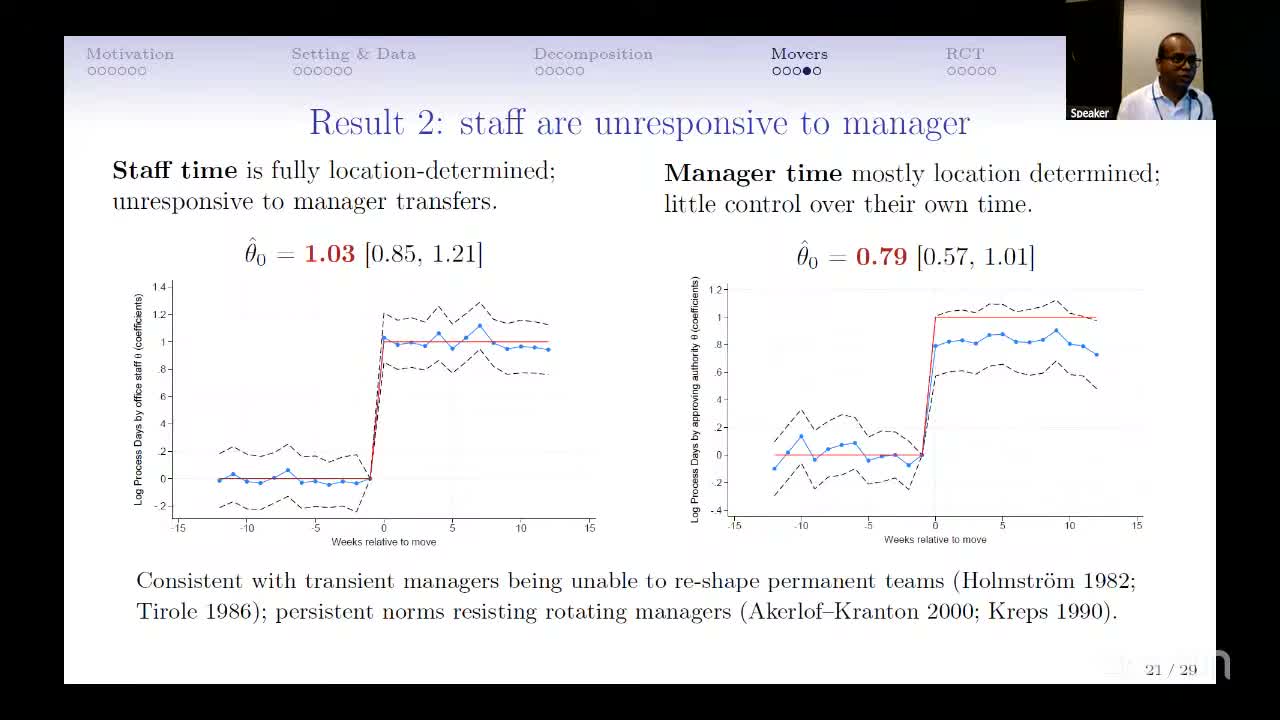
Read that chart the way you’d read a ceo-effects chart in corporate finance, and it’s devastating. If managers carried their productivity with them, the coefficient would be near zero — the new office would start performing like the manager’s old one. Instead it’s statistically indistinguishable from one: the manager arrives and the office keeps doing exactly what it was doing, immediately, with no pre-trend (so this isn’t good managers being dispatched to failing offices) and symmetrically in both directions — a manager moving from a fast office to a slow one gets slower, personally, right away. Even the component of processing time the manager nominally controls converges 80% of the way to local custom. The staff don’t adjust to the manager; the manager adjusts to the staff.
Then, because two research designs are never enough, there’s a statewide rct run with the government: statutory deadlines on 15 randomly selected high-volume services were permanently tightened by about three days (16%), with 15 services as controls. Low-performing offices did speed up — top-down mandates work on laggards — but the improvement was orthogonal to manager quality: offices with one-standard-deviation-better managers improved by no more than offices with worse ones, and the response came out of staff time. The high-performing offices supply the comedy: their managers dutifully got faster, while their staff — realizing the new deadline still left slack — actually slowed down toward it. Give a productive team a lenient target and they will regress to it, which any student of Goodhart could have predicted, but it is bracing to see it in administrative timestamps.
The Q&A was appropriately adversarial about selection. A questioner with police-sector experience worried that truly awful managers get exiled to the archives division and stars get promoted out of the sample, censoring both tails of the manager distribution; the authors answered that transfers in the data don’t track performance (they track election cycles and rotation norms), but conceded the entry-exit accounting deserves more work. Others pushed on speed versus quality — faster could mean sloppier, or more bribable. The observable proxy, applications “sent back” to citizens (which resets the legal clock and would be the natural way to game a speed dashboard), doesn’t respond to the deadline change; bribes are frankly unobservable, though applications flow through arm’s-length kiosks rather than face-to-face.
Why are government managers so inert when private-sector managers appear to matter so much? The authors’ answer is Holmström-Tirole with an Indian accent: a transient supervisor on a 10-month rotation cannot re-shape a permanent, unionized, locally embedded team, and changing an office’s norms means spending effort and making enemies on a posting you’ll leave within the year. As one Indian Administrative Service officer summarized the finding to the authors: in government, the ceo is just as good as the company. The policy implication inverts the standard playbook — the state’s first-order instrument (transfer the manager) is the one demonstrably connected to nothing, while the unglamorous office-level interventions (staff capacity, process, technology, whatever “culture” turns out to be made of) are where the entire variance lives. The talk closes with the one concession the literature has earned: in episodic, “mission-mode” campaigns, energized bureaucrats do move outcomes. It’s the routine 51 weeks of the year that belong to the staff.