Notes on:
A Free Lunch? How Changing Childcare Defaults Increases Parental Labor Supply
Working paper
29 July 2026
gender · childcare · behavioral economics · Switzerland
Talk · Paper · PDF · Transcript
Written by Opus 5
Part of NBER Summer Institute 2026 — Gender in the Economy
Justus Bamert (Princeton) — “A Free Lunch? How Changing Childcare Defaults Increases Parental Labor Supply,” presented at the nber Summer Institute, Gender in the Economy, on 29 July 2026. Forty-five minutes, no discussant, questions from ten minutes in. Written from the August 2026 draft. (A caveat on quotation: YouTube’s auto-captions dropped much of the speaker’s audio in the first twenty minutes while catching the questions, so the talk’s early section is reconstructed from the paper.)
The public childcare literature has a persistent embarrassment. Expand access, cut the price, and maternal labor supply moves less than the theory says it should — Baker, Gruber and Milligan (2008) found it in Quebec, Havnes and Mogstad (2011) in Norway, and Kleven and coauthors (2024) more recently. You subsidize the thing that is supposed to be binding and mothers do not come flooding into work.
There are the usual explanations: crowd-out of informal care, inelastic labor demand, the constraint was never childcare. Bamert offers a duller one, which is the sort that turns out to be right more often than it should. Almost every public childcare system in the world is opt-in. Your child is not enrolled unless you sign them up. And nobody has checked whether that institutional detail is doing anything, because in a standard household model it cannot: fully optimizing parents pick the welfare-maximizing option regardless of which box is pre-ticked.
Zurich un-ticked the box.
The reform
Before 2016, public lunchtime childcare existed at every Zurich kindergarten and school, and children went home for lunch unless a parent opted in. After the reform, children stay for lunch unless a parent opts out. The reform also replaced income-based fees with a flat chf 6 per day, which cut the price for higher-income households and left it roughly unchanged for low-income ones — a fact that turns out to be the identification strategy for separating the default from the price.
It rolled out school by school starting in 2016, which gives a stacked event study against clean control schools. Zurich has no school choice; children are assigned by residence and capacity, so the sorting concern that would sink this design elsewhere doesn’t apply, and the paper shows no differential pre-trends and no compositional shifts at adoption. The data are administrative: enrollment by child, by day of the week, by school-year, for the universe of children in Zurich’s public system from 2011 to 2021, linked to parents’ labor records. 69,134 children and 74,435 parents.
Lunchtime enrollment rises 22.3 percentage points, a 41.8 percent increase. Total time in public childcare rises 2.3 hours a week off a base of 6.0. Some of that is spillover: parents become more likely to enroll children in after-school care on days the child is already auto-enrolled at lunch — even though after-school care stayed opt-in and unchanged in price — and having one child at a reform school raises enrollment for siblings at non-reform schools.
Labor supply follows, concentrated where you would expect. For parents of kindergarten-aged children, employment rises 2.9 percentage points on the extensive margin: mothers 3.7 points, fathers 2.0. Nothing significant for parents of older children. On the intensive margin, mothers of kindergarteners and early primary children report higher earnings driven by more ftes and hours, not higher wages. Combined, the annual earnings of a mother with a child in kindergarten rise by chf 2,971 from a base of chf 39,000 — the 7.5 percent in the abstract.
Is it the default, or is it the six francs?
This is the question the paper has to answer, and it answers it three ways.
First, the group whose price did not change. Low-income families already receiving the full subsidy face the same fee before and after; among them, usage and extensive-margin labor supply still rise.
Second, and more vividly, the shape of the enrollment distribution. Auto-enrollment starts in the second kindergarten year at two lunches a week and rises to three from Grade 1 — only on days with afternoon classes, which is why Wednesdays, when Swiss schools finish at midday, are missing and why the room spent a while asking what happens on Wednesdays. Plot the number of days each child is enrolled, before and after, by grade:
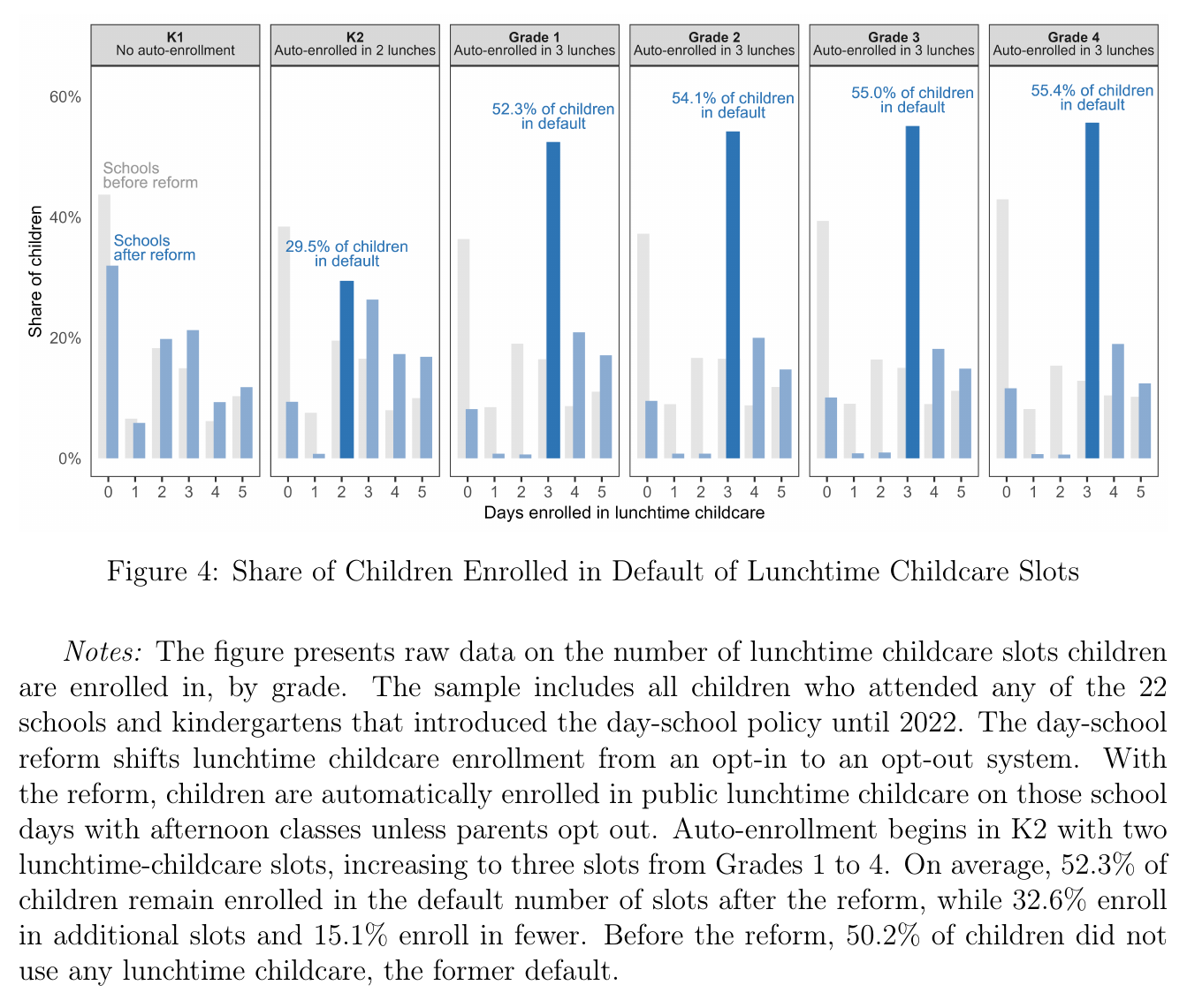
Roughly half the children sit exactly on whatever number the administrator chose, and this is stable at the individual level four years after exposure. Third, implied price elasticities differ sharply across groups in a way a pure price story cannot accommodate.
So it is the default. Which returns us to the puzzle, one step deeper: what friction is a default relieving, when opting out requires sending the school an email?
Not that kind of friction
The complier analysis is where this stops being a nudge paper. Bamert characterises the families induced into public childcare and finds they look like the population on earnings and parental birthplace — but they are disproportionately two-parent households, disproportionately households that ran a male-breadwinner model before the reform, and disproportionately from origin countries with high agreement that children suffer when a mother works.
That is exactly backwards from the standard behavioral story. The families who move are not the disorganised ones. They are the ones with the strongest prior preference for home care. The reform’s compliers are the people you would have bet were infra-marginal.
A questioner from the floor supplied the reframe, about two minutes into the talk, and it is better than anything in the paper’s introduction. This is not a retirement default. In a retirement default the friction is inattention or complexity — a real cost of acting, borne privately. Here the parents are well informed (the surveys say so, and there is no difference between families with and without prior childcare experience) and the act of opting out is trivial. What stops a mother signing up is that she would be the mother who left her child at school for lunch. The German word, which the questioner supplied and the room recognised, is Rabenmutter — raven mother, the bird that abandons its young.
And a shame cost has a property no transaction cost has: it depends on how many other people are doing the thing. If one woman does it, she is shamed. If everyone does it, nobody is. The default does not lower the price of the action. It moves everybody at once, and thereby destroys the signal that made it costly.
Bamert brings two pieces of evidence to this. Before the reform, a Hoxby-style (2000) peer regression shows children are more likely to use lunchtime childcare when their Grade 1 peers did — quasi-random peer composition predicts your own Grade 3 enrollment. And the reform’s effects are substantially stronger in classes with low baseline peer usage, which is what you’d expect if the default substitutes for the peer-induced take-up that high-usage classes already had.
Then the parental surveys, which are the part I find hardest to explain any other way. Parents who stayed in automatic lunchtime childcare were asked why, up to three reasons. They say it makes work and family easier to combine and that it is good for the child — from families who, in many cases, had never used it before, which means their beliefs about it changed. They say it is “part of the new concept,” i.e. it is simply what one does now. They say their child’s friends are there. What they do not select, in numbers: logistics, price, or the child’s own preferences.
The alternatives get ruled out in order. Information: parents report being well informed, and there’s no gap between prior users and non-users. Adjustment costs: it’s an email, and the same parents are actively adding services and changing their labor supply, which is not what people paralysed by paperwork do. Quality improvement: food quality is one of the most contentious topics in the surveys, and government spending per child falls, because there are far more children.
(One thread the room pulled that the paper doesn’t follow: family-style meals in classrooms raise the question of children with religious dietary restrictions, who are plausibly also from the most conservative families. Whether such a family finds it more or less exposing to stay for lunch with a different plate is a nice question about what exactly the norm is signalling, and Bamert acknowledged never having looked. Also unresolved: opting out means having to re-apply for the income-based subsidy later, which is a real friction for one group and slightly complicates the “it’s just an email” claim.)
Is it worth it?
Provision costs the government about usd 1,000 per child per year — subsidised meals, extra childcare staff, some facility adaptations. The willingness-to-pay side depends on which model you believe, which Bamert handles by reporting both.
If parents were fully optimizing all along, then their earnings gains are offset by the disutility of the work, and willingness to pay is just the cost of provision. The mvpf comes out slightly above one — each franc returns a bit more than a franc, larger if you restrict to kindergarten families. If instead parents were constrained, the earnings gains measure the value of removing the constraint, and the mvpf is 3.4.
Which is a nicely honest way to present it, because the whole paper is an argument that the second world is the right one, and the reader gets to see how much of the welfare number rides on that argument.
(The reform is called the day-school policy and its stated purpose was, presumably, lunch. What it accomplished was to relieve about a fifth of Zurich’s kindergarten mothers of the obligation to be seen collecting their children at midday — and it did so not by making that easier, but by making it unremarkable.)