Notes on:
International Real Business Cycles
Journal of Political Economy
20 January 2023
international macro · business cycles · risk sharing
Paper · PDF
Written by Fable 5
David Backus, Patrick Kehoe and Finn Kydland, Journal of Political Economy 1992. Read here in its Minneapolis Fed Staff Report 146 version (November 1991), whose numbers may differ slightly from the published article. No talk recording exists for this paper; the piece is written from the paper alone.
Suppose you take the one model that macroeconomics of the early 1990s was proudest of — the Kydland–Prescott (1982) real business cycle model, which had done a respectable job of matching the volatility and comovement of postwar U.S. consumption, investment, and hours using nothing but technology shocks and an optimizing household — and you make the smallest possible international extension of it. Two countries, identical preferences and technology, one homogeneous good, and complete markets: everyone can insure against everything, and capital (though not labor) can move freely. Countries differ only in their technology shocks, which are correlated and spill over from one country to the other with estimated coefficients. Then you ask the model the international questions: how correlated should business cycles be across countries, and what should the trade balance do?
This is the paper that asked, and the answer broke the model in a way that organized the field’s agenda for the next two decades.
What complete markets promise
The household in each country maximizes expected utility over consumption and leisure,
and the world allocation solves a planner’s problem that weights the two countries equally. Complete markets have a famous implication in this world: with one good and separable preferences, everyone’s consumption moves together, deterministically. With log utility the cross-country consumption correlation is literally one, regardless of how correlated incomes are. Your country’s harvest fails; your insurance pays out; you consume like your neighbor anyway. Risk sharing decouples what you eat from what you produce, and couples it to what the world produces.
Meanwhile production chases productivity. A country that draws a good technology shock is, temporarily, the best place on earth to install capital, so investment surges there and — this is the striking part — falls abroad, as the planner redirects world saving toward the lucky country. The home country runs a trade deficit to finance the investment boom (absorption rises more than output), and the foreign country obligingly exports its resources into the boom. In the model’s impulse responses, a one-standard-deviation home productivity shock raises home investment by around two percent of steady-state output while foreign investment drops; foreign consumption rises anyway, because insurance.
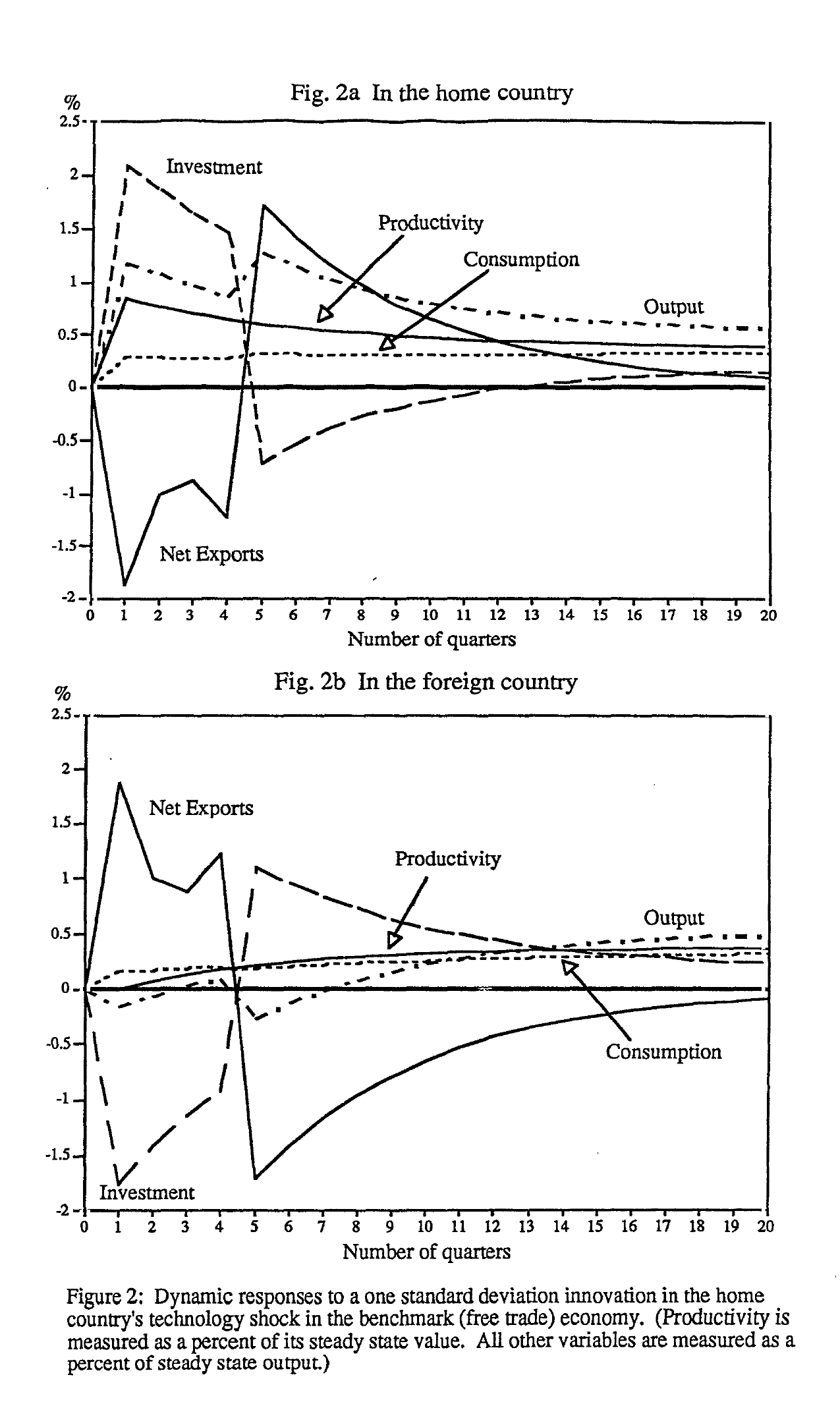
So the model makes two sharp, linked predictions. Consumption should be more correlated across countries than output — nearly perfectly correlated, in fact. And output can easily be negatively correlated across countries, because capital flees the temporarily-less-productive place. In the benchmark calibration the numbers are: cross-country consumption correlation 0.88, cross-country output correlation −0.18.
What the data say
The data say the opposite, in every pairing the authors could measure. Across twelve developed countries, output correlations with the U.S. are positive nearly everywhere (0.70 for a European aggregate, 0.77 for Canada), and consumption correlations are smaller than output correlations in every single country — 0.46 for Europe, 0.65 at best for Canada, negative for France and South Africa. The world’s households behave as if the international insurance market barely exists: what a country consumes tracks what it produces, not what the world produces.

There is a matching set of quantity problems. Model investment is wildly too volatile (relative standard deviation 10.94 against 3.15 in U.S. data), because nothing stops capital from sloshing toward the latest shock. The trade balance is likewise absurd: the standard deviation of net exports over output is 2.90 percent in the model against 0.42 in U.S. data and under 0.9 in Canada, Germany, and Japan — roughly seven times too volatile — and the model’s trade balance is basically acyclical (correlation with output −0.02) where every actual country’s is countercyclical.
Anyway, they tried everything
The paper’s second half is a systematic attempt to break its own result, and the honesty of the exercise is why it stuck. Raise risk aversion from γ = −1 to −5: consumption correlation falls to 0.74, output correlation rises to −0.11, ordering unchanged. Crank up the spillovers and the innovation correlation beyond what the Solow-residual estimates justify: output correlation climbs to 0.38, but consumption goes to 0.95. Add a small transport cost on net trade — a quadratic penalty whose marginal cost is about 0.58 percent at the benchmark’s typical trade flow: this works wonders on the quantities (net-export volatility collapses from 2.90 to 0.16, investment volatility from 10.94 to 2.60, investment becomes properly procyclical), and does almost nothing to the correlation ordering (consumption 0.91, output 0.02).
Then the extreme case: shut down all trade, in goods and in state-contingent claims. Autarky. No insurance market exists at all, and the consumption correlation is still far above the output correlation. The reason is elegant and slightly damning: the foreign household sees the home productivity shock, knows it will spill over into its own future productivity, and — permanent income hypothesis — raises consumption today while output hasn’t moved yet. You don’t need risk sharing to make consumptions comove; you just need forward-looking consumers and persistent, spilling-over shocks. The anomaly is not a complete-markets artifact. It’s deeper than the market structure.
A small trading cost, incidentally, replicates autarky almost exactly, and the authors’ explanation is a number worth remembering: the welfare gain from international asset trade in this model is 0.3 percent of consumption. When the gains from trade are that small, a tiny friction kills the trade. (This is the Cole–Obstfeld (1991) point, and it has a long afterlife in the literature on why international portfolios look so home-biased.)
The anomaly, as bequeathed
The authors’ own summary is careful: most of the discrepancies “evaporate with modest changes in parameter values or economic structure” — trading frictions fix the quantities — but the consumption/output correlation ordering survives everything they throw at it, so they “label it an anomaly.” The label stuck; the literature calls it the bkk puzzle or the quantity anomaly, and it is the opening entry in the catalogue of ways international data refuse to show the risk sharing that theory predicts. Its sibling, at the price level rather than the quantity level, arrives one paper later in this reading list: Backus and Smith (1993) looking for the missing risk sharing in the comovement of consumption ratios and real exchange rates, and not finding it there either.
What makes the paper a classic rather than a negative result is the discipline of the exercise: every parameter was set from closed-economy studies or micro evidence, “without regard for their international implications,” so the international failures are genuine out-of-sample rejections rather than calibration choices. The frictionless benchmark had to be built and taken seriously before its failures could become the field’s to-do list — and items one through three on that list (trading frictions, incomplete markets, and shocks that aren’t technology) are, not coincidentally, where the rest of this syllabus goes.