Notes on:
Monetary-Fiscal Interactions: A Reappraisal
NBER Working Paper 34257
9 December 2025
monetary policy · fiscal policy · New Keynesian models · FTPL · HANK
Talk · doi · PDF · Transcript
Written by Fable 5
George-Marios Angeletos (Northwestern), Chen Lian (Berkeley), Christian K. Wolf (mit) and Dalton Rongxuan Zhang (Northwestern). Presented by Angeletos as the day-one keynote of the ecb–imf conference on Fiscal Policy and emu Governance, Frankfurt, December 9, 2025, under the earlier title “Monetary-Fiscal Interactions: hank vs rank,” chaired by Philip Lane; no discussant. Written from the August 2026 nber working paper (No. 35642) and the talk transcript.
Fiscal dominance — the idea that when the government runs deficits and refuses to raise taxes, the price level has to do the adjusting — is one of the great unsettled arguments of monetary economics. The Fiscal Theory of the Price Level says the government’s budget constraint is a valuation equation: nominal debt is a claim on future surpluses, and if the surpluses aren’t coming, the price level rises until the debt is worth what the surpluses can support. Put that machinery inside the standard sticky-price New Keynesian model — as a large post-Leeper (1991) literature does — and you get the modern story of monetary-fiscal interactions: if fiscal policy is “active” (it won’t adjust taxes) and monetary policy is “passive,” deficits drive output and inflation, and the central bank has lost the wheel.
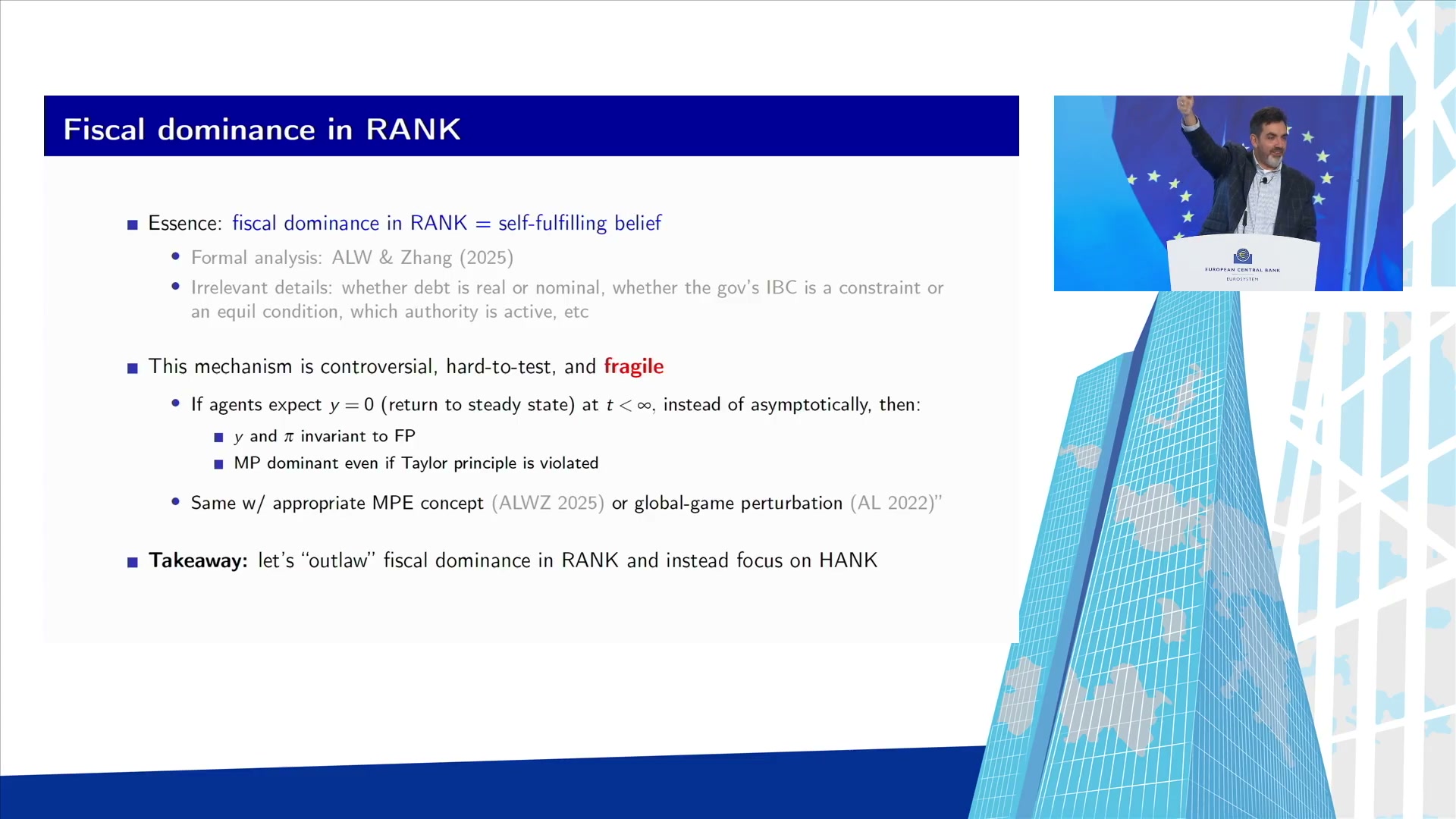
This paper’s claim is that, inside the representative-agent New Keynesian model, that entire mechanism is a self-fulfilling prophecy that has to last literally forever — and that once you rule out infinitely-lasting self-sustained booms, which the authors argue any model built for the short run should, fiscal dominance in that model simply dies. What survives, and what they think the profession should be doing instead, is fiscal policy in heterogeneous-agent (hank) models, where deficits move demand for the boring classical reason that actual households — finite-horizoned, borrowing-constrained — treat a tax deferral as real money.
The trick is to ask what the household knows. The paper’s method is almost embarrassingly simple: take the standard model — sticky prices, demand-determined output, Ricardian households — and instead of solving for competitive equilibria, recast it as a game among the households and look at Nash equilibria. The one substantive assumption is that households are rational in a slightly stronger sense than usual: they understand the structure of the economy, including the fact that the government’s intertemporal budget must hold and that their own income is determined by everyone else’s spending. A Ricardian household that understands this can strip its budget constraint down alarmingly far. Its bond holdings and its tax obligations net out — that’s just Barro (1974) — so any fiscal operation, from the timing of taxes to helicopter drops to outright default, drops out of its lifetime budget entirely. What’s left is: my spending is constrained by my permanent income, and my permanent income is everyone else’s spending. Fiscal policy is, in the game-theory sense, payoff-irrelevant. Monetary policy still matters, because the real interest rate enters how households discount; taxes don’t.
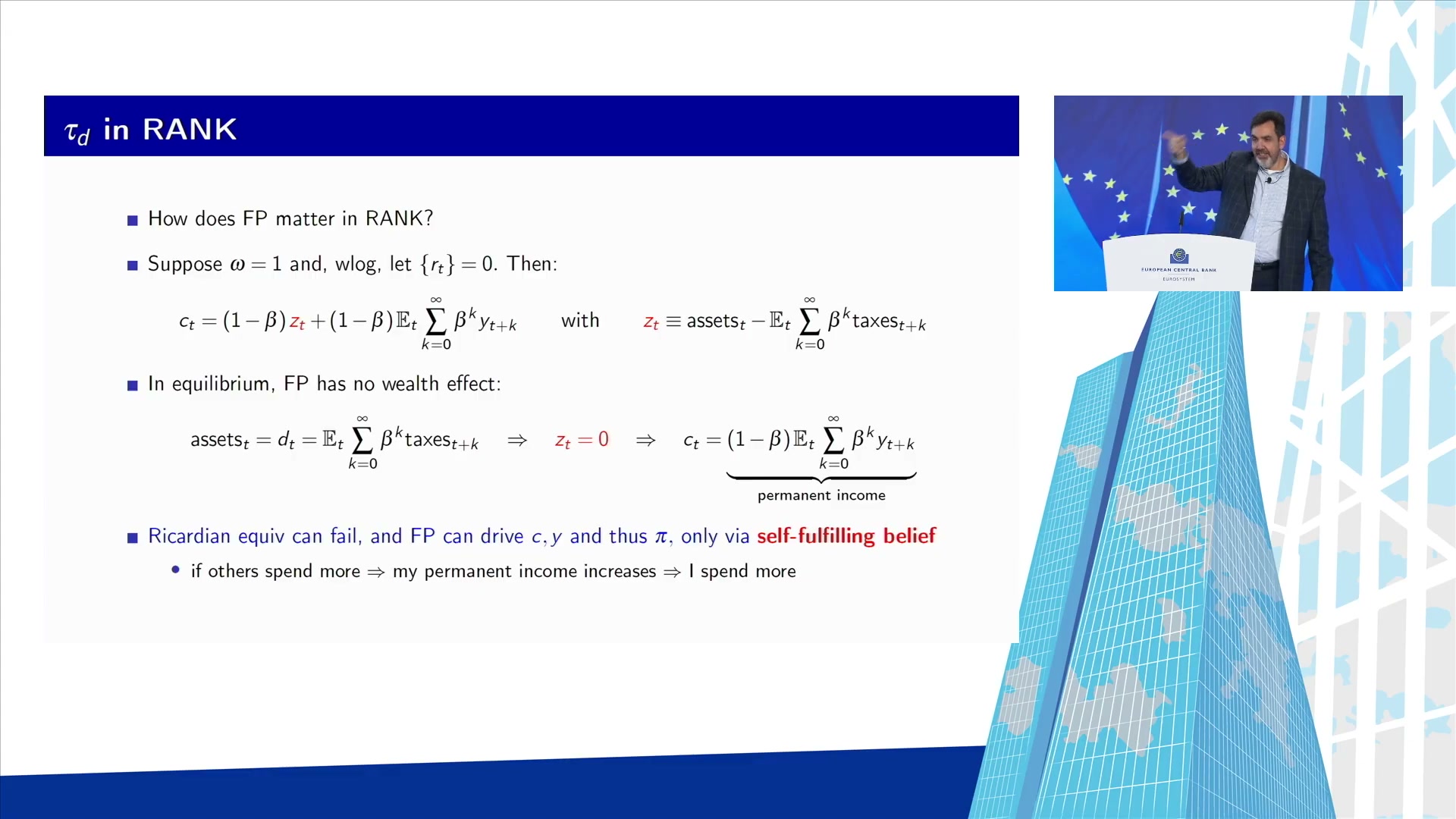
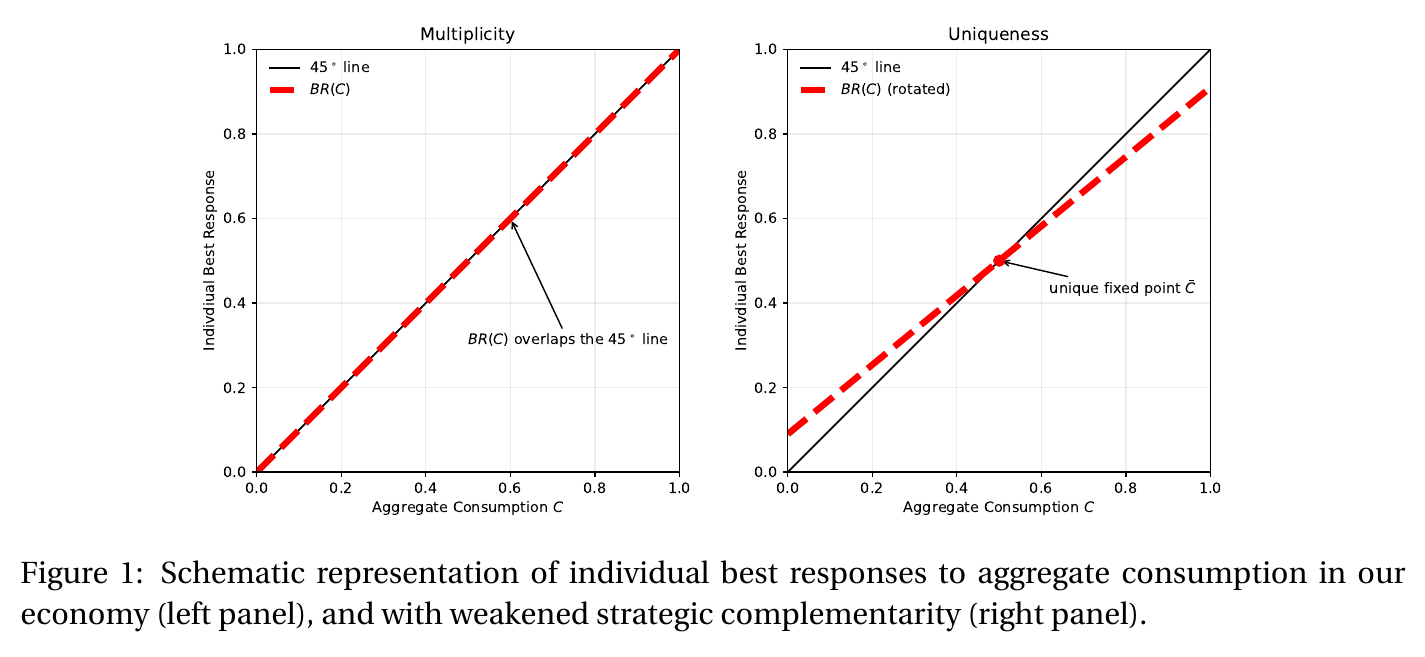
That leaves a strange and beautiful degenerate game. With the real rate pegged at the discount rate, each household’s optimal consumption equals its permanent income, and its permanent income equals aggregate consumption, so the best response to “everyone spends ξ forever” is “I spend ξ forever” — for any ξ. Consumer optimality gives c = y, demand determination gives y = c, and the economy’s best-response curve lies exactly on the 45-degree line: a continuum of equilibria, one for every level of permanent income the households care to believe in. The paper’s Figure 1 is the whole argument in one picture.
The load-bearing equation is the economy-wide best response under a real-rate peg (eq. 31 in the paper):
where is household ’s consumption and is aggregate consumption at date : individual spending equals a weighted average of everyone’s spending, with weights summing to one — a cumulative marginal propensity to consume of exactly one, feeding on income that is exactly as demand-determined as spending itself.
So what is “active fiscal policy” actually doing? Here is where the reappraisal bites. In this representation, the set of equilibria is invariant to fiscal policy — so how does the ftpl literature get deficits to cause booms? Answer: by using the competitive-equilibrium concept, where the government’s budget acts as a selection device. The set of competitive equilibria is the set of Nash equilibria that happen to satisfy the government’s budget under the announced tax rule. An “active” government that pegs its tax revenues regardless of debt is choosing a rule that only one Nash equilibrium can satisfy — so, in the ce logic, the households obligingly coordinate on exactly the self-sustained boom whose extra tax base (or, with nominal debt, whose extra inflation and debt erosion) balances the books. The authors call the real-debt version the “Fiscal Theory of Output,” and show the ftpl proper is the same object with the adjustment running through the price level instead of the tax base: two sides of one coin, both powered by the same infinite spending-income loop. The deficits have zero net wealth effect on anyone — households know the bonds aren’t wealth — so the entire boom is self-levitating: an infinite multiplier applied to a direct effect of zero. The government isn’t paying its debts with taxes; it’s paying them with the private sector’s collective agreement to be richer forever. If households instead coordinate on some other spending level — which nothing in their payoffs prevents — the “active” government doesn’t get its selected equilibrium; it gets a forced tax adjustment, or a default.
The refinement. The New Keynesian model was built to study the short run; everyone teaching it says the long run is supply-determined. The authors’ refinement just takes that seriously: households believe the economy returns to flexible-price outcomes at some finite date H, which may be a thousand years out. That single requirement rotates the best-response line off the 45-degree line — the sum above truncates at and picks up an anchor term , so the slope drops from to , which is all the right panel of Figure 1 needs. Uniqueness follows, with no Taylor principle, no boundedness assumption, and no fiscal selection: monetary policy alone drives output and inflation, and it does so through the path of real rates rather than through anyone’s beliefs about the year 3025. A boom that must end at any finite date, however remote, cannot exist at all — the fiscal-dominance equilibrium is a bubble that survives only if it is common knowledge that it never, ever pops. As Angeletos put it in Frankfurt: “I love multiple equilibria in general, but that particular multiplicity I’m very allergic to.”
What’s left standing is hank. None of this says deficits don’t matter in the world; it says the rank route to their mattering is the wrong one. Add a classical failure of Ricardian equivalence — the paper uses bonds-in-utility as a tractable proxy for finite horizons and liquidity constraints — and fiscal policy re-enters household payoffs directly: government debt is now something households actually value holding. Multiplicity doesn’t vanish (the infinite loop is still available in hank; the paper shows a continuum of equilibria there too), but under the same refinement you get a unique equilibrium in which deficits are expansionary for the honest reason, quantifiable with mpc evidence rather than resting on beliefs at infinity. In the log-utility case the Euler equation becomes (eq. 36 in the paper)
where and are monetary and fiscal shocks, is the utility weight on asset holdings, and the debt-to-gdp target: deficits and rate cuts enter symmetrically, both frontloading spending like a discount-rate shock. Fiscal and monetary policy become interchangeable instruments operating on demand — which is roughly how, one suspects, most practicing central bankers already thought about it.
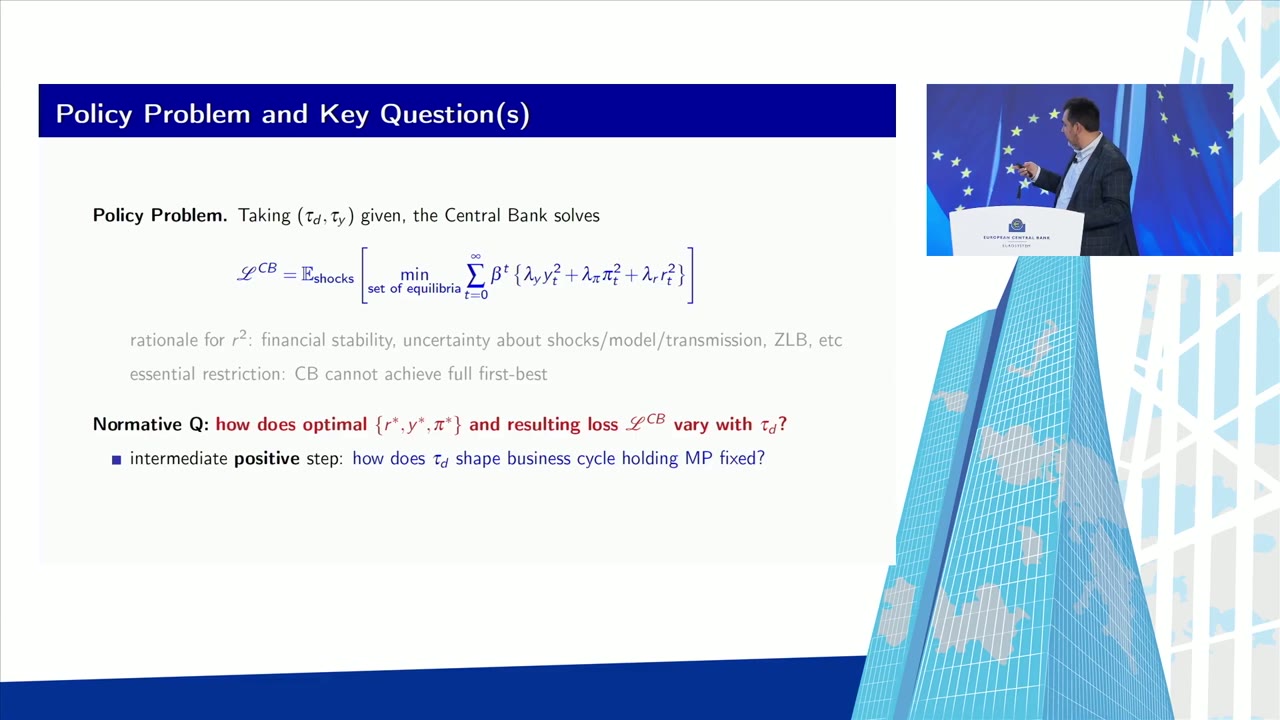
What the room pushed on. The Q&A at the ecb (questioner names per the chair, with the usual caption-transcription caveats) was warmer than you might expect for a paper telling the ftpl literature its mechanism is a coordination artifact. The first questioner — from the ecb side — essentially agreed and offered the paper its best slogan: this is fiscal relevance, not fiscal dominance, and it’s what any central-bank model already produces. Another asked what would distinguish the two theories in data; Angeletos’s answer is worth keeping: non-Ricardian households are “hungry” and spend transfers fast, so deficit-driven inflation should be front-loaded and short-lived, whereas ftpl households smooth forever, generating very persistent inflation — a genuinely testable macro difference, on top of the micro evidence, which he regards as already settled against the permanent-income consumer. A third asked whether two-agent (tank) models would do; answer: tank is a degenerate special case with issues, but generic hank goes through. The talk’s second half, it should be said, went beyond this paper into companion work on optimal slow fiscal adjustment — the argument that a central bank facing demand shocks should actually welcome fiscal foot-dragging, since backloaded taxes stimulate demand precisely when non-Ricardian households need it — which drew the sharpest question, on post-Covid us inflation, that the clock mercifully cut short.
The quiet punchline of the paper is conservative rather than radical: the conventional, textbook solution of the New Keynesian model — Taylor principle, bounded equilibrium, fiscal policy irrelevant — turns out to be the only solution consistent with the model’s own founding principle that demand matters in the short run and supply in the long run. The ftpl’s sticky-price incarnation, on this reading, wasn’t a rival theory of inflation so much as a rival theory of what happens at the end of time. (The authors, diplomatically, put that in terms of “hard-to-test assumptions regarding beliefs at infinity,” which is the polite way academics say unfalsifiable.)