Notes on:
Toward a Quantitative General Equilibrium Asset Pricing Model with Intangible Capital
Review of Financial Studies
1 February 2013
intangible capital · asset pricing · long-run risk · value premium · vintage capital
Paper · doi · PDF
Made with AI: Opus 5.5 (reading, diagram and writing), GPT 6.1-Sol (reading), Fable 5.1 (adjudication), Sonnet 5.5 (verification), GPT 6-Astra (verification)
Hengjie Ai, Mariano Massimiliano Croce and Kai Li, Review of Financial Studies 26(2), 2013, 491–530. Written from the preliminary January 2010 sed meeting draft; the published version may differ; no recorded talk.
Ai, Croce and Li want a production economy in which ideas are a big asset class and a safe one. That is less obvious than it sounds. Intangible investment in the us is about as large as physical investment (Corrado, Hulten, and Sichel 2006). If you read market-minus-book value as the value of a firm’s intangibles, growth firms are idea-intensive and value firms are machine-intensive, and the value premium says the machines earn about 5% a year more. So the asset that supposedly owns the future earns less than the asset that owns the factory floor, and the paper’s job is to build a general-equilibrium model where that is the natural outcome rather than an embarrassment.
A note on the numbers before any appear. Every number here comes from the January 2010 draft, the only full text publicly available, and the published version may well have recalibrated. The draft also disagrees with itself on a few headline figures: the introduction reports a 4.54% market premium where Table 5 has 4.74, and the text reports a 4.29% model value premium where Table 5 has 4.08. I use the table’s numbers throughout and say so when it matters.
This note is in the collection for one question: when an economy is full of good ideas, who captures the rents from them? The answer this paper gives is clean, a little deflating for ideas, and worth taking slowly.
The mechanism: ideas are options, and options are cheap to print
Following Ai’s earlier (2009) “Intangible capital and the value premium”, intangible capital is a stock of unexercised investment options: “ideas, blueprints, business plans, softwares”, in the draft’s words. You make one option out of one unit of the consumption good; that spending is intangible investment . An option you don’t use dies with probability each period. An option you do use is gone, because exercising it is irreversible: you pay units of physical investment, where is the option’s quality, drawn fresh each period, and you get one production unit. Production units are physical capital . They come in vintages, run on labour alone once built, and die at rate ; Proposition 1 aggregates them into an ordinary .
So physical capital is not bought, it is made, out of machines-money and ideas . You exercise the best ideas first, so the cutoff quality is and the number of new units is , a ces aggregator with weight on and elasticity between the two. Pushing more through a fixed pool of ideas means reaching down to worse ideas, which is an adjustment cost with a microfoundation.
Now price everything. Here is the first-order condition for making a new production unit:
This is eq. 13 with eq. 14 in the draft: is the Epstein–Zin (1989) stochastic discount factor, the relative productivity of a brand-new unit, the cum-dividend value of an installed unit, the physical-investment cost of the marginal idea, and the value of the option you used up.
The right-hand side is the whole rent story. The value of a new unit of capital is split between the machines that went into it and the idea that went into it. And the idea’s price, , is pinned at 1. Not calibrated to 1: pinned there, because anyone can turn a unit of consumption into an option one for one, so an option can never be worth more than 1 and, as long as , never less. The draft says it directly: the value of an unimplemented idea “is always 1”, like a neoclassical growth model without adjustment costs. Equivalently (eq. 19), is the present value of all future option payoffs, and because the supply of options is perfectly flexible only the quantity responds to shocks.
If the price can’t move, everything the claim on ideas earns has to come through its dividend:
This is eq. 17 in the draft, with its ces form eq. 27: is the option payoff (the marginal product of an option in units of output), and are the ces weight and elasticity, and is investment per option, so with all the risk in is risk in .
Compare physical capital, eq. 16: . Its price , the present value of future marginal products, does move. So in this model an idea is a bond-like claim with a variable coupon, and a machine is an equity-like claim with a price. That asymmetry is most of the paper.
Who captures the rents from good ideas
There is one representative household, and it owns both claims, so “who captures” cannot mean which people. It has to mean which asset’s payoff or price absorbs the rent. Here is what the paper says and what is my reading of it, kept apart.
The paper says the option payoff is “the marginal product of intangible capital” and can be read as the option’s payoff; that eq. 13 splits the value of a new unit into the cost of the marginal idea and the option used; that because ideas are produced one for one; and that the idiosyncratic quality draw is not priced, so the option’s risk premium is entirely in .
My reading, derived from eqs. 8 and 15 and not stated in the draft, with one repair: eq. 8 as printed drops the cost per exercised idea that the text states, and only with it restored does eq. 15, , hold. Then, by the envelope condition, , where here is the quality density. That is the goods saved by exercising ideas better than the marginal one, valued at the marginal unit’s cost. So the option payoff is the inframarginal surplus of good ideas, and it accrues to the claim on as a flow dividend each period, never as a capital gain. Because ideas are freely produced at price 1, no rent is ever capitalised into the price of an idea. If ideas get more valuable, the economy just makes more of them, which is a very effective way of making sure nobody gets rich holding them.
The rents from aggregate good news go somewhere else entirely, to installed capital. That is the surprising thing, below.
The wedge: new capital misses a year
The model needs one more ingredient, and it is the one doing the quantitative work. Productivity follows Croce’s (2014) long-run-risk process (a 2008 working paper when the draft was written): with a persistent component . Old vintages load fully on aggregate productivity. A new vintage, in the Benchmark, loads with in its first period: it misses one year of the aggregate shock, which is what in eq. 13 encodes.
The empirical motivation is in Section III: in compustat 1950–2006, firm-level tfp co-moves more with aggregate tfp the older the firm, by 0.031 per year of age (s.e. 0.006, though with an R² of 0.036 age explains little of firm-level variation), and in the size appendix small firms’ exposure is 0.348 and insignificant against 1.150 for large ones. The calibration then sets to zero, the extreme end.

Table 3 lays out the ladder. All four models share , , , , and . The Benchmark has intangibles, long-run risk and the vintage lag (, , , , ). Model 1 drops the lag () and re-fits to 0.79 and to 6.30%. Model 2 also drops long-run risk. Model 3 drops intangibles and is an rbc model with Epstein–Zin preferences, with chosen to hit the consumption–investment ratio, which costs it a 12.65% risk-free rate. Note that the Benchmark and Model 1 differ in more than one switch.
The one surprising thing: good news about the future makes ideas pay less
Take Model 1 first, no lag. Good long-run news arrives, and because makes investment elastic, rises nearly permanently and capital is rebuilt fast. With , faster rebuilding offsets the higher future productivity, so the marginal product of capital, and with it , barely moves. Meanwhile the idea dividend rises with , exactly in good long-run states. So in Model 1 ideas are the asset exposed to long-run news, and physical capital is not, which gets the value premium backwards in spirit and tiny in size.
Now add the lag. Good long-run news raises the productivity of every existing vintage right away, but a unit built today misses the first year of it. So there is a strong income effect and no substitution effect. You feel richer, you consume more, and you wait a year before exercising your ideas, because the new vintage would start behind. The draft concedes that it “may be surprising” that small positive long-run shocks have significant and prolonged negative effects on investment, and puts the persistence down to : new capital stays behind old capital for as long as the news persists.
Capital stays nearly permanently behind its Model 1 path, the marginal product (with ) stays high, and jumps. The installed capital stock captures the windfall in its price. And falls on impact, so the idea dividend falls, so responds negatively to good long-run news. The draft’s phrase is that this makes intangible capital “a good insurance device against the long-run risk”. Only against long-run risk, though: on a short-run shock rises along with (the left column of Fig. 2), which is why the intangible premium in Table 5 is small but still positive.
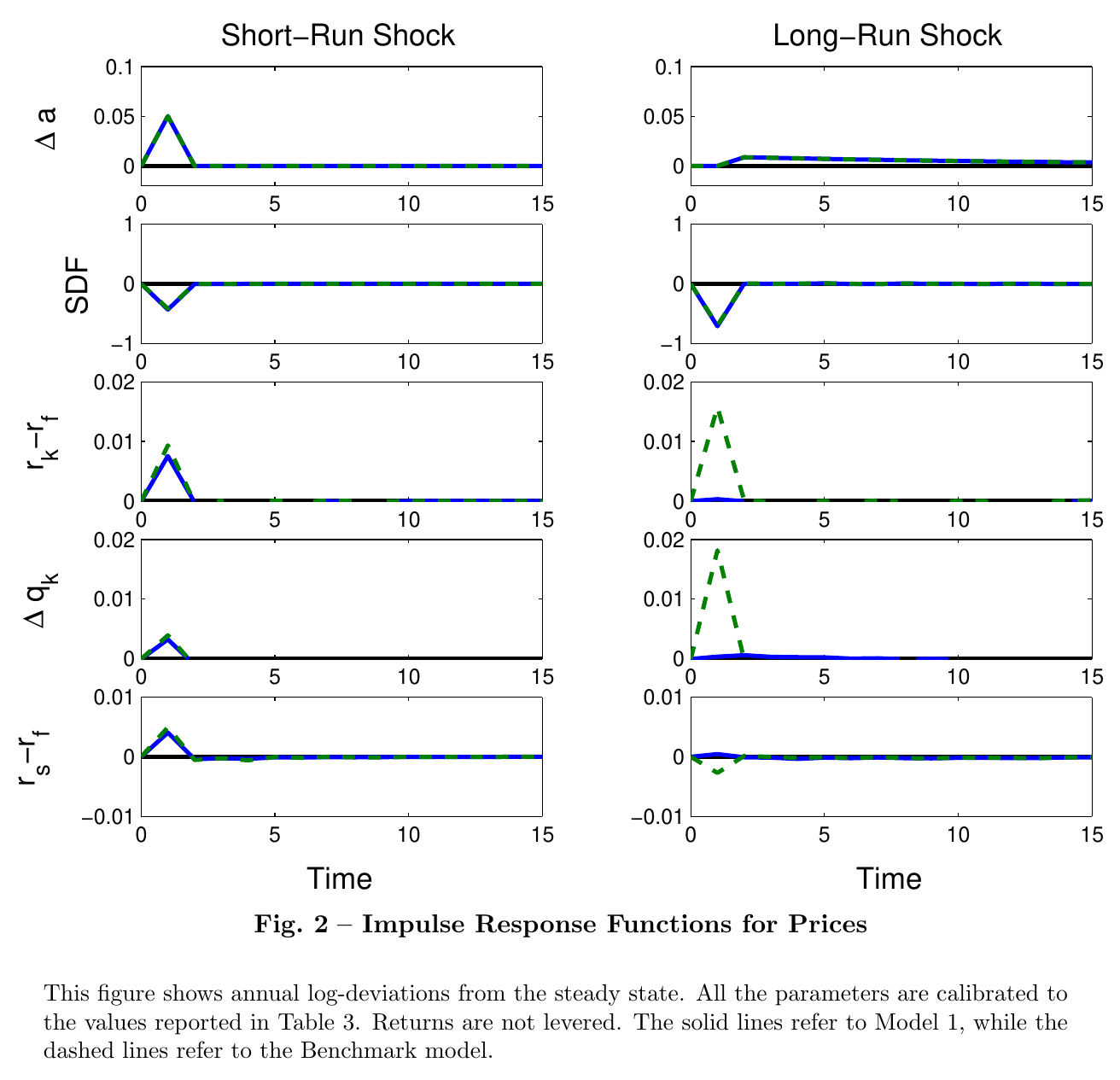
Fig. 2 shows it. In the long-run-shock column, in the Benchmark jumps by about 1.5% per one-standard-deviation shock, against a response the draft calls “barely visible” in Model 1, and the intangible return dips below zero in the last panel. Under Epstein–Zin pricing with and , long-run news is where marginal utility moves most, so an asset that pays off in good long-run states earns a premium and one that pays off in bad ones is a hedge.
So the rents from a good future go to the machines already installed, as a capital gain, and the claim on ideas absorbs the cost, as a lower dividend. The asset that, in the usual story, “owns the future” turns out to be the hedge against news about it. In my reading this is the direct answer to the collection’s question for this model: the long-run rent is captured by installed physical capital, the inframarginal rent of good ideas is paid out as a flow to the idea claim, and nothing is ever capitalised into the price of an idea.
The evidence
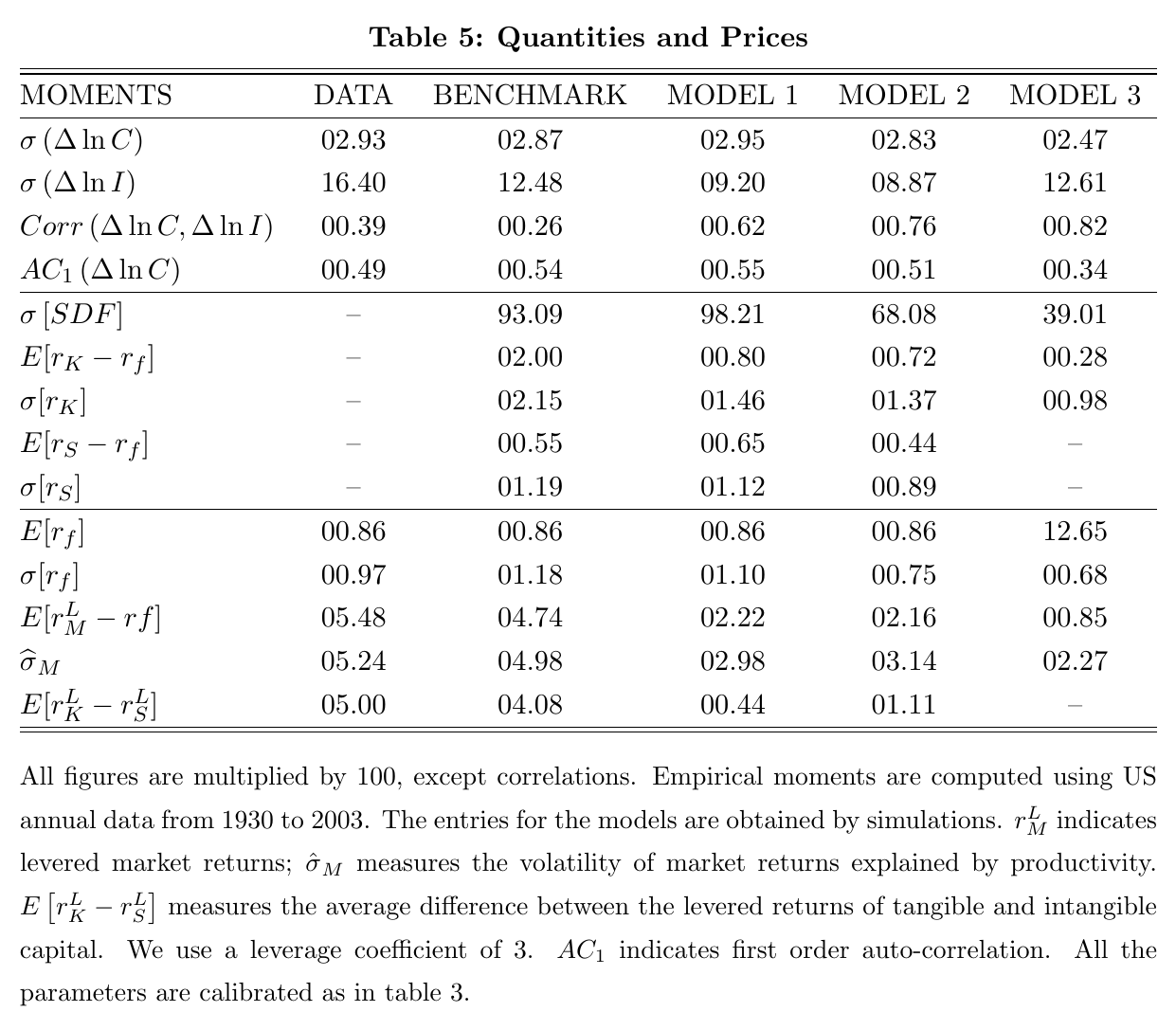
The calibration matches its targets in Table 4 (the consumption–investment ratio, 5.60 against 5.62; of 1.01 against 1.00; output-growth volatility and autocorrelation; a 0.86% risk-free rate). Table 5 has the untargeted moments, and it is where the ladder pays off. The unlevered physical-capital premium rises from 0.28% in Model 3 to 0.72 in Model 2, 0.80 in Model 1 and 2.00 in the Benchmark. The intangible premium is 0.55% in the Benchmark, below Model 1’s 0.65, with volatility 1.19% against 2.15% for physical capital. The stochastic discount factor’s volatility is 93.09% in the Benchmark; adding intangibles alone takes it from 39.01 (Model 3) to 68.08 (Model 2), which the draft calls “almost doubles”.
Levered with a coefficient of 3 (the draft’s footnote says debt-to-equity of 2, consistent if the coefficient is one plus the ratio), the Benchmark market premium is 4.74% against 5.48% in the data, and Model 1 manages 2.22. The levered value premium, , is 4.08% against 5.00% in the data, while Model 1 produces 0.44 and Model 2 1.11. That is the “more than two times” and “an order of magnitude” in the text. By the table, 4.08/5.00 is 82% of the data; the abstract says “about 75%” and the text, using 4.29, “more than 70%”. The market’s productivity-related volatility, the part of stock-market volatility the draft attributes to productivity shocks (about a quarter of a 19.42% total), is 4.98% in the Benchmark against 5.24 in the data.
On quantities, the Benchmark’s investment volatility of 12.48% falls short of the data’s 16.40, and its consumption–investment correlation of 0.26 is below the data’s 0.39, where the frictionless models overshoot (0.62 to 0.82). The draft reads that lower correlation as support for investment falling on long-run news.
Model 2 is worth a glance: without long-run risk it has a bigger spread (1.11) than Model 1 with it (0.44). Adding long-run risk without the lag makes ideas, not machines, the exposed asset, and shrinks the spread. (The draft’s sentence about this on p. 23 is garbled, but the table is clear.)
Objections, mine (pdf-only, no talk, discussant or Q&A)
The lag is doing all the work, and its evidence is about something nearby. is the extreme setting, while the data are about firm age in compustat, measured as years in the database (roughly time since listing), not about investment vintages, and the small-firm exposure is insignificant rather than zero. Young and small firms also have noisier measured tfp. The draft is candid that the model “is silent on why young firms” are less exposed.
Investment falling on good long-run news runs against the news-shock co-movement literature, and the whole hedge property of ideas rides on it.
The value-premium mapping leans on leverage. The unlevered Benchmark spread is 2.00 − 0.55 = 1.45 points, and 3 × 1.45 = 4.35, not 4.08 (Model 1’s 0.44 does fit 3 × 0.15), so the draft never quite says how leverage is applied. Growth firms are typically less levered than value firms, and the draft never tries unequal leverage; by the linear arithmetic, less leverage on the idea claim would widen the spread, not shrink it. Either way the headline number is mostly the lever, and book-to-market sorts are not pure tangible and intangible claims.
Most of all, is an assumption about who can capture innovation rents, dressed as a technology. With one-for-one, frictionless production of ideas there is no scarcity, no firm-specificity and no appropriability problem, so no rent can ever sit in the price of an idea. Give idea production any convexity and would move with , probably upward on good long-run news, which is exactly the exposure the model needs ideas not to have. For a model of this kind in which innovation is risky rather than a hedge, see Kung and Schmid (2015). The 93% annual volatility of the discount factor is also a lot of pricing power to have doing the converting.
None of which takes away from the paper’s real contribution, which is to make the value premium a fact about timing rather than about ideas being special. Ideas are worth exactly what it costs to have them, and the money is in the machines that were already running when the good news came.