Notes on:
A Theory of Economic Coercion and Fragmentation
NBER Working Paper 33309, August 2026 revision
1 February 2026
geoeconomics · coercion · fragmentation · power
Talk · Paper · PDF · Transcript
Made with AI: Fable 5 (reading), Opus 5 (writing)
Christopher Clayton (Yale som), Matteo Maggiori (Stanford gsb), Jesse Schreger (Columbia). The August 2026 draft, 102 pages with appendix; this is the version used, and it supersedes nber Working Paper 33309 of December 2024. Video: Maggiori at the Hoover Institution Economic Policy Working Group, Stanford, February 2026 (70 minutes, chaired by John Taylor, no discussant; the room interrupts throughout and the questioners are not always identifiable from the captions). Figures are cropped from the pdf.
The defence paper
A Framework for Geoeconomics (2026) was about offence: how a hegemon with enforceable relationships and inputs that others depend on extracts concessions by threatening to cut them off. This paper asks what everyone else does about it, and the answer has an unpleasant symmetry to it. The mechanisms that make integration valuable — external economies of scale, strategic complementarities, specialization — are the same mechanisms that make the hegemon’s inputs hard to substitute, so the gains from trade and the exposure to coercion are one quantity looked at from two sides. The paper’s own tag for it, the header it gives the argument, is “Krugman Meets Geoeconomics,” and that is accurate: the production structure is Krugman (1979, 1980), the coercion is cms (2023), and the new thing is the interaction.
The leading example is payments. A global messaging and settlement system is efficient because everyone is on it, which is exactly why the alternatives are under-scaled and poor substitutes, which is exactly why threatening to disconnect a bank from it is a usable threat. The United States controls the dominant system in practice. Russia built spfs after 2014 and China built cips; both are inefficient substitutes, and the paper’s point is that their inefficiency is not incidental, it is the hegemon’s power measured in a different unit.
The timing, and the inside and outside option
The model is a Stackelberg game in three stages. At the Beginning every government, including the hegemon’s, sets revenue-neutral wedges on its own firms’ input choices — industrial, financial and trade policy in reduced form. In the Middle the hegemon, and only the hegemon, offers foreign entities a contract: take these costly actions (transfers, tariffs, political concessions) or lose access to the inputs I control. At the End production happens subject to both sets of wedges. Because the hegemon has no legislative authority abroad, what it can demand is bounded by a participation constraint, : the target’s value under compliance, net of what it pays, must be at least its value after exclusion. The optimal contract binds it, so the target is held to its outside option and the hegemon’s power is the gap between the inside and outside options.
That single sentence organizes everything. The hegemon wants the gap large, so it has two instruments: make the inside option better (coordinate the global externality, make its inputs cheap and ubiquitous) or make the outside option worse (make the alternatives scarce). The target’s government wants the outside option high, because that is what it keeps. Anticipating the Middle, it sets wedges at the Beginning that raise what its firms would have if they refused — and the paper calls this anti-coercion policy, noting that it looks in practice exactly like protectionism or security-motivated industrial policy.
The doom loop
In the stripped-down payments model the result is deliberately stark. Each country’s optimal anti-coercion policy is an infinite tax on using the hegemon’s system and an efficient subsidy to the home alternative: full fragmentation (Proposition 4). The reason is that the hegemon would extract the entire gain from using its system ex post, so any use of it only crowds out the home alternative and lowers the outside option; better never to become dependent. The externality is the doom loop. When one country pulls back, the hegemon’s system loses scale and becomes less attractive to everyone else, whose governments then pull back further. The paper shows the result is Pareto-dominated not just by the planner but by the no-hegemon Nash outcome: a world with the same externalities and no coercion, in which countries under-use the global system for the usual reasons but at least use it. The general theory (Section 3, Propositions 6–8) softens the corner solution but keeps the direction: integration that creates dependency is integration governments will lean away from.
Maggiori answered the room’s pushback on endogeneity — surely the input-output matrix is endogenous and countries have seen this coming — by saying yes, that is what the Beginning stage is for, and that the model is medium-run in a specific sense: a cut-off firm re-optimizes all its other relationships and can scale them up; what it cannot do is have its government change policy after the threat. The ex-ante wedges must be invariant to whether the contract is accepted, otherwise governments would promise the moon in the outside option merely to stiffen their firms’ bargaining position.
International organizations as hegemonic statecraft
The result Maggiori said had changed his own mind is Proposition 5. If the hegemon can commit to extract only a fraction of the inside option rather than the whole gap, a small enough is welfare-improving for the hegemon: a rule that binds only itself lures countries back into some use of its system, which restores the scale externality and some revenue, where unconstrained coercion yields none because everyone has already walked away. The equilibrium allocation under the commitment is the no-hegemon Nash allocation, with transfers layered on top, so foreign countries are better off too. The paper’s gloss is that the liberal order and its institutions are an incarnation of hegemonic statecraft rather than its absence, which is the political-science view (Baldwin 1985) and not the economist’s global-planner view. The exchange this produced at Hoover is worth the video: one participant said that anyone who has spent time in the U.S. government, the cea or the Treasury, already holds that view, another that the institutions were sold, very explicitly by Truman and others, in exactly those terms, and a third observed that in practice they have delivered a great deal to the rest of the world. Maggiori’s reply was that he meant it as a theoretical statement about what commitment does, not a quantitative claim about what the imf did, and that he was happy to leave the broader argument off the record.
Power as a sufficient statistic, and why it is nonlinear
The measurement half of the paper is what makes it more than a parable. With nested ces production the hegemon’s power over country — the percentage loss to ’s final-goods producers from losing the hegemon’s inputs, after re-optimizing — is a closed-form function of observable expenditure shares and elasticities (Proposition 12, eq. 21 in the paper). The ingredients are ’s expenditure shares on each sector , on each input within it, on foreign versus domestic sources of that input, and the hegemon’s share of the foreign supply, together with the substitution elasticities at each nest. Input-output tables and bilateral trade in goods and services are enough to compute it.
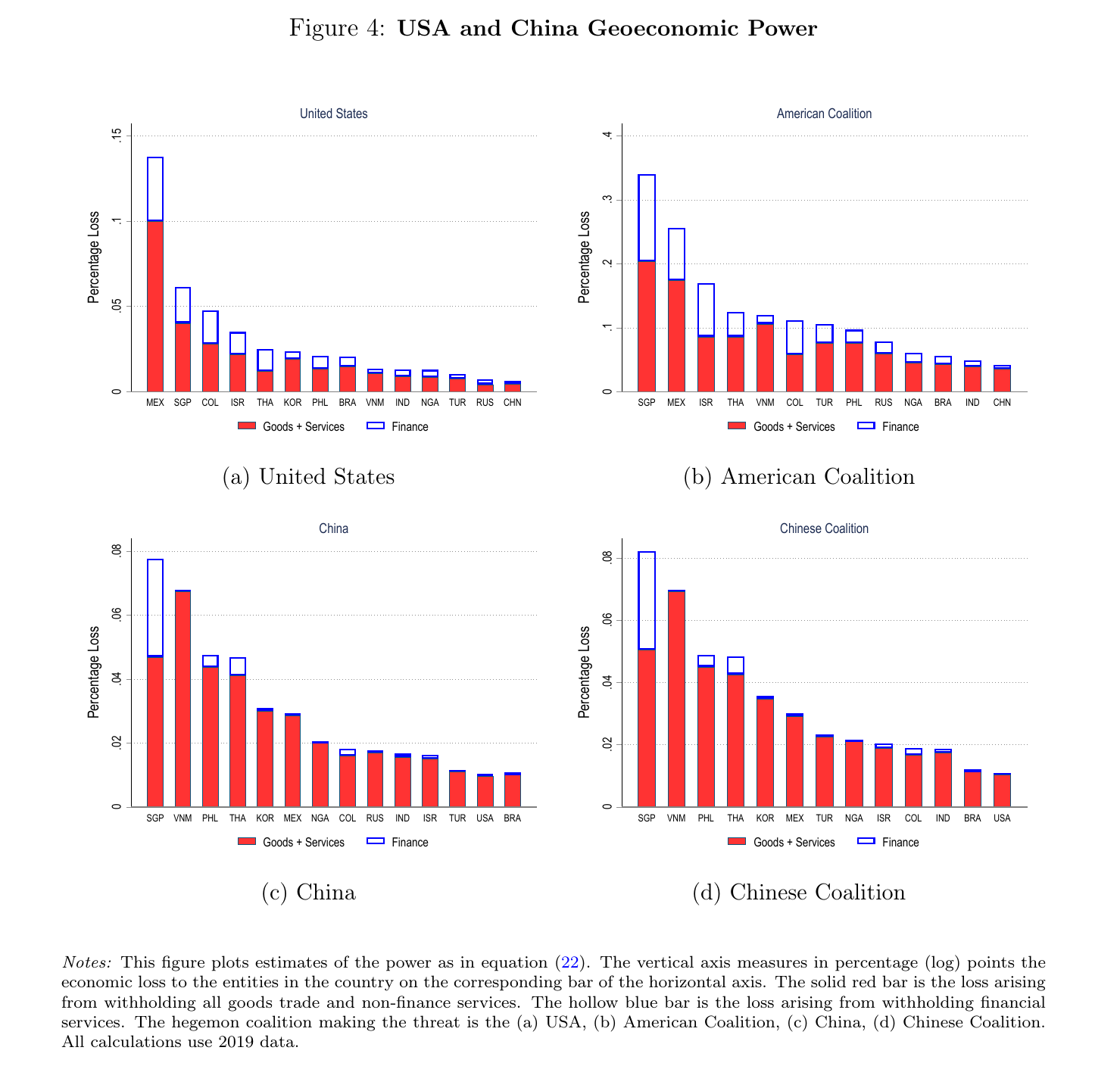
Two findings come out. American power leans heavily on financial services while Chinese power is almost entirely manufacturing, which matches where each actually coerces. And power is sharply nonlinear in the hegemon’s share of an input: the loss to a target from exclusion rises steeply as approaches one, because at 95 percent control there is no alternative to scale up, while at 85 percent there is. Maggiori’s illustration was the renminbi. If China went from 3 to 10 percent of world financial transactions, a macroeconomist would say nothing has changed for exchange-rate pass-through or monetary policy, and would be right; for U.S. power over a Russia-sized country, a 10 percent alternative is an ocean to route transactions through, and the loss is enormous. The share-based framing of dollar-dominance debates, in which nothing matters until shares are near fifty-fifty, is therefore the wrong framing for power. He also pointed out that Hirschman’s (1945) own concentration index, built for precisely these dependencies, gets the direction right and the magnitude wrong, since it implies security requires equal shares, whereas the nonlinearity says a middle power can buy most of its security with very little fragmentation, by diversifying a few large chokepoint inputs from 1 to 10 percent.
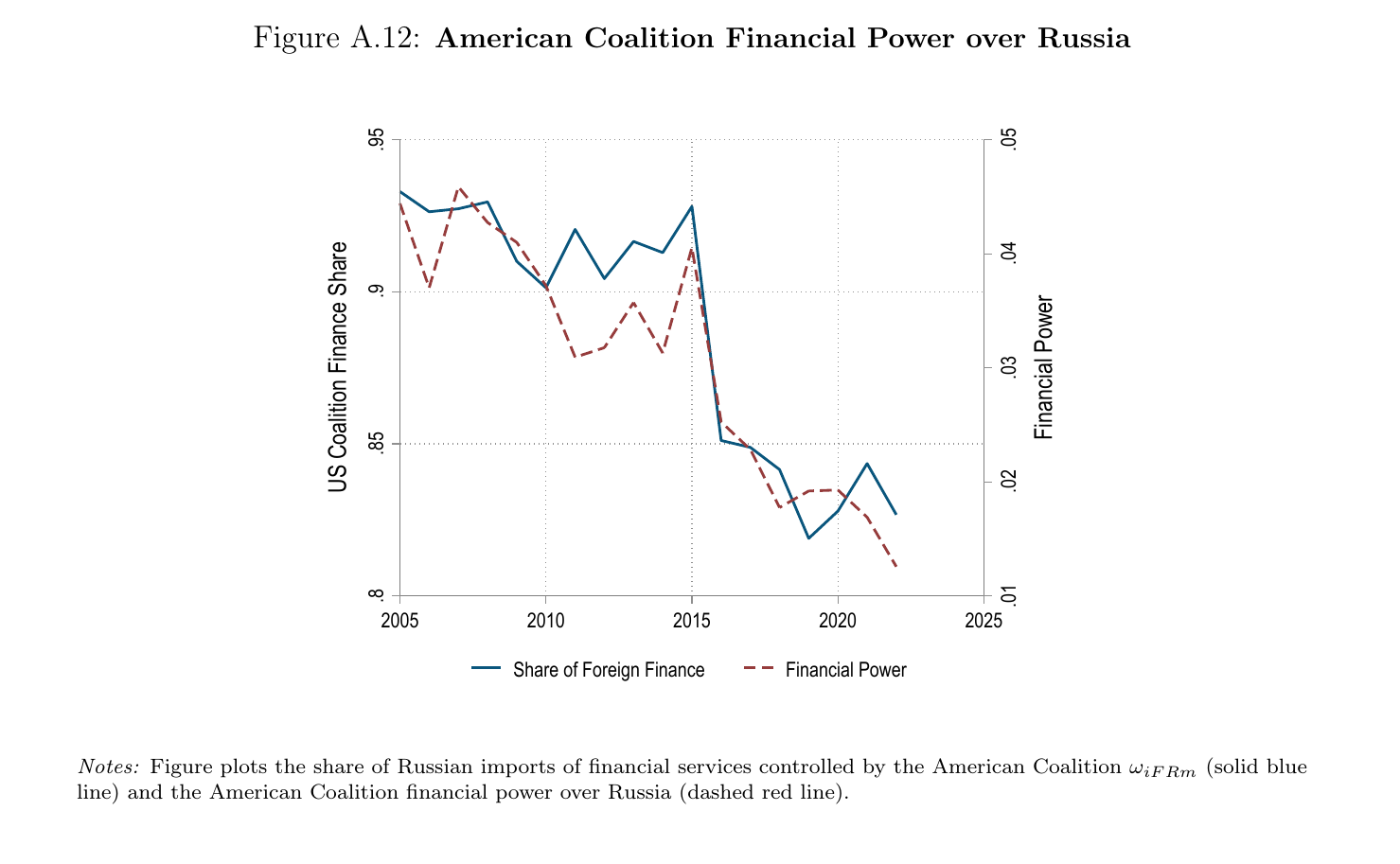
The Russia figure is the nonlinearity in data. After Crimea the coalition’s share of Russia’s foreign financial services fell from around 93 to about 84 percent, and the estimated power fell by roughly half. Where the difference went the draft will not say firmly: the China share rises across the datasets it checks, but so much of the cross-border financial-services data is interpolated that it calls the evidence inconclusive and expects Russia’s new links to be under-reported. The paper offers this as part of the explanation for why the 2022 financial sanctions bit less than expected: Russia had spent eight years buying its way down the steep part of the curve.
Where it sits
Read it immediately after A Framework for Geoeconomics and before the de-risking tariff papers (Lashkaripour–Simonovska 2026, Mayer–Méjean–Thoenig 2025), which are special cases of the defence problem in trade models; and before Pflueger–Yared (2024), whose feedback loop between military and financial hegemony is the kind of complementarity Maggiori said, in the Q&A, he believes bundles threats into more-than-additive power. For the reading group’s own interests it is the paper that defines what “economic security” can coherently mean, and that supplies the number — the power statistic — that a connector economy would want to compute about itself.