Notes on:
A Model of the International Monetary System
Quarterly Journal of Economics 133(1): 295--355
2018
geoeconomics · reserve currencies · safe assets · Triffin dilemma
Paper · doi · PDF
Made with AI: Opus 5 (reading and writing)
Emmanuel Farhi and Matteo Maggiori (Harvard, nber and cepr at the time of publication; Maggiori has since moved to Stanford). Quarterly Journal of Economics 133(1), 2018, pp. 295–355, doi:10.1093/qje/qjx031. This digest is of the published version, which supersedes nber Working Paper 22295; all figures are cropped from it. No seminar recording specific to this paper could be found, so this is a pdf-only digest.
Triffin, Nurkse and Keynes in one diagram
The international monetary system has a small set of arguments that everyone cites and nobody had written down together. Triffin’s dilemma: a reserve-currency issuer must run deficits to supply the world with reserves, and the deficits eventually undermine confidence in the currency. Nurkse’s warning: a system with two reserve currencies is less stable than one with a single hegemon, as the 1920s showed. Keynes’s scarcity argument: too few safe assets is deflationary. Farhi and Maggiori’s model is a market for safe debt with a monopolist supplier whose promise to repay is only as good as its reputation, and all three arguments come out as properties of the supplier’s problem.
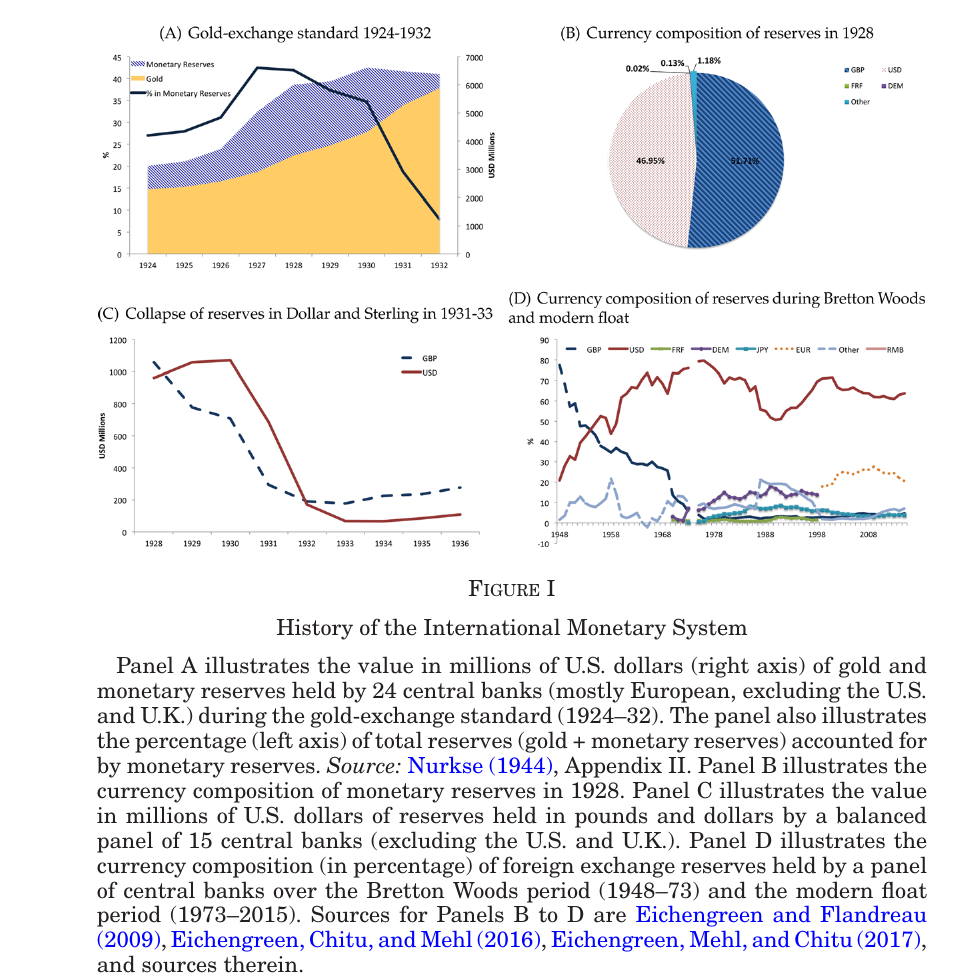
The 1920s are the paper’s opening exhibit. Monetary reserves at twenty-four central banks rose from 28% of total reserves in 1924 to 42% in 1928 and then shrank to 8% by 1932; at the 1928 peak the split was roughly 52% sterling against 47% dollars. A system that got large, got crowded and then got small very quickly.
The hegemon as a monopolist with limited commitment
The rest of the world (RoW) is risk-averse and wants a safe asset; the alternative is a risky real asset that pays well except in a disaster. The hegemon is risk-neutral and is the only agent that can issue debt denominated in its own currency, which is what makes the debt potentially safe. Sell more of it and you have to pay more, which is the demand curve the whole paper rests on — equation (1) in the published version:
The gap is the safety premium, and a monopolist facing that curve does the obvious monopolist thing: issues half of what a competitive market would, , and pockets the rent. The paper is refreshingly blunt that this is the exorbitant privilege and that “there is a sense in our model in which the privilege is truly exorbitant, since it is a pure monopoly rent.”
Then commitment goes. The hegemon does not default; it devalues, which the paper models as a partial default because historically that is how reserve issuers have actually reneged — Britain in 1931, the United States in 1933 and 1971–73. Devaluing costs , which Section VII rationalizes as the probabilistic loss of future monopoly rents under grim-trigger punishment, with the formal model deferred to the Online Appendix. Ex post, the hegemon devalues in a disaster whenever the debt service it escapes exceeds that cost, which is equation (7):
This is where the quantity you issue becomes the quality of what you issued. Lemma 2 partitions issuance into three zones: a safety zone with , where the safe equilibrium is unique; a collapse zone above (equation (8)), where devaluation is certain and priced in; and between them an instability zone where both equilibria exist and a sunspot picks, with collapse probability . Nothing fundamental changes inside that middle zone. Confidence changes.
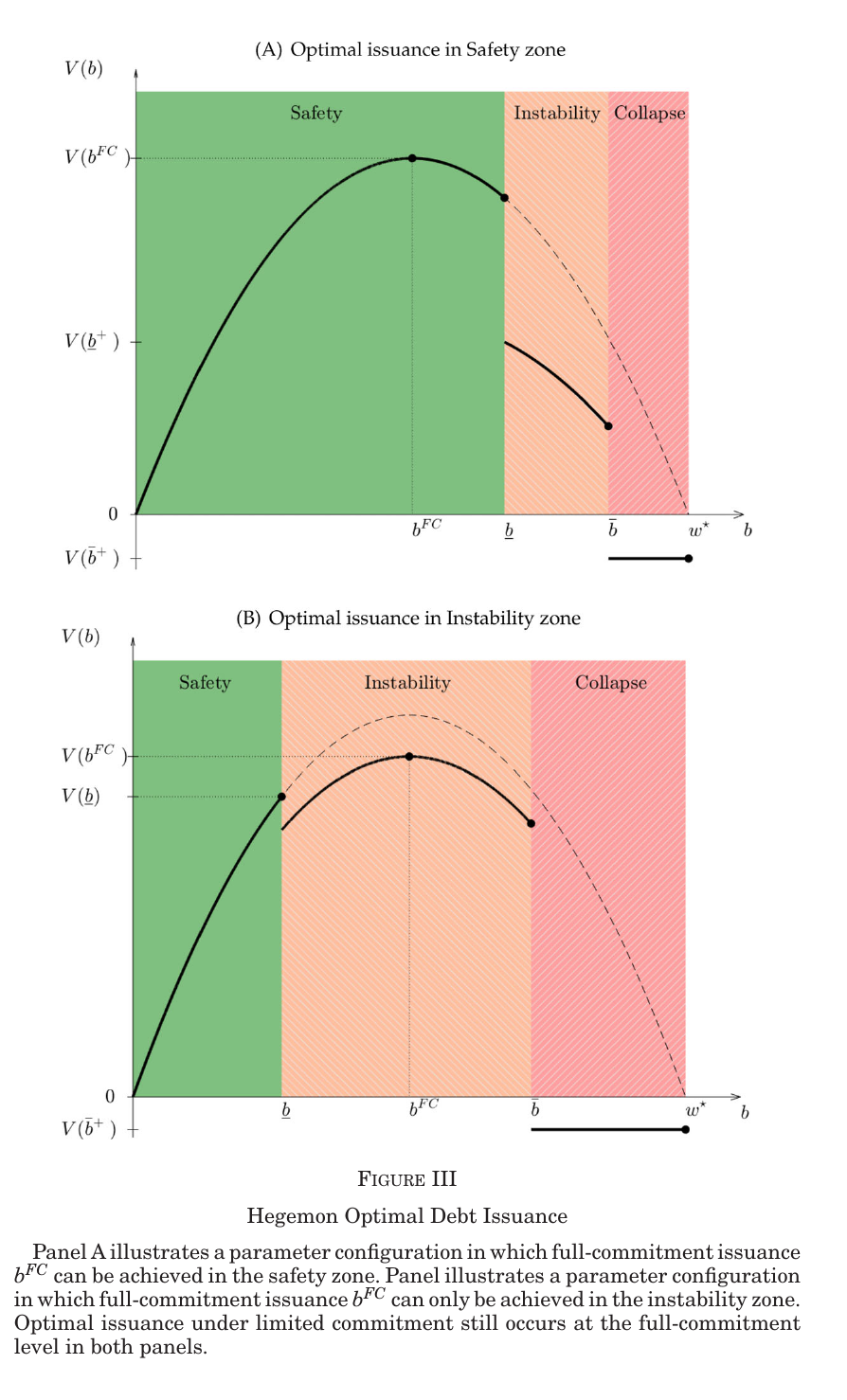
Proposition 2 is the Triffin dilemma, and it is a single line of algebra on p. 317:
When the world’s demand for reserves outgrows your safe debt capacity, your unconstrained optimum no longer fits inside the zone where your promise is credible. You retreat to and leave rents on the table, or you issue into instability and accept a chance of a run. For below a threshold you take the risk. Kenen (1963), quoted in the paper, called this “an ugly dilemma,” and the model’s contribution is that the dilemma is derived rather than asserted: it is what a monopolist does when its own volume determines whether its product works.
The distortion does not point the way you expect, and that is the whole trick
Here is the part that an earlier version of this note got exactly backwards, and it deserves care. The hegemon maximizes equation (9),
which contains its own rents and no part of RoW’s surplus at all. You might therefore expect the answer to be overissuance, since the hegemon ignores the inframarginal surplus a collapse destroys. Proposition 3’s first clause says the opposite. With a linear demand curve the cutoffs rank and the hegemon underissues — textbook monopoly, restricted supply, nothing surprising. Overissuance is the second clause, and it needs a demand curve made sufficiently convex (the kinked piecewise-linear specification of equation (10)) and sufficiently small. The paper’s own framing on p. 296 is that the hegemon “may either under- or overissue”; the finding is that overissuance is possible, not that it is the outcome.
The published version adds a subsection, “Comparative Statics for Over- and Underissuance,” and a figure that did not exist in the working paper, to make the conditions legible. There are three of them: overissuance is likelier when the demand curve is more convex (a convex curve means a collapse destroys more inframarginal surplus for RoW), when the default cost is lower (cheap devaluation makes the instability zone tempting), and when the probability of a confidence crisis is intermediate. That last one is the quiet second surprise. If a crisis is very likely, both parties want the safety zone; if it is very unlikely, both want the instability zone. The conflict of interest exists only in the middle.
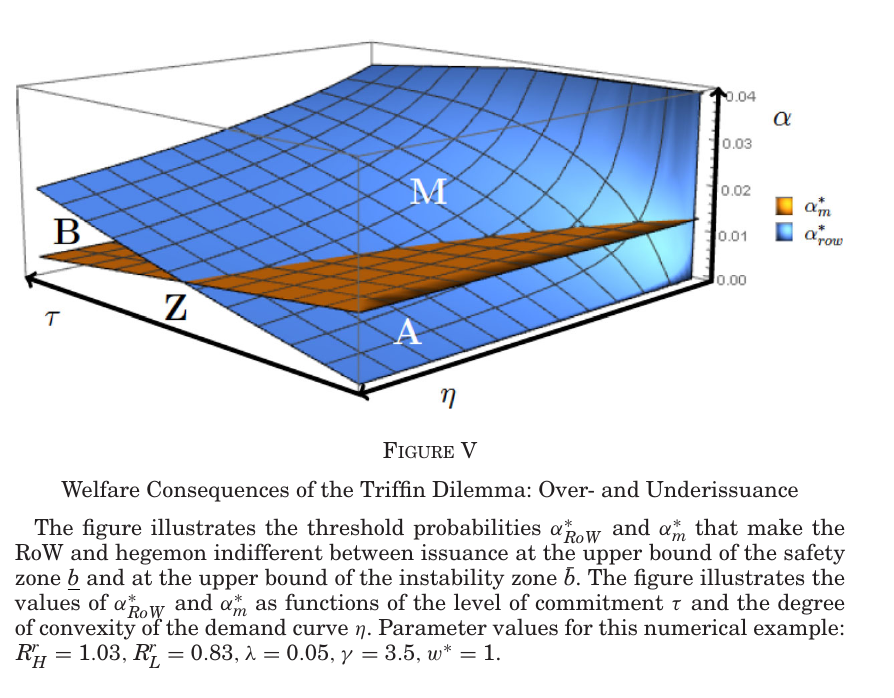
Whether the convexity condition holds in the world is a question the paper gestures at rather than settles: Krishnamurthy and Vissing-Jørgensen (2012) estimate that the spread between Treasuries and aaa corporates “decreases at a decreasing rate with increases in the supply of Treasuries,” which Holmström and Tirole (2011) read as liquidity needs becoming progressively satiated. The authors are scrupulous about their own pictures, warning on p. 329 that the figures “are to be interpreted as illustrative qualitative examples and not as realistic calibrations.” The analogy they claim is Spence’s (1975) monopoly theory of quality, transplanted into a setting where quality is tied to quantity through an equilibrium mapping rather than chosen directly.
Scarcity and the gold standard
Section V adds production, rigid nominal wages and a truncated Taylor rule in the RoW. Below a threshold level of issuance the demand curve for reserves goes perfectly elastic at a safe rate of one: the rate cannot fall further, so the quantity that adjusts is output. Underissuance by the monopolist becomes a world recession, which is the Keynesian side of the argument arriving as a corollary rather than a separate theory. The gold-exchange standard is the same mechanics with the rate pinned at a level above one instead, and Section V.C adds the expenditure-switching gain from devaluing, which lowers the effective default cost below — so the temptation to devalue is strongest precisely when the hegemon’s own economy is depressed.
Multipolar: better in the limit, worse on the way
Section VI puts symmetric issuers into Cournot competition. Under full commitment each issues , supply rises toward the first best and the rents dissipate, with most of the gain arriving with the first few entrants — the Eichengreen case for a multipolar system. Under limited commitment the key observation is that the safety boundary is independent of the interest rate and therefore of competition, so with many issuers each stays inside its own safety zone and the good outcome survives. With two it need not. In one duopoly configuration both issue at : total issuance doubles, but the effective supply of safe assets is unchanged because each currency is now safe only with probability one half, and one of the two collapses for sure — Nurkse’s instability, with the sterling–dollar alternation of the 1920s as the illustration. In the other, the duopoly reduces total supply because each issuer retreats into its safety zone, and the published version now argues this rather than asserting it: a long footnote observes that while the safety boundary is competition-proof, the instability boundary is lower when a rival sits safely in its own zone, so the second issuer’s payoff from gambling falls relative to staying safe. The authors decline to take a stand on which outcome is likelier; a multipolar system can be less stable, not must be.
Where it sits
Presented (theory) in 3.1, as the supply side of the reserve-asset story; Gopinath–Stein (2021) is the demand side and the two together are the block’s foundation. The bank today looks like the model’s constrained hegemon: us external debt is 158% of gdp, 85% of it dollar-denominated, and in 2015 foreign residents held 6.2 trillion dollars of us government and agency debt out of 10.5 trillion in total debt securities, so most but not all of the world’s dollar safe assets are public. Its influence on the geoeconomic papers is direct. Bianchi–Sosa-Padilla’s (2025) downward-sloping demand for the hegemon’s safe debt, and the trade-off they find between collecting the privilege and using sanctions that erode it, is this model’s monopolist given a second objective. Global Hegemony and Exorbitant Privilege (Pflueger–Yared 2024) and Hegemonic Globalization (2025) turn the reputation cost into a geopolitical variable. Internationalizing Like China (2025) is the challenger’s version of the same reputation problem, and Mukhin’s (2022) last counterfactual — the dollar undone by its own issuer — is a collapse-zone event. It is a model of the monetary system rather than of statecraft, and it is presented because the other 3.1 papers use its vocabulary without re-deriving it; one session on the monopolist’s problem makes the sanctions-finance papers read as the extensions they are.
The published version also comes with a replication package in the Harvard Dataverse, which for a pencil-and-paper theory paper mostly means the figures. Given that the whole normative result turns on the curvature of a demand curve nobody can observe directly, being able to redraw the surfaces yourself is a more useful thing to have than it sounds.