Notes on:
A Framework for Geoeconomics
Econometrica
11 January 2024
geoeconomics · coercion · hegemony · production networks
Talk · Paper · doi · PDF · Transcript
Made with AI: Opus 5.5 (reading, diagram and writing), GPT 6-Sol (reading), Fable 5.1 (adjudication), GPT 6-Astra (verification)
Christopher Clayton (Yale School of Management), Matteo Maggiori (Stanford Graduate School of Business) and Jesse Schreger (Columbia Business School), “A Framework for Geoeconomics,” Econometrica 94(1), January 2026, pp. 105–136 (published version). Talks: Maggiori at the Hoover Institution economics seminar, Stanford, 10 January 2024, chaired by John Taylor with Schreger on Zoom and the room interrupting throughout (video); and Maggiori’s abfer 13th Annual Conference Master Class, Singapore, May 2026, with moderated Q&A, which also covers follow-up work (video). No discussant at either. Figures: the model schematic is ours; Figures 1–3 are cropped from the published version; slide frames are from the Hoover talk (working-paper notation) and the abfer talk (follow-up notation), each linked to its timestamp.
“A Framework for Geoeconomics” is a model in which a hegemon’s power over a foreign firm is not a gun it points at the firm. It is a product it sells to the firm. The product is credibility, and the firm is happy to buy it.
You are a firm in a country with bad courts, and your suppliers deliver before you pay. Each supplier can punish non-payment only by never dealing with you again, so each caps what it ships you. Now a large country comes along and says: from now on, if you stiff any of these suppliers, all of them cut you off. That is a grim threat, and also the best thing that has happened to you all year, because your promises are now backed by your whole supply network and your suppliers will ship you more. The large country has created surplus for you. Then it asks for some of the surplus back. Sometimes it asks for money. More interestingly, it asks you to do something, like buy less Huawei gear, which costs you little and is worth a lot to it. Maggiori’s name for the Belt and Road version is “cross collateralization” (H 00:40:08): China uses your manufacturing relationship as collateral for your loan.
The paper sits between war and complete contracts (H 00:03:07): the threats are commercial, and what the hegemon wants is unenforceable or “unpalatable” to write down (p. 106). Nearly every assumption is load-bearing, so read it one assumption at a time.
The model, assumption by assumption
Buyers can steal. The economy is a standard global input-output network in which a sector is an industry-country pair (“Russian oil extraction and American oil extraction are two distinct sectors,” p. 106), populated by a continuum of identical firms. Suppliers deliver first; at the end of the period the buyer pays or steals, and a victim recovers only of the bill (p. 110). So is the stealable share, and the only thing stopping theft is losing future inputs (Lemma 1, p. 112):
The one-shot gain from stealing from the set can’t exceed the discounted value of being cut off by those suppliers. Set everywhere and no incentive constraint ever binds, coordinated threats add nothing, and the hegemon is a large country with no power, which is a strange thing to be in a paper about geoeconomics. Maggiori’s defence is that the excluded case is narrow on purpose: “What we are excluding to be clear is paying up front. So this doesn’t work very well for small transactions that can be entirely collateralized” (H 00:15:31).
Losing suppliers hurts, and suppliers are all you have. Production satisfies Inada conditions and : “a firm that has no ability to source intermediate inputs cannot produce” (p. 109). Local factors are always delivered and can’t be stolen. The network is fixed, with no entry and no new links: “You start with a set of relationships, and you can only go down if you stole” (H 00:32:36). So exclusion is a real punishment, the only one, and there is no escape into new suppliers.
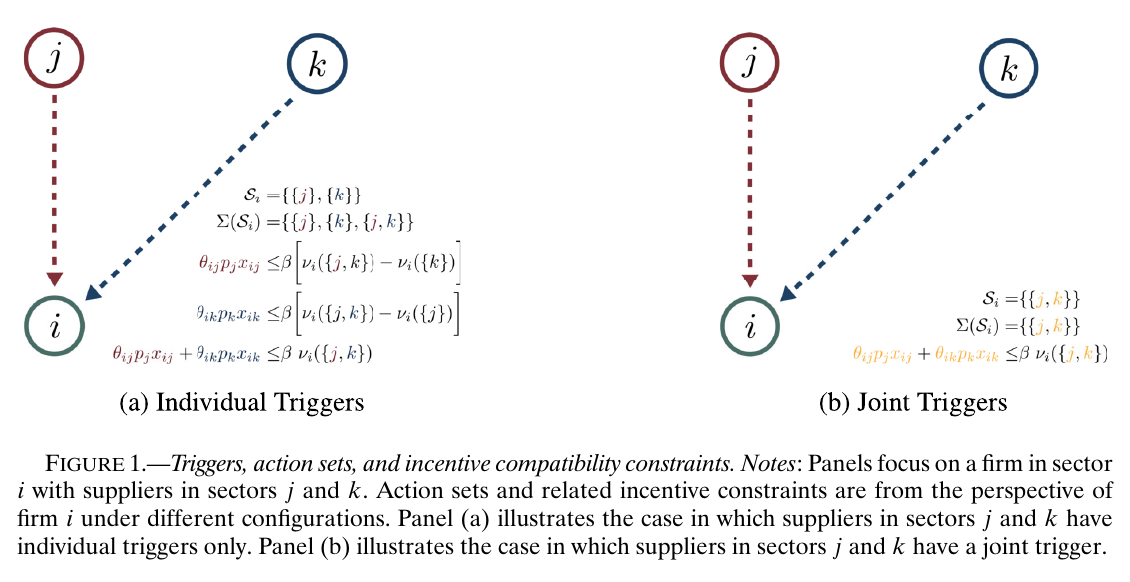
Punishment is grim, Markov and firm-specific. Under an individual trigger, steal from and never trusts you again. Under a joint trigger, steal from or and both stop (p. 111). Figure 1 is the whole engine in two panels. With individual triggers there are three constraints: steal from , from , or from both. Link them and only steal-from-both survives, because stealing from one now costs you both, and the single-supplier constraints were the ones that bound. The equilibrium is subgame perfect and Markov in the trust set, and the authors say plainly that it isn’t the best one available: “Our purpose is not to explore the best sustainable equilibrium, but to focus on a simple Markov one” (p. 111). Warned at Hoover that the construction can miss the maximal fixed point, Maggiori agreed and moved on: “I’m perfectly fine with this being an spe” (H 00:31:40). Exclusion hits only the atomistic deviant, so off-path punishment moves no prices, which lets threats be valued at fixed and .
Threats are free. Every buyer is atomistic, so a supplier who refuses one sells to someone else and loses nothing. “I’m essentially rigging the model to make the threats cheap, which is an intentional decision” (H 00:17:50). If your unsold output went to waste, “that would be a very expensive [threat]… We’re not doing that” (H 00:48:30). That is why the hegemon never holds back a threat.
One exogenous hegemon with a short reach. Only can coordinate joint threats and make take-it-or-leave-it offers, and where it came from is “totally exogenous, we’re not solving where on earth you come from” (A 00:36:11). It can contract with its own sectors and their direct foreign customers, and it can fold a trigger block into a joint threat only if the block contains one of them (p. 113). Maggiori calls the one-step limit “totally arbitrary” (H 00:43:16). The picture is China pressuring Lithuania through Germany (H 00:35:25).
Two instruments, no commitment. The contract offers a joint threat, non-negative transfers and wedges. A transfer can be cash, a mark-up, a loan surcharge or lobbying for a concession, and it isn’t paid if the firm steals (fn. 4), so it tightens the incentive constraint. Wedges are rebated lump sum, “best thought of as quantity restrictions” (p. 113), so there is no revenue motive: “I want him to be purely about dictating what you do” (A 00:40:41). Contracts last one stage game because the hegemon “cannot commit to future contracts” (pp. 112–113). At Hoover it came out as “can commit… Um Can. Cannot. Cannot.” (H 00:44:50), a fittingly time-inconsistent statement of it.
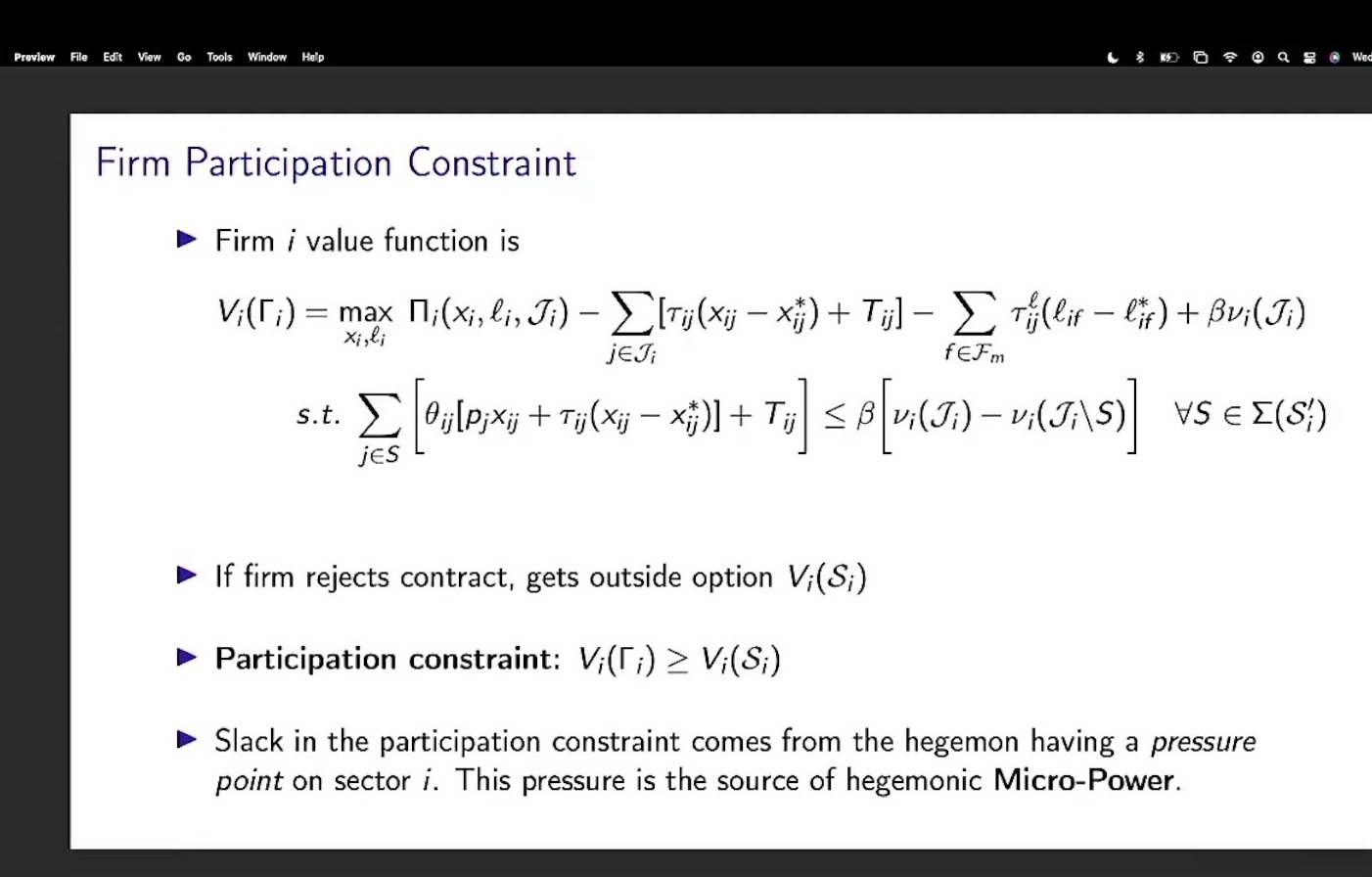
Participation is voluntary, and refusing costs nothing. This is the assumption the paper is built on. The hegemon can’t legislate for foreign firms: “I’m offering a threat and I’m asking for actions. So, I’m going to have to have a participation constraint” (H 00:45:29). A firm that accepts solves (p. 114)
and a firm that rejects keeps its old trigger structure, . It is not punished. The threat raises the value of accepting rather than lowering the value of refusing, which is an odd thing for a threat to do, and Maggiori defends it on efficiency grounds: the blunt version “is an inefficient threat… it’s a hold up. I’m making your outside option worse off, but that worsens your incentives compared to increasing your inside option” (H 00:36:03). A joint threat that strictly raises the firm’s value is a pressure point, and the gap at fixed and is Micro-Power, “the most the hegemon could demand before its contract gets rejected” (p. 119). Rare earths confer a lot of it; water in a Nordic country, very little (H 00:46:41).
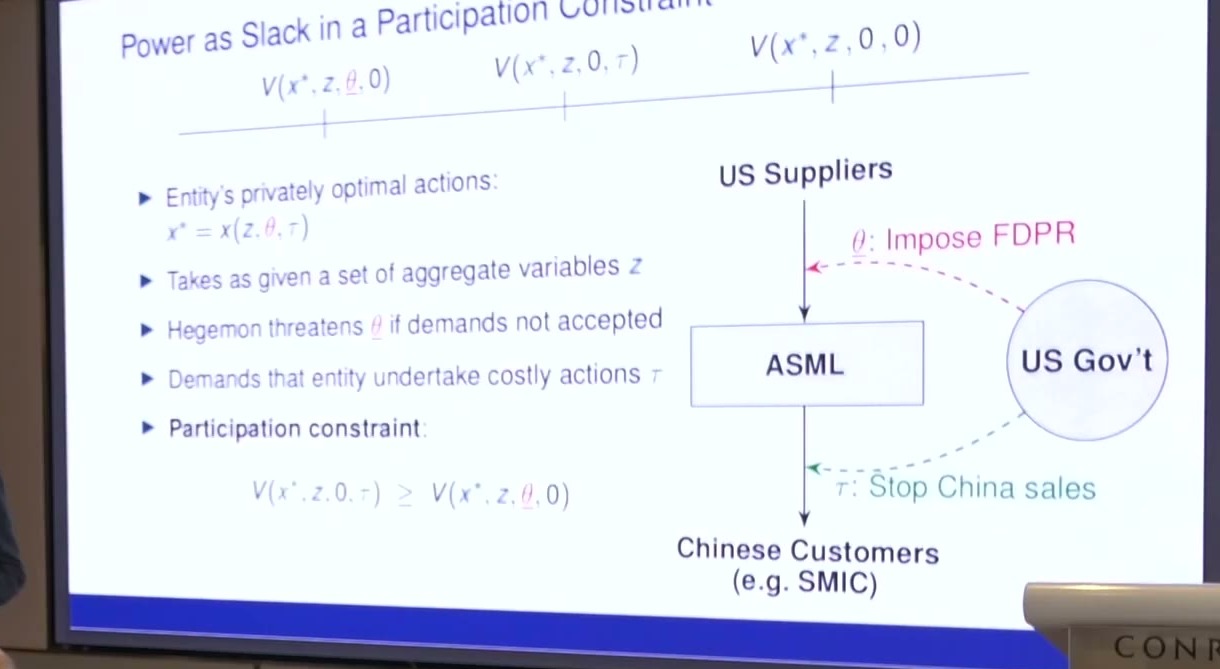
The abfer talk’s asml example runs the other way: the foreign direct product rule lowers asml’s outside option (“if you’re asml, that’s a death sentence,” A 00:24:31). That is the stick. In this paper the stick lives only in a supplementary extension (B.3.1, p. 114), and it is the main case of the follow-up work.
The hegemon doesn’t care about you. It maximizes , eq. (4), where wealth counts domestic profits, domestic factor income and transfers from foreign firms. Foreign transfers don’t net out, “precisely because the hegemon’s consumer has no claim to foreign sectors’ profits” (p. 114). That zero weight on foreign profits (H 00:48:15) is what separates the hegemon from a global planner, and the negative-sum results come from it. The term carries national security and the taste for concessions, and Maggiori is frank that it is a placeholder: “I find it totally unsatisfying cuz we don’t provide any theory where these things come from” (A 00:34:34).
Aggregates that only the hegemon internalizes. Bilateral quantities enter production functions (scale economies, thick markets, payment systems) and utility, and firms take them as given. It is “a very simple reduced form way to capture all sorts of externalities” (H 00:10:01). Prices are flexible; they were fixed only in examples, “to avoid terms of trade” (H 00:42:35). A perturbation spreads through a generalized Leontief inverse (Prop. 2, p. 115):
adds up every round of re-optimization the externalities set off, on top of the price channel of Baqaee and Farhi (2019). Maggiori thinks they’re “the first to do it in generality, but it’s a sort of 15 lines of algebra” (H 00:56:54). One more assumption is easy to miss because it sits in the appendix. When a contract is consistent with several equilibria, “we assume the hegemon is able to select its preferred equilibrium ” (p. 130, following Farhi and Werning 2016). That is a lot of power to hand an actor whose power is supposed to be the thing derived, but it is standard.
What comes out
Proposition 1 (p. 115) says it is “weakly optimal for the hegemon to offer a contract with maximal joint threats to every firm it contracts with.” The “weakly” matters. Joint threats “weakly increase targeted entities’ profits” (p. 115), and a firm whose individual constraints didn’t bind gains nothing, so it has no pressure point (that zero case is our inference; the paper says joint threats “generically generate value”).
Proposition 3 (p. 117) describes how the power gets spent. It gives necessary conditions, not a full characterization, and it assumes that an equilibrium exists (fn. 8). For a foreign firm with a pressure point:
This is a Pigouvian tax with two twists. The first is that the externality is the one the hegemon perceives. The second is that it is scaled by , the shadow value of the firm’s participation constraint, which is to say by the price of power over . Activities the hegemon likes get subsidized and activities it dislikes get taxed, so “friends” and “enemies” are activities, not countries: “Nvidia is unfriendly to the us for its activity of selling to China despite the fact that overall we might want Nvidia to be very successful” (H 01:14:35). Domestic firms get smaller wedges and no transfers, since the hegemon owns their profits; foreign firms pay transfers, but only up to a point, since a transfer tightens both constraints. Macro-Power is “the social value to the hegemon’s country of the costly actions it demands” (p. 120). Because these are only necessary conditions, the optimal contract is “definitely not unique” (H 01:00:14).
The welfare accounting is the paper’s cleanest point. A planner with the same powers and constraints (Prop. 4, p. 121) also uses maximal joint threats, but it sets transfers to zero, because they are “negative-sum globally since they tighten incentive problems,” and it may disagree with the hegemon about who counts as a friend. Enforcement is positive-sum and extraction is negative-sum. The hegemon “is moving up the Pareto frontier… then chooses a contract that moves to the inside” (H 00:54:02). Whether the world ends up better off than with no hegemon at all is ambiguous: it “can even be worse for some entities” (p. 122), depending on which effect wins. And because indirect effects can dominate, “increases in geopolitical rivalry might still generate more bilateral trade in some sectors” (p. 121).
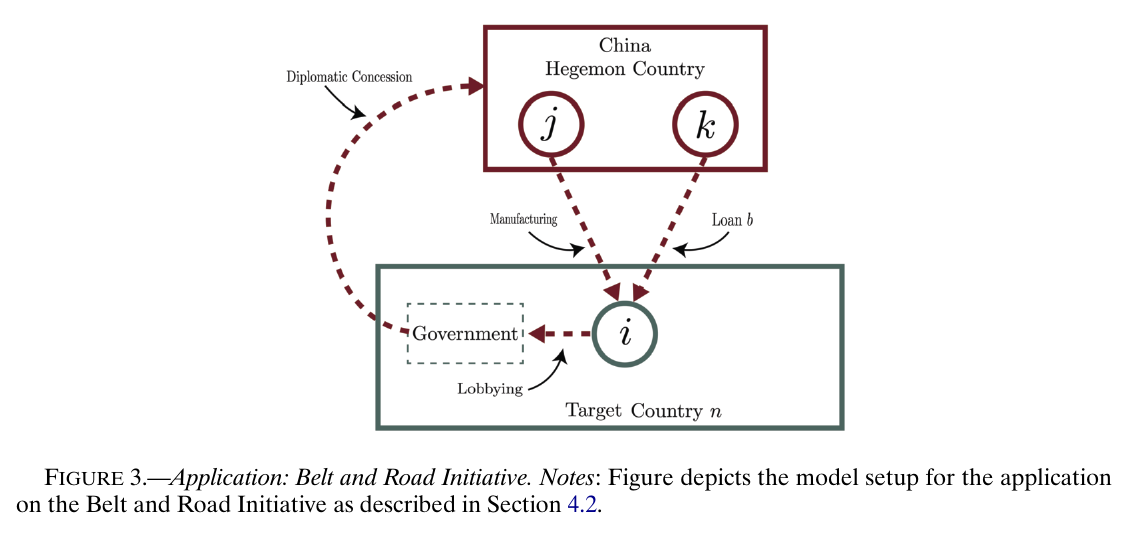
Belt and Road is the whole mechanism in one example. A loan with has no legal enforceability, and borrowing is capped at , a cap that “binds whenever ” (p. 125). Tie the loan to a manufacturing relationship with . If the cap bound before, manufacturing stays where it was, borrowing rises, and China takes the surplus as a transfer, possibly a political one such as not recognizing Taiwan (pp. 126–127). Maggiori admits the setup is arranged to get around Bulow–Rogoff (1989): “we’re rigging it because if we allowed up front contracts in savings, we would get back to your result” (H 01:23:48). The empirical point: China “might be making horrible returns on the loans, but if he’s getting political recognitions or to use naval bases, that might be worth a small fortune” (H 01:25:05). Judge the loan book alone and you are pricing one leg of a trade.
The one surprising thing
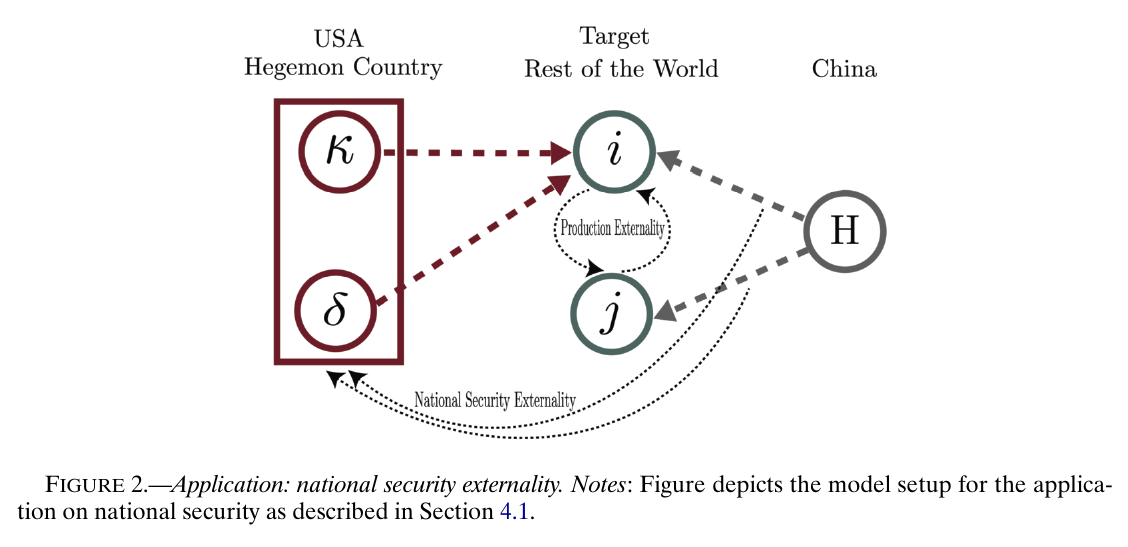
The target prices a demand at its private cost. The hegemon values it at its general-equilibrium effect. When those two numbers come apart, the hegemon would rather be paid in actions than in money. In the Huawei application (Figure 2) the us can contract with European sector but not with . Because of scale economies, when drops Huawei, Huawei becomes less productive for too. That also makes the remaining firms in cheaper to keep compliant, which is the Building Power term in (6) doing its job. So the us asks for more than the direct security benefit would justify: “I’m going to ask them to do more than I would have otherwise asked them… I might get to reach the equilibrium even if I control only a small part of the world economy” (H 01:20:18). His summary at the end of the talk: “I like those that extract minimal surplus out of you and affect the equilibrium a lot because I can convince you to do a lot of those for me” (H 01:28:32).
This is a trade-off, not a claim about frequency. The paper says that, all else equal, the hegemon “favors monetary extraction from sectors that have little influence on the global equilibrium” and favors wedges where the target’s activities affect sectors it cares about (p. 107). Take away the equilibrium influence (Defs. 1–2) and it “uses all its Micro-Power to extract transfers” (p. 119). The surprise is not that hegemons sometimes want favours instead of cash; it is that the best favour is the one the target barely notices giving.
What the rooms pushed on
Hoover pushed on the game theory; Maggiori mostly conceded, then defended the choice. Why not neutral escrow instead of supply cutoffs? Escrow is folded “in a cheap way” into θ, and the paper is about the cases where escrow fails: “I’m building a mine in Africa… I’ll get expropriated… Or think of sovereign lending” (H 00:36:51). Couldn’t firms coordinate privately? Some do, sometimes with the State Department’s help (H 00:38:13). Forgiveness? Poisson re-entry would probably just scale the punishment down, he conjectured, but “I need to be careful and think whether it works here” (H 00:50:49). What do rival powers do? Nothing: the rest of the world “take[s] it on the chin,” and anti-coercion policy is “yet another paper” (H 01:04:18). Can’t China just build its own chips? Not in the model, whose industry structure is fixed; what disciplines the hegemon is the participation constraint: “If you try to ask too much out of them, they’re going to simply reject the contract… everything is willing participation” (H 01:06:53). The closing question summarized the paper as monopoly power plus increasing returns, and he accepted that with one amendment: the power is “my power to ask you to do costly actions,” many of them “driven from changing the equilibrium” (H 01:27:54).
abfer asked about the world instead of the game. Why now? A “pure change in commitment” by the us makes short-run extraction tempting, and a competitor who erodes the future value of a relationship “might turn me very nasty and extractive in the short run” (A 01:37:50). But gratuitously annoying your allies is “a disastrous policy in this model” (A 01:40:08). When a questioner said the data can’t support any of these formulas, he agreed entirely (“I subscribe 100%”) and said “we’re easily 5 to 10 years away from having any decent answers” (A 01:44:14). Asked how hegemons emerge, he said “I don’t know” (A 01:48:55), which is also what the model says.
Two things that don’t match
![Hoover 2024 slide “Interpreting the Tax Formula”: tau* = -1/(eta_i + theta_ij Lambda-bar_ij)[eps^z + eps^zNC dz*NC/dz + eps^Pm dP^m/dz]](figures/fig_01-00-50.jpg)
At Hoover, Maggiori says suppliers “can repossess a fraction theta” (H 00:18:12) and calls enforceable relationships ones with theta “very close to one” (H 00:37:09). That is backwards relative to the published paper, where θ is the stealable share and Belt and Road sets for “no loan legal enforceability” (p. 125). Use the paper’s convention. The 2024 tax slide above puts in the denominator. The published eq. (5) has alone. The sources don’t say where the term went; use the published form.
What you are left with is a theory of coercion in which nobody is coerced. Every firm signs voluntarily, is no worse off for signing, and hands over part of the gain; the hegemon’s craft is choosing which part, ideally the one that costs the firm least and moves the world most. That is roughly how a good deal is supposed to work, too.